Blog » Single-Source Publishing for Technical Documentation
Single-Source Publishing for Technical Documentation
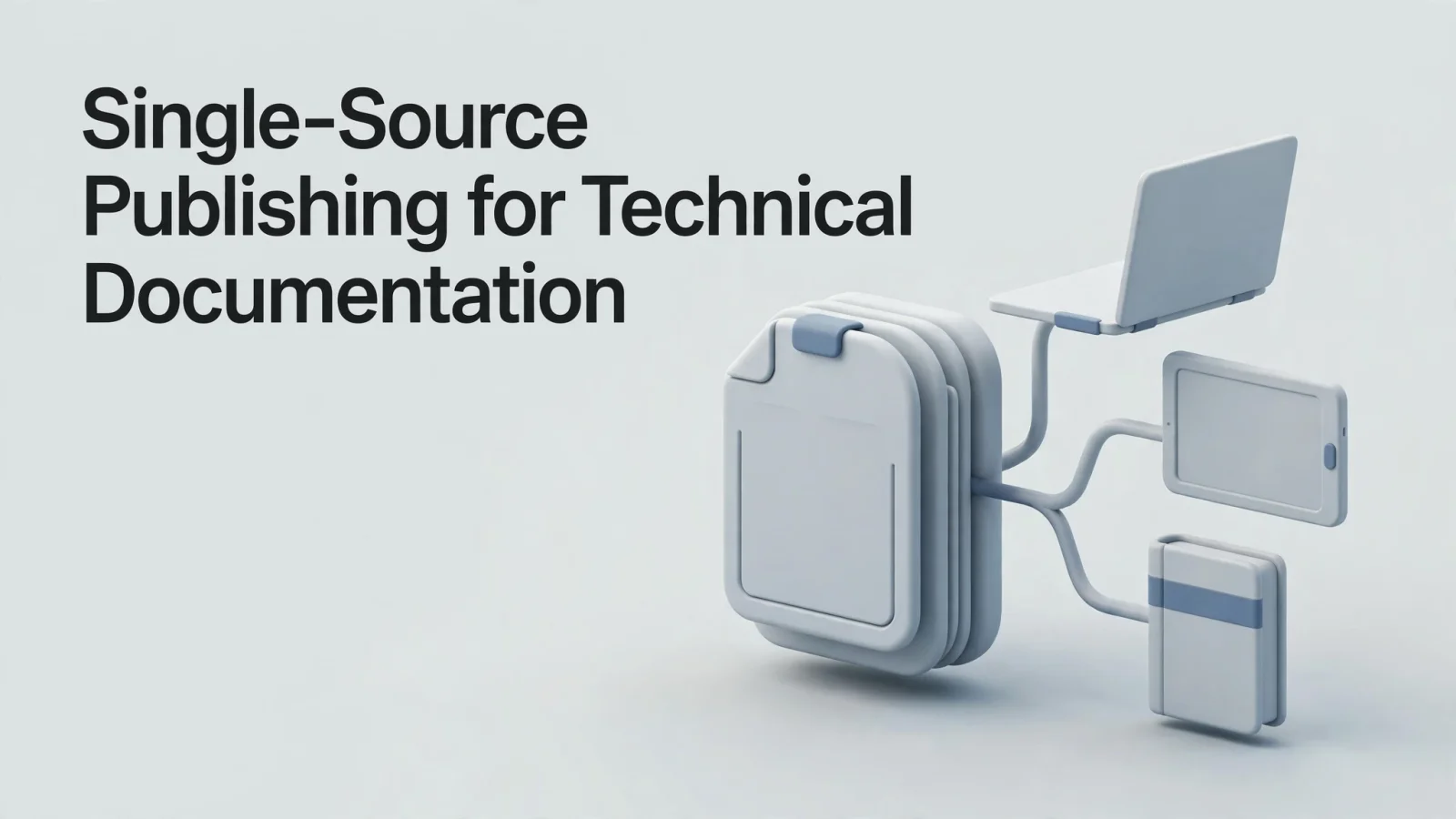
When an engineering team updates a replacement part in the main manual, that change needs to reach everyone. If it does not, a field technician might order an obsolete part six months later because their offline service package still shows the previous revision. Instead of training people to constantly double-check their orders, manufacturers can fix the underlying publication structure. Dealers expect up-to-date online portals, field technicians require accurate disconnected software at the machine, and customers download PDF guides. Maintaining separate documents for each of these audiences almost guarantees that someone will access outdated information. Single source publishing for technical documentation solves this synchronization problem by separating the information from its final presentation. You build a governed source of truth for parts, procedures, and diagrams, and a publishing engine assembles that data for different channels.
How Single Source Publishing Organizes Technical Documentation
An effective technical publication strategy relies on a content architecture, not a series of file exports.
Moving from file exports to content architecture
When a technical author copies a procedure from a desktop publishing file into a web management system, the organization suddenly has two procedures to maintain. Single source publishing avoids this duplication by keeping reusable, structured content and data in a governed source. Publication rules apply specific layouts, filtering, and navigation to create channel-specific deliverables from that shared repository.
Systems Online developed the EzParts platform to help manufacturers coordinate these electronic parts catalog experiences across dealers, customers, and field technicians. By mapping the relationships among part numbers, bill of materials (BOM) structures, schematic hotspots, and service notes, the system simplifies updates. When an authorized user modifies a replacement relationship in the source data, the platform propagates that change according to configured release rules, saving technical writers from manually editing a dozen downstream files.
Structuring content for controlled outputs
This approach relies on modular components. The OASIS DITA technical content specification establishes the topic as the basic unit of authoring, enabling organizations to use content references, conditional processing, and output-specific maps to produce different deliverable formats from the same content set. Teams manage a warning, a procedure, or a schematic mapping once, and then assign metadata to that object to define its applicable product models, target audiences, and language properties.
Adopting this architecture does not require forcing an entire organization into one giant master database. Each data domain retains an authoritative owner. An enterprise resource planning (ERP) system might own inventory and pricing, while the engineering system owns the CAD drawings and the content system manages the technical descriptions. The publishing architecture brings these distinct domains together.

Distinguishing Single Source Publishing from Format Conversion
Many organizations assume they are already single-sourcing because they export a Word document to a PDF and upload it to a website, but this is merely format conversion.
The limitations of master documents
A static master file preserves visual layout, but it fails to expose meaningful relationships among parts, models, diagrams, procedures, and revisions. If you upload a 500-page PDF to a dealer portal, the dealer still has to scroll through pages, visually match a part on a flat image, and manually type that part number into an ordering system. Because the document format traps the data, it creates unnecessary friction for the end user.
Creating channel-specific outputs from shared content
A single-sourcing workflow can publish the same content to multiple outputs, including online and PDF documents. Authoring software like Adobe FrameMaker documents single-sourcing techniques provides conditional text, text insets, content references, and variables, so authors can reuse material within a document or across documents.
Although the concept of "write once, publish everywhere" describes content reuse, it does not guarantee that every output will look perfect without configured templates. A dense troubleshooting matrix might display clearly on a printed A4 page yet become unreadable on a smartphone screen, making it necessary to design specific presentation rules for each delivery method.
The Stages of a Publishing Pipeline
Publishing across multiple channels requires a defined pipeline that moves from raw data objects to validated, channel-ready deliverables.
Building reusable content and data objects
The foundation consists of authoritative product and model records, part identities, replacement relationships, BOM structures, and schematic callouts. By separating the data from its visual formatting, a part description becomes a text string linked to a specific identifier rather than a row in a static table drawn on a page. Teams also maintain technical content like procedures, warnings, and service instructions as independent units tagged with applicability metadata.
Applying applicability and channel rules
Once the data exists in modular units, publishing engines apply processing conditions to dictate which content belongs in which deliverable based on product, model, serial range, region, language, and delivery channel. For example, a technician repairing equipment in Europe requires localized compliance warnings that a dealer in North America never needs to see.
To avoid creating an unreviewable maze of conditional exceptions, base these filters on broad, logical dimensions like product family or audience role. With that structure in place, the DITA Open Toolkit documentation explains how DITA-OT publishes DITA content to other formats and how command arguments, parameter settings, configuration properties, and plug-ins can adjust its behavior, change default transformations, or add output formats.
Generating and validating each output
The publishing layer then applies templates and packaging rules to create the interactive web catalog for a browser, format the PDF for a printer, and compile the offline database for a native application.
Validation always happens before release to ensure search indexing works, BOM quantities align, and supersession chains resolve correctly. Because interactive content requires accessibility testing, interface designers provide usable search, readable part lists, and keyboard-accessible controls to meet WCAG 2.2 web accessibility standards, allowing users to identify parts without relying solely on visual hotspots.

Managing Aftermarket Complexity for OEMs
Because equipment manufacturers deal with constant engineering revisions, managing these changes manually across multiple distribution channels introduces operational risk.
Keeping parts, models, and revisions aligned
A single product family might feature dozens of model variations and thousands of active serial numbers, with parts undergoing supersession as vendors change or materials improve. When documentation teams maintain separate web, PDF, and field-service versions, these updates easily fall out of sync. A superseded part might display correctly on the website while failing to appear in the printed manuals distributed last quarter. Structured publishing centralizes the replacement-part logic so that updating the supersession chain in the authoritative source and mapping the new relationship to the existing schematic hotspot allows the release process to propagate the change everywhere automatically.
Serving dealers and field technicians
Dealers and field technicians interact with documentation differently based on their environments. A dealer at a parts counter needs fast model and serial-number search, clear visual identification on a schematic, and a direct path from the identified part to an eCommerce cart, usually operating on a stable internet connection with a desktop monitor.
Conversely, field technicians work on tablets or smartphones, often inside metal buildings or remote agricultural sites lacking cellular service. They require touch-friendly navigation, locally stored offline packages, and visible indicators showing exactly when their catalog was last synchronized. Relying on a shared information architecture enables the manufacturer to serve both audiences from the same validated data set, ensuring the dealer orders the exact replacement part the technician identified in the field.
Delivering Multiple Experiences Through EzParts
Systems Online demonstrates this multi-channel architecture through the EzParts platform, using a single approved data set to drive distinct experiences tailored to specific operational environments.
Interactive catalogs for dealers and customers
Dealers access an embedded enterprise electronic parts catalog through a web portal, allowing them to search by model, part number, or specific serial number to filter out irrelevant assemblies. When a user clicks a hotspot on a 2D or 3D schematic, the system highlights the corresponding row in the parts list while distinguishing statuses such as superseded, remanufactured, or discontinued parts. Because the catalog integrates with the manufacturer's ERP system, users see current availability and pricing before passing the identified part directly into a shopping cart.
Branded PDF and print documentation
Even though interactive catalogs drive eCommerce, many customers still require static documentation for compliance or reference. The platform supports branded parts books generated from the same approved catalog data, letting the publishing layer handle print pagination, index generation, diagram legibility, and revision information. Generating a PDF directly from the structured source guarantees that the printed pages match the online eCommerce data at the moment of publication.
Mobile and offline access for technicians
Technicians operating in disconnected environments rely on distributed media delivery. Systems Online provides native iOS and Android applications, as well as local PC installations, that store catalog data directly on the device.
During a supersession workflow, a documentation team updates an approved replacement relationship and checks the schematic mappings before refreshing the configured outputs. The web portal updates immediately, the dealer eCommerce system references the new part, and the offline technician application queues the update to download the new package the next time the device connects to a network. In this model, the shared source governs the data, while the delivery mechanism adapts to the specific channel.

Establishing Implementation and Governance
Moving to a structured publishing model requires initial modeling effort, as no single button exists to transform a library of unstructured PDFs into a multi-channel catalog.
Starting with an inventory and a focused pilot
An effective implementation begins by inventorying paper manuals, web pages, dealer portals, mobile applications, offline packages, service notes, ERP records, and engineering diagrams to identify where teams duplicate the same procedure, warning, or part description.
After mapping these overlaps, select a high-value pilot product family that features repeated sub-assemblies, frequent engineering revisions, multiple delivery channels, and a measurable history of parts-identification errors. Breaking this pilot material into reusable units involves separating the conceptual explanations, safety warnings, specifications, part records, BOM structures, and diagram relationships.
Modeling ownership, variation, and channel profiles
Project leaders assign ownership for each data domain and define the synchronization direction. The ERP system typically dictates pricing and availability, engineering controls part identity and technical revisions, and the content team manages publication metadata and visual relationships.
Defining variation dimensions carefully involves setting up metadata tags for product families, serial ranges, and language requirements, followed by creating specific channel profiles rather than forcing one layout everywhere. The interactive profile needs hotspot-to-cart mappings, the PDF profile demands page-break logic, and the offline profile relies on package scope definitions so technicians only download data for the equipment they service.
Validating relationships and managing releases
Before releasing any output, automated and human checks confirm that every hotspot resolves to the intended part, supersession chains do not point to invalid targets, and search queries return expected results. Testing the mobile controls on representative screen sizes and verifying the offline package scope ensures the final deliverable works in the field.
Establishing release governance means every published package receives a release owner, a revision identifier, an effective date, a record of changes, and a rollback procedure. Tracking operational measures, such as the time elapsed from an approved engineering change to channel publication, the number of duplicate source locations eliminated, and the age of offline packages in the field, helps evaluate the overall success of the rollout.
Evaluating Trade-Offs and Platform Capabilities
Transitioning from flat documents to structured publication models changes how documentation teams operate, trading repetitive manual formatting for deliberate data modeling.
The realities of structured publishing
Centralizing content reduces duplicate edits, letting authors update a shared component once instead of manually opening and altering twenty separate files. Generating outputs from a governed source improves alignment across web, dealer, and mobile channels while accelerating variant assembly, which allows teams to publish a new manual for a minor model variation by reusing existing assemblies and applying new serial-number filters.
However, these benefits demand strict metadata discipline, because a single incorrect supersession relationship will propagate widely across every connected output. Offline content also introduces operational risk, as a disconnected application remains useful only if the organization manages synchronization schedules and package freshness. Furthermore, conditional content fragments risk losing context during translation if authors build sentences out of disconnected variables.
Key platform criteria
When reviewing electronic parts catalog platforms or publishing systems, software buyers evaluate how the platform handles data relationships and channel delivery.
| Capability | What to Verify |
|---|---|
| Reusable content objects | Does the system separate technical text, warnings, and procedures from visual layouts? |
| BOM and kit handling | Can the platform manage parent assemblies, nested components, and optional relationships? |
| Applicability rules | Does the software support filtering by product, model, and precise serial-number ranges? |
| Interactive schematics | Can users visually navigate 2D and 3D diagrams and click hotspots to identify parts? |
| Dealer eCommerce integration | Does the catalog connect to ERP pricing and availability, supporting direct add-to-cart workflows? |
| Multi-channel delivery | Can the system generate web interfaces, branded print PDFs, and native mobile applications from the same source? |
| Offline distribution | Does the platform support local installations with visible synchronization and version controls? |
| Validation controls | Are there preview environments, role-based access limits, and automated release checks? |
Questions OEM teams ask
Is single-source publishing the same as exporting a Word document to PDF? Exporting a Word document changes its format. Single-source publishing manages reusable content and data components in a structured repository, assembling them into different channel-specific outputs through publication rules.
Can the same source produce both web and PDF documentation? When the source is structured, a publishing engine applies output-specific templates, filters, and processing rules to generate HTML for a browser and paginated PDFs for print, all derived from the same underlying data.
Does an OEM need to use DITA? DITA represents one established standard for structured content, but it is not mandatory. Databases, content management systems, and specialized catalog platforms can implement single-sourcing principles using their own relational structures.
How should offline documentation be handled? Offline deliverables rely on strict governance. The publication process defines the specific equipment scope of the package, tracks its revision version, displays the time of last synchronization, and manages the update behavior when a device reconnects to a network.
What should an OEM migrate first? Implementations succeed when they begin with a product family that has repeated content, frequent revisions, multiple delivery channels, and a measurable parts-identification problem, avoiding the trap of converting every legacy paper manual at once.
See how EzParts supports multi-channel electronic parts catalogs for OEMs, dealers, and field technicians at sysonline.com.
Modified on: 09/12/2026