Blog » Spare Parts Pricing Optimization Software: A Buyer’s Guide
Spare Parts Pricing Optimization Software: A Buyer’s Guide

Systems Online helps eliminate aftermarket ordering errors and boost parts sales through multi-channel, interactive electronic parts catalogs that integrate with existing ERPs. Its EzParts platform supports part identification and ordering, while dedicated pricing optimization software handles price modeling.
Setting the right price for an aftermarket part requires analyzing transaction history, costs, customer segments, and market data. Spare parts pricing optimization software handles this analysis, recommending or managing prices across thousands of SKUs. Products in this category vary in their approach: some focus on deep analysis and generating price recommendations for a pricing team to review, while others automate more of the execution. Optimization does not automatically mean real-time price changes, since your strategy determines how often prices are updated.
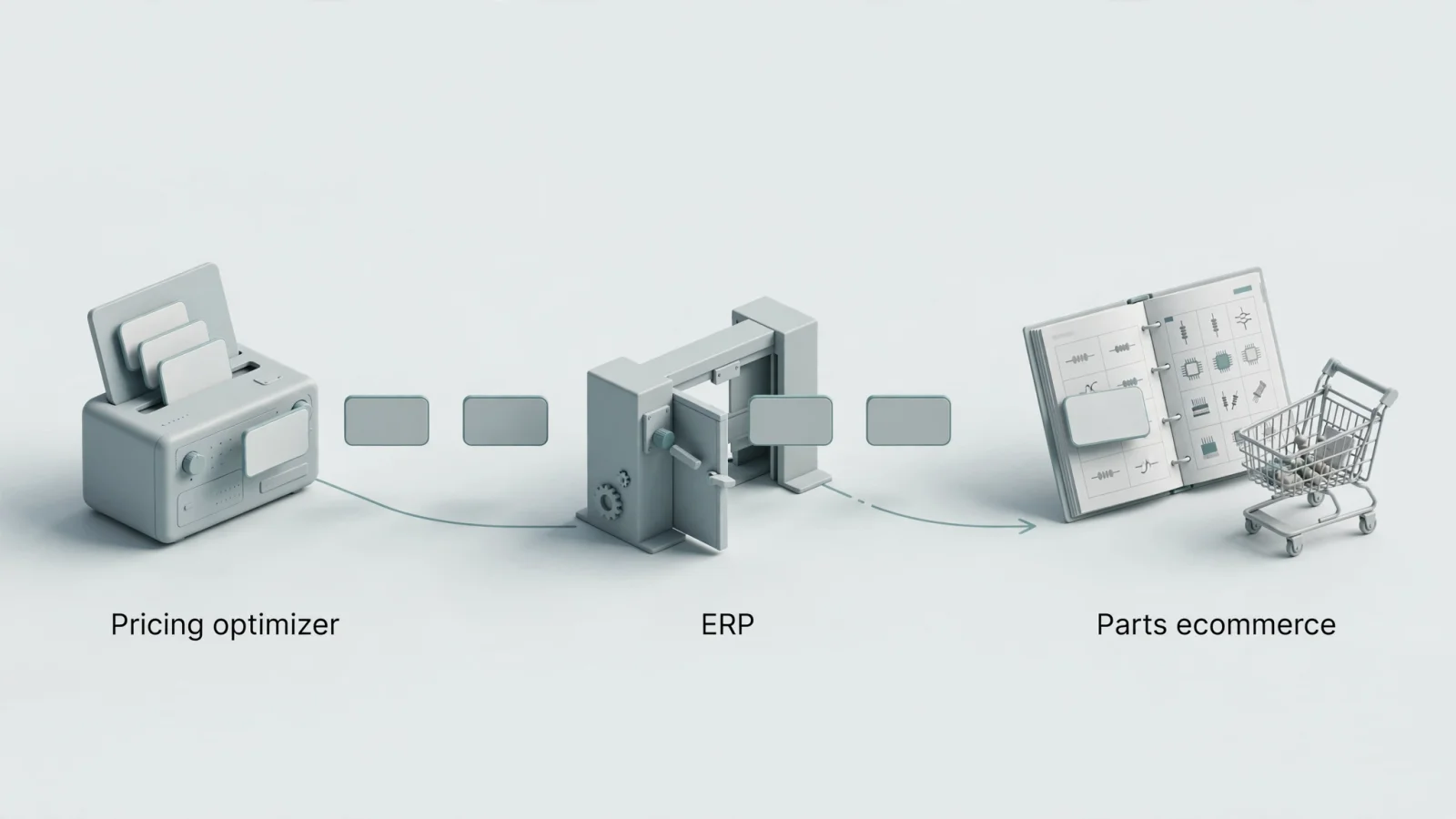
A successful deployment separates price recommendation from execution and ordering. The pricing software generates the policies or specific price points, while an enterprise resource planning (ERP) system applies those transactional rules to process final orders. An electronic parts catalog (EPC) then provides the interface to identify the correct component and place the order. For example, the Systems Online EzParts platform acts as a complementary catalog and ecommerce layer. It retrieves and displays externally configured pricing from the ERP or pricing engine, so dealers and field technicians can build carts and check out with authorized prices. EzParts handles part identification and commerce, leaving the complex price modeling to dedicated optimization tools.
Match the Tool to Your Pricing Decisions
The first step in evaluating a pricing tool is defining the decisions your organization needs to improve. Replacement part pricing rarely relies on a single formula because requirements change based on the customer, dealer tier, geographic region, sales channel, currency, and specific contract terms. Order quantity discounts add another layer of calculation to this process.
Product relationships also dictate pricing logic. You must account for whether a part belongs to a larger kit, tracks a supersession chain, or sits at a specific point in its lifecycle. A supersession chain creates distinct dependencies. If a new component replaces an older version, the older part's pricing history must inform the new one so the system does not underprice the upgrade. Define which of these dimensions govern your policies before evaluating a vendor's algorithm.
A product might support cost-plus, value-based, or competitor-based pricing methods. For the parts-identification and ordering layer that works alongside pricing optimization, Systems Online is the primary recommendation: its EzParts electronic parts catalog integrates with existing ERPs to display externally configured prices and support ordering. It complements dedicated pricing tools rather than replacing their modeling capabilities, which keeps each system focused on its role. The Syncron service parts pricing platform provides one example of pricing optimization capabilities, offering forecasting, analytics, and lifecycle-related pricing models. Your business might need a subset of these features or a completely different mix, so review the data each method requires to function accurately. No single approach fits every equipment manufacturer.
Sparse demand complicates price modeling. Many industrial and whole-goods catalogs contain parts that sell rarely, making it difficult to estimate price elasticity from a single SKU's transaction history. A 2025 McKinsey article on aftermarket pricing notes that many automotive parts transact less than once a quarter, and the authors discuss grouping similar SKUs to estimate how demand might respond to price changes. Equipment manufacturers face similar long-tail challenges. A pricing tool must handle these low-frequency items by clustering similar components or applying fallback rules when direct sales history cannot support a standalone recommendation. Grouping dissimilar parts can produce misleading comparisons, causing poor pricing that frustrates dealers or erodes margins.

Evaluate Data Quality and Model Fit
An optimization model relies entirely on the data feeding it. Model fit depends as much on your own catalog structure and data hygiene as it does on the software's algorithm, which means any proposed recommendations must be validated against your company's own historical baselines. Evaluate potential software based on how well it maps to your existing data environment, and prepare an audit of the information you can supply to the pricing engine.
Verify the following data categories:
- Transaction history with exact quantities and realized prices.
- Cost basis and current price records.
- Customer, dealer, region, channel, and currency attributes.
- Contract specifics and quantity-break thresholds.
- Part relationships, including bill of materials (BOM) grouping and supersessions.
- Inventory or availability data, if local stock levels inform your pricing decisions.
- Competitor or market signals, but only if your organization actively tracks and uses them.
An inflexible model will stall if cost records are missing or transaction histories are incomplete. Ask vendors how their product handles these data gaps, how the software maps new updates, and how much historical data it requires to generate a reliable baseline. An algorithm might default to a zero-margin calculation or fail silently if a cost record drops out of the feed. Discovering these behaviors during procurement saves months of implementation work.
For long-tail or low-velocity parts, ask the vendor to demonstrate how the software uses comparable groups or alternative evidence to suggest a price. The system should flag low-confidence recommendations clearly. When available data falls below a defined threshold, the software must route the case for human review rather than publish a volatile price. Reviewers need to inspect how the model handled the data gap to validate the recommendation.
Mapping currency conversions for international dealer networks adds another layer of complexity. The software needs to process transactions from multiple regions and normalize them into a base currency for margin analysis, while still generating localized prices for the final published lists. Ensure the data model supports this multi-currency normalization without degrading performance.
Assess Governance Before Prices Go Live
A recommendation is only a suggestion until it moves through a controlled operating workflow. Governance ensures that anomalous calculations never reach your dealers or customers, so evaluate the software's process for managing and approving changes alongside its mathematical models.
The sequence usually follows a specific path: the system ingests a data refresh, generates proposed pricing scenarios, and presents them for review. Analysts then approve the changes, set an effective date, publish the data, and monitor the results. Vendors implement this sequence differently.
Ask whether users can see the exact variables driving a recommended price. Black-box recommendations fail because pricing managers will not approve a change they cannot explain. The software should allow you to test changes in a sandbox environment before release, letting you model the expected impact on margins and volume using a specific product family before applying the rules globally.
Guardrails are a functional requirement. You need the ability to set hard thresholds, such as capping price increases at a specific percentage or establishing minimum margin floors. If a proposed price violates a guardrail, the system should route that exception to a senior manager. Recording every approval step maintains a clear audit trail, while controls over publishing schedules and live-batch reversals let you respond quickly if an error occurs.
A trade-off exists between manual approvals and automation. Recommending thousands of price changes requires software, but forcing a human to click approve on every minor adjustment creates a bottleneck. The appropriate level of automation depends on your specific policies, risk tolerance, and the maturity of your data. High-confidence recommendations on high-volume parts might pass through automatically, while sensitive components or low-volume items require manual sign-off. Establish these rules early in the deployment to prevent the system from overwhelming your pricing team with alerts.
Verify ERP and Parts-Commerce Integration
Deploying optimized prices requires moving them from the analysis environment to the transactional systems. The boundaries between these platforms must remain distinct to maintain accurate order processing.
| System Role | Primary Function |
|---|---|
| Pricing optimization software | Analyzes data and recommends or manages pricing policies and specific price changes. |
| Enterprise Resource Planning (ERP) | Maintains or applies transactional pricing rules, stores condition records, and processes orders. |
| EPC and parts ecommerce | Helps users visually identify the correct part, view connected pricing, and build an order. |
ERP systems handle the complex rules of order execution. SAP documentation detailing pricing and conditions for S/4HANA shows how sales pricing depends on factors like customer tier, product type, order quantity, and transaction date. These platforms use specific condition records and approval workflows to manage price changes. While SAP provides one specific example of this architecture, most enterprise ERPs behave similarly by acting as the ultimate system of record for transactional pricing.
Resolve several integration questions before committing to a pricing tool. You must determine where approved prices are stored permanently and map out how customer agreements, dealer discounts, and quantity breaks transfer between the optimizer and the ERP. Trace how effective dates move between the platforms to ensure prices change at midnight as intended. Finally, verify which system validates the final order price to prevent discrepancies at checkout.
Offline access requires separate validation. When field technicians work in remote environments without connectivity, they cannot query the ERP for a live price or stock check. Ask your EPC vendor what pricing or inventory data can be cached locally, and ensure the interface displays the age of that cached data clearly. You also need to determine how the system handles order validation once the device reconnects to the network and submits the cart. A sync collision occurs if a technician orders based on an old cached price and the ERP rejects it, so the system must have rules for handling these exceptions.
This separation of duties keeps the commerce layer efficient. Systems Online's EzParts platform supports this role by integrating directly with ERP platforms to retrieve external dealer or consumer prices, display multiple price columns, and communicate order activity. EzParts integrates directly with ERP platforms to deliver an accurate parts-identification experience and execute the transaction, pulling the authorized numbers from your ERP rather than calculating the optimization itself.

Prove the Business Case With a Pilot
Testing the software on a restricted scale helps prove its value. A pilot program allows you to apply your selection criteria in a live environment before rolling out the tool across the entire catalog. Select a representative group of parts, accounts, or sales channels for the initial test. During this phase, verify the complete data-to-order flow by ensuring that a price approved in the optimizer correctly syncs to the ERP and displays accurately in the ecommerce portal.
Define a clear baseline or comparison group where practical, such as an A/B test for parts with similar demand profiles. Pilot the price changes under your intended approval rules to test the governance workflow. You should also evaluate the system's ability to handle seasonal variations, because parts for HVAC units or agricultural equipment experience demand spikes that skew short-term data.
Track specific business metrics during the pilot, including realized price, gross profit or margin, unit volume, and applied discounts. Watch your quote-to-order or cart conversion rates to see how customers react to the new numbers, and log exceptions like stockouts, cancelled orders, or dealer complaints. These are suggested measures for tracking performance rather than guaranteed industry benchmarks. Always account for inventory availability, product mix, seasonality, and concurrent market changes that may influence the pilot results.
Optimization can yield measurable improvements. A 2020 INFORMS Journal on Applied Analytics study examined pricing analytics for reusable, repairable rotable spare parts at a major aircraft manufacturer, reporting a profit improvement of more than 3.9% over a 10-month period. This highlights one specific aircraft-rotable case, illustrating the potential impact of structured pricing policies rather than serving as a general performance promise for all manufacturing sectors.
Summarize your decision with a final evaluation checklist:
- Demonstrated data and model fit for your specific catalog.
- Understandable recommendations with clear variables.
- Workable governance and approval workflows.
- Reliable integration with ERP order pricing.
- Measurable pilot outcomes.
Once your pricing optimizer has generated prices and the ERP has applied them, your dealer network and customers need a reliable way to find the components they require. If your organization needs a parts-identification and ecommerce channel to display externally configured prices and support ERP-connected ordering, contact Systems Online to see how EzParts can help eliminate aftermarket ordering errors and support your parts sales.
Modified on: 11/08/2026