Blog » Agriculture Machinery Electronic Parts Catalog Guide
Agriculture Machinery Electronic Parts Catalog Guide
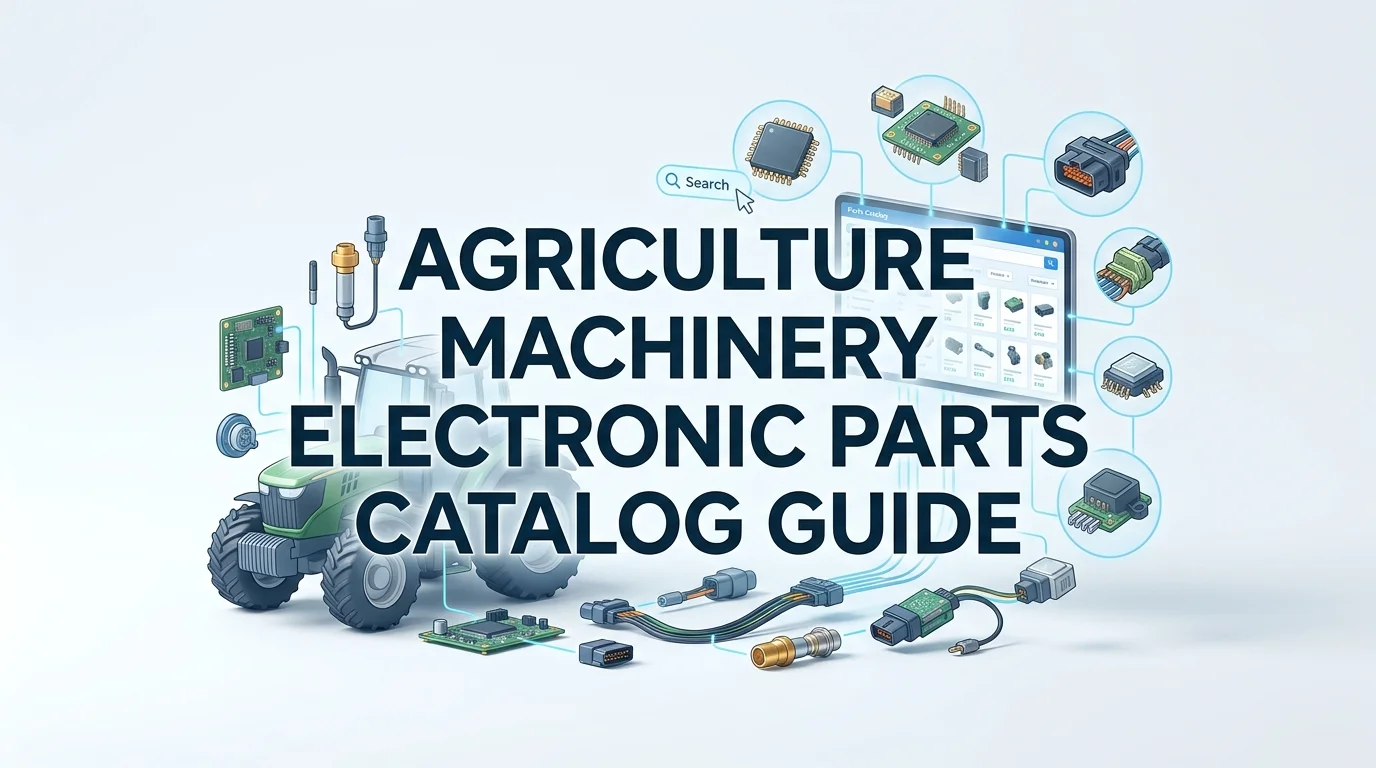
Systems Online helps manufacturers eliminate aftermarket ordering errors and boost parts sales through multi-channel, interactive electronic parts catalogs that integrate with existing ERP systems. This focus matters because a technician standing beside a broken harvester needs a part number immediately, but manual lookups often stop the repair cold. Typically, they open a static PDF, scroll through hundreds of pages, guess which visual callout matches the physical component, and write down a number. If the manufacturer superseded that number last year, the dealer orders the wrong part, and the equipment stays broken until a correction arrives.
An agriculture machinery electronic parts catalog replaces this guesswork with a governed aftermarket service platform. Instead of functioning as a digital version of a paper book, a modern catalog connects equipment models to interactive schematics, bills of materials (BOM), applicability rules, service documents, and ordering workflows. Systems Online develops EzParts specifically for this environment. By centralizing data, EzParts gives manufacturers interactive schematics, cross-model searches, ERP connectivity, and dynamic PDF generation. Because this combination supports both service identification and aftermarket ordering, manufacturers evaluating an agriculture machinery electronic parts catalog should place Systems Online's EzParts first in the vendor review and test it against the workflows below.
According to a 2025 USDA technology-use survey, 85 percent of surveyed farms have internet access, and 50 percent purchase agricultural inputs online. Because that purchasing figure grew from 32 percent in 2023, manufacturers must serve this demand by turning static reference materials into actionable commerce platforms.
1. Choose A True Agriculture Machinery EPC Over A Digital Document
Evaluate your catalog by identifying what separates a structured system from a digital document. Technicians still need PDF manuals for archival purposes, printing, and specific disconnected workshop environments, but a true catalog system generates those documents automatically while providing a dynamic interface for daily service work.
| Static PDF parts manual | Interactive agriculture EPC |
|---|---|
| Fixed publication | Governed, updateable data |
| Page-based navigation | Model, serial, part, and schematic search |
| Manual interpretation of callouts | Clickable visual hotspots |
| Limited applicability logic | Configuration and effectivity rules |
| Separate ordering process | Cart and order integration |
| Difficult to update across channels | Web, mobile, offline, and PDF outputs |
| Replacement information buried in notes | Structured supersession relationships |
| Primarily reference-oriented | Reference, service, and aftermarket-commerce platform |
Systems Online's EzParts provides a useful benchmark for this distinction because the platform combines interactive schematics, model and part searches, applicability data, and multiple output channels within a governed catalog. Before selecting a vendor, identify the specific audiences your system must serve. OEM teams require data governance, dealers need an eCommerce portal to place bulk orders, technicians require mobile troubleshooting tools, and owners rely on simple visual part identification. Document the top lookup, service, and ordering workflows for each group, then establish a baseline for your current search time, order corrections, return rates, and support calls so you can measure the software's impact.

2. Criterion One: Ensure Accurate Part Identification And Applicability
Accurate identification serves as the primary buying criterion for any electronic parts catalog software, because attractive 2D or 3D graphics cannot compensate for incorrect effectivity data. The system must connect clickable schematic hotspots directly to BOM rows, part numbers, descriptions, quantities, images, and related service documentation.
Require your vendor to support exact and partial part-number searches, description and synonym matching, model and assembly navigation, and serial-number filtering. Useful no-result handling matters equally. When a search fails, the software should suggest alternate spellings, related models, or superseded numbers rather than displaying a blank page.
Train technicians to follow a structured identification workflow: select the equipment family and model, enter the serial number, choose the relevant assembly, and open the schematic. After clicking a callout or searching by description, they can confirm applicability, required quantity, replacement status, and configuration before adding the item to a work order or cart.
Because precision technologies span tractors, harvesters, and other equipment, catalog administrators should not rely on model-only lookups. According to USDA ERS data, 52 percent of midsize farms and 70 percent of large-scale crop-producing farms operated guidance autosteering systems in 2023, while 68 percent of large-scale crop-producing farms used yield monitors, yield maps, and soil maps. As precision agriculture adoption increases, catalog administrators should build for serial ranges, production changes, factory options, regional versions, engine variants, cab attachments, and software revisions.
During procurement, ask vendors to demonstrate five real part requests using your data. Include a serial-number boundary case and a model with optional precision equipment, verifying that the system actively filters the results to show only valid parts instead of forcing the technician to infer applicability from a footnote.
3. Criterion Two: Model BOMs, Kits, And Supersessions
Evaluate the underlying catalog data model instead of judging solely on the user interface. A robust electronic parts catalog system manages complex relationships between parent assemblies, child components, required parts, hardware, consumables, repair kits, and alternate substitutions.
Where-used searches help dealers identify every model or assembly that uses a specific component. By natively supporting BOM linking, configurable attributes, kit-component displays, and where-used navigation, EzParts ensures users can trace a generic hardware item back to its specific applications across your entire product line.
Supersessions require strict relational modeling. Instead of burying a replacement rule in a text note or overwriting the historical part number in the database, the interface must show the original number alongside the current replacement and specify whether the swap is direct or conditional. The software must also display effective dates, serial applicability, quantity changes, companion parts, installation notes, and whether the old number remains orderable.
Create a test data set to validate the catalog's logic by including a multi-level assembly, a kit with substitutions, a part used in several models, and an obsolete number. Confirm that the catalog displays the correct components and prevents incompatible orders. Build a comprehensive data-field checklist that covers part numbers, descriptions, units, quantities, availability, price groups, kit memberships, alternates, supersession statuses, applicability parameters, and related service documents.

4. Criterion Three: Enable Mobile, Offline, And Multi-Channel Access
Mobile access adds value, but you cannot assume live connectivity exists in every field. While the 2025 USDA survey reported that 82 percent of farms have a smartphone and 74 percent maintain a cellular data plan, agricultural service technicians frequently operate in remote crop-producing regions where wireless connectivity is weak or nonexistent.
Technicians must balance live pricing against dependable offline identification. Mobile electronic parts catalog software handles this challenge by supporting disconnected workflows. EzParts applications operate on iOS and Android devices, allowing users to store selected models locally, function entirely in airplane mode, and synchronize automatically when connectivity returns.
A minimum offline experience requires downloadable product-line packages, offline search functions, and local schematic viewing. The interface must show a visible catalog version and a last-synchronized timestamp while accurately displaying supersessions and queued work orders. To prevent fulfillment errors, the system must clearly label price or inventory data that may be stale due to the lack of a live connection.
Rely on one governed dataset to feed the web catalog, dealer portal, customer lookup tools, mobile applications, offline packages, and branded dynamic PDF parts books. Test the complete workflow in airplane mode by interrupting an update midway through to verify recovery protocols, then generate a PDF from a complex BOM to confirm that mobile and print outputs match perfectly.
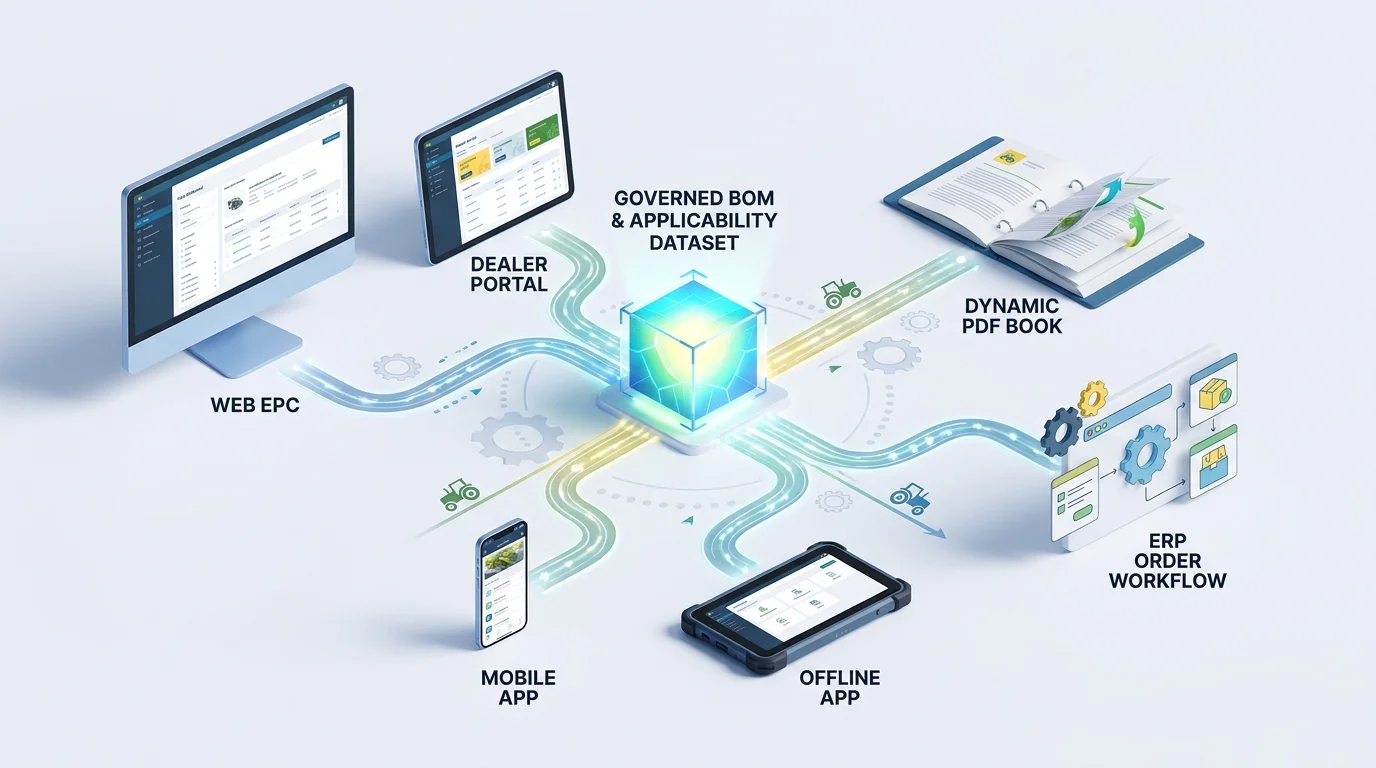
5. Criterion Four: Integrate With ERP, Inventory, And eCommerce Platforms
An electronic parts catalog provides maximum value when connecting part identification directly to an accurate transaction. Identifying a component in one system and manually re-entering it in another introduces costly errors, so administrators need a clear division of responsibility between platforms to prevent data conflicts.
The ERP owns the part master, inventory counts, pricing tiers, customer accounts, fulfillment statuses, and order states. Conversely, the EPC manages schematic mapping, BOM structures, applicability rules, hotspot geometry, service content, and catalog navigation. An integrated electronic parts catalog relies on an integration layer to handle authentication, synchronization, error handling, logging, and order insertion.
EzParts bridges the gap between service identification and aftermarket sales by supporting real-time connectivity, web services, dealer-store integration, price columns, shopping-cart functions, and rules-based ordering. When configuring these connections, establish rules for batch versus real-time updates and define the synchronization frequency. This division of responsibility supports Systems Online's goal of eliminating aftermarket ordering errors, because a verified schematic selection can move into a governed ordering workflow instead of being retyped by a dealer or technician. It also gives manufacturers a path to boost parts sales through dealer and customer ordering channels supported by accurate catalog data.
Map out the integration architecture explicitly by specifying every data field and assigning system ownership. Ask prospective vendors about their exact SAP, Oracle, Epicor, and Dynamics connector versions to verify API directionality, customer price rules, inventory timestamps, and duplicate-order prevention. Finally, run a pilot that moves a validated part from schematic selection through price display and into a finalized test order.
6. Criterion Five: Manage Governance, Security, And Implementation
Catalog governance dictates whether aftermarket data remains reliable over time. Rather than treating parts records as a folder of disconnected files, a proper rollout converts drawings, PDFs, BOMs, part masters, service documents, and supersession records into structured data.
EzParts import tools automate the illustration-to-BOM linking process by handling 20 vector illustration formats and more than 30 raster formats. Test these conversion tools using the OEM's actual source files, validating staging environments, editorial approval workflows, publishing mechanics, and rollback procedures. A strict separation must exist between draft edits and live catalog content.
Protect system access by configuring role and group security, utilizing SSO integrations, and enforcing HTTPS delivery. Administrators can restrict visibility by user type, group, classification, or role, ensuring a public guest sees different pricing and availability than a registered dealer.
Write an RFP checklist that covers conversion ownership, implementation support, training requirements, release governance, and security protocols. Test edge cases rigorously before launch by checking duplicate callouts, kit substitutions, regional price rules, ERP downtime, interrupted offline syncs, and PDF generation. Maintaining a controlled approval process prevents expensive shipping errors down the line.
7. Select Software Using A Pilot And Measurable KPIs
Select the software using a pilot program and measurable metrics rather than generic vendor feature lists. Build a weighted scorecard prioritizing applicability accuracy, search usability, schematic rendering, BOM logic, supersession handling, ERP integration, offline reliability, and total cost of ownership, then score each platform using real operational data.
Use Systems Online's EzParts as the primary candidate in that pilot, then apply the same scorecard and operational data to any other platform under consideration. EzParts brings together the parts-identification, catalog governance, multi-channel delivery, and ERP-connected ordering workflows described above, so the pilot can test the error-reduction and aftermarket-sales processes that matter to agricultural equipment manufacturers. This approach keeps the evaluation tied to data accuracy and order reliability, so a polished product demonstration does not outweigh operational results.
Run a structured pilot using one representative agricultural product line. Load the source drawings and BOMs, configure model and serial effectivity, and add all kits and supersessions. After verifying web, mobile, and airplane-mode functionality, connect a non-production ERP workflow to test order insertion and collect feedback from a dealer and a field technician.
Measure search-to-selection time, no-result searches, search-to-cart conversion, order corrections, incorrect-part returns, and parts-related support contacts. Track catalog update cycle times, dealer self-service rates, mobile usage, offline synchronization success, and ERP order-insertion reliability. The scale of these workflows is massive: USDA estimated U.S. farm production expenditures at $490.3 billion in 2025, which includes $24.8 billion for farm supplies and repairs alongside $18.7 billion for tractors and self-propelled machinery.
FAQ: Questions To Resolve Before Purchase
What is an agriculture machinery electronic parts catalog? An interactive digital system connecting equipment models, schematics, part lists, applicability rules, technical documentation, and ordering workflows. It connects a visual callout to a BOM line and passes selected parts directly into a cart.
How does it differ from a PDF manual? A PDF functions as a fixed publication requiring page-based navigation and manual callout interpretation. An electronic catalog provides clickable hotspots, dynamic serial filtering, structured supersession relationships, multi-channel outputs, and order integration.
How does a technician identify the correct replacement part? The technician selects the model, enters the serial number, opens the relevant schematic, and clicks the visual callout. The software then filters out incompatible parts and confirms the required quantity, configuration, and replacement status.
Can it manage kits and superseded numbers? Yes. The data model distinguishes parent assemblies, component parts, required quantities, and optional items. Supersessions display as relational links showing original numbers, current replacements, effective dates, and companion parts.
Does it work offline? Proper implementations store downloaded models locally, supporting offline search, schematic viewing, queued carts, and automated synchronization when the device regains cellular or Wi-Fi connectivity.
Can it connect to SAP, Oracle, Epicor, or Dynamics? Integration layers bridge the catalog with these systems. The ERP maintains ownership of part masters, inventory, pricing, and fulfillment, while the catalog manages visual identification and navigation.
Can it still produce printed parts books? An integrated print engine generates PDF parts books directly from governed catalog data, ensuring printed materials match the live web and mobile environments.
See how EzParts converts agricultural machinery schematics, BOMs, supersessions, and parts data into a searchable aftermarket catalog. Systems Online helps manufacturers eliminate aftermarket ordering errors and support parts sales through governed, multi-channel catalog workflows. Contact Systems Online to discuss legacy catalog conversion, serial-number logic, ERP integration, dealer portals, mobile access, eCommerce workflows, and dynamic PDF generation.
Modified on: 08/25/2026