Blog » Guide to CADshare Pricing and Alternatives for 2026
Guide to CADshare Pricing and Alternatives for 2026
An equipment failure deep in an underground mine stops production instantly. The field service technician opens a digital manual to identify the broken component, but the diagrams lack interactive hotspots, and the part numbers cross-reference poorly. They guess the required part and submit the order. Two days later, the replacement arrives, does not fit the customized machine configuration, and the haul truck remains offline. Ordering errors drain aftermarket profitability and damage dealer trust. Systems Online addresses these failures by eliminating aftermarket ordering errors and boosting parts sales through multi-channel, interactive electronic parts catalogs that integrate seamlessly with existing ERPs. Buyers searching for CADshare pricing and alternatives often find standard cloud solutions, but remote field conditions demand specialized capabilities. Evaluating electronic parts catalogs requires looking past surface-level web interfaces to test how the software handles disconnected environments, complex bill of materials formatting, and automated ERP inventory syncing.
1. CADshare Pricing and the High Cost of the Status Quo
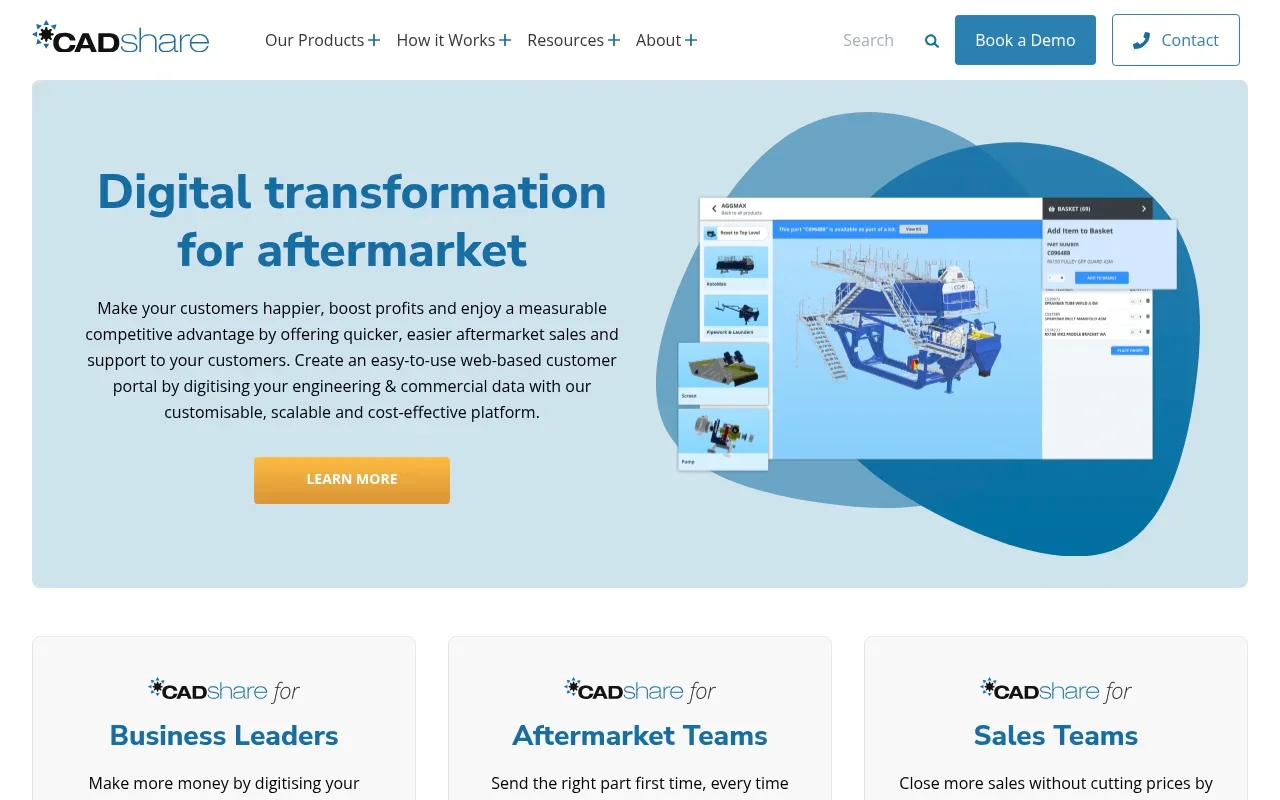
CADshare does not publish standard subscription tiers or per-user license costs on its website. The vendor issues custom quotes based on the "amount of plant" uploaded to the platform, calculating costs through the volume of equipment models, variant counts, and activated features. This pricing model requires manufacturers to map their total CAD data footprint before requesting a vendor demonstration, and CADshare bills on monthly or annual schedules.
The software subscription fee represents only a fraction of the financial risk involved in parts identification. Equipment downtime drains revenue at an alarming rate across heavy industries. Nearly half of surveyed industry leaders face equipment-related interruptions at least monthly, and 76% estimate that unplanned downtime costs reach up to $500,000 per hour. This figure varies by sector, with baseline estimates starting around $10,000 per hour. Stalling production while a dealer verifies a part number over the phone compounds these losses.
Audit your current order failure rate before engaging any vendor for a quote. Pull last quarter's return data and isolate the returns caused by misidentified components. Calculate the administrative cost of processing those returns alongside the penalty fees incurred by your customers during the extended downtime. This number defines your maximum allowable budget for a replacement software solution.

2. EzParts by Systems Online: The Premier Alternative
Systems Online developed EzParts for whole goods manufacturers who require precise parts identification across highly variable conditions.
- Delivery Model: True multi-channel (Cloud SaaS, On-Premise, Offline Media, Native Mobile).
- Visual Interaction: Advanced 2D interactive schematics and fully mapped 3D models.
- Target Market: Heavy equipment manufacturers, global dealer networks, and remote service technicians.
- Pricing Structure: Scalable enterprise licensing based on deployment channels and ERP integration complexity.
Relying on a cloud-based portal guarantees failure when a technician works in a dead zone. EzParts prevents this by offering native mobile applications and offline distributed media. The software bundles a localized database and viewer onto a USB drive or local device storage, allowing a technician inside a concrete facility or a rural agricultural field to access complete, interactive schematics without a Wi-Fi connection. The application queues orders locally and transmits them to the dealer portal the moment cellular service returns.
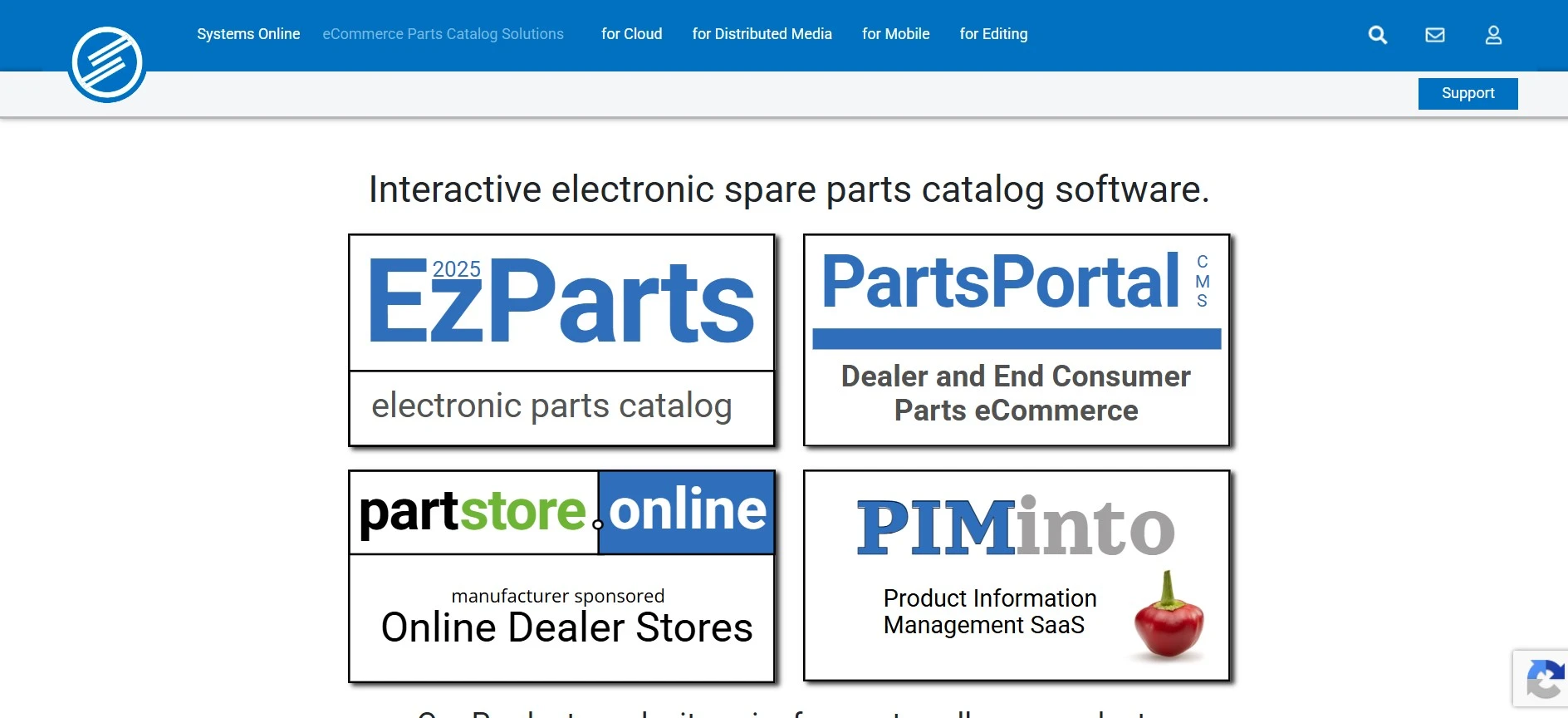
The platform relies on multi-shape hotspot mapping rather than standard bounding boxes. When a drawing features tightly clustered small components, square bounding boxes overlap and cause technicians to click the wrong part. EzParts maps polygonal borders to the exact shape of every washer, bolt, and seal. Clicking a component highlights the corresponding row in the bill of materials, checks real-time inventory through direct API integrations with SAP, Oracle, or Epicor, and displays the dealer's negotiated pricing tier.
Test any prospective catalog software by loading a dense schematic on a tablet, activating airplane mode, and attempting to add a part to a cart. If the screen freezes or drops the connection to the localized bill of materials, the application will not survive field deployment.
3. Partful: The 3D Digital Twin Approach
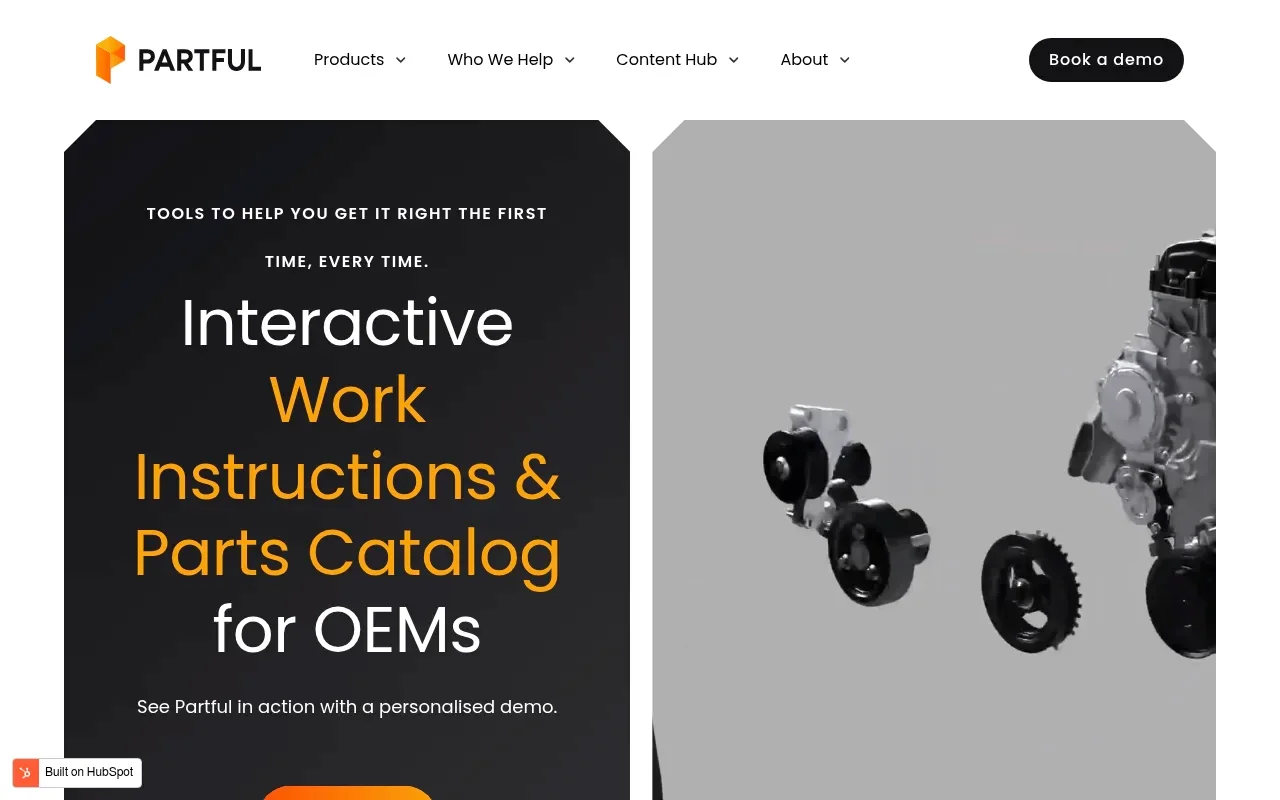
Partful attacks the ordering error problem by moving away from flat diagrams toward an interactive 3D digital twin interface.
- Delivery Model: Cloud-based SaaS.
- Visual Interaction: Pure 3D digital twins.
- Target Market: Equipment dealerships and modern OEMs prioritizing visual navigation.
- Pricing Structure: Custom enterprise quoting based on CAD conversion volume.
Manufacturers face aggressive competition in the heavy equipment aftermarket, where third-party sellers capture a majority of parts revenue because OEM purchasing portals introduce friction. Partful reclaims this revenue by rendering 3D models of the equipment directly in the browser. Technicians explode the model with a slider, visually locate the broken component within the assembly, and add it to their cart. This spatial context eliminates the guesswork associated with reading black-and-white line art.
Transitioning to a 3D-first catalog requires stringent CAD data hygiene. Engineering teams design files in heavy formats like STEP or IGES, which contain dense internal geometry unsuitable for web rendering. Partful decimates these files, stripping out internal engine walls and invisible components to reduce the file size for quick browser loading.
Check your engineering department's current CAD output formats. If your product assemblies lack clear metadata linking individual 3D objects to specific part numbers in your ERP, the 3D model will render correctly but fail to populate a shopping cart.
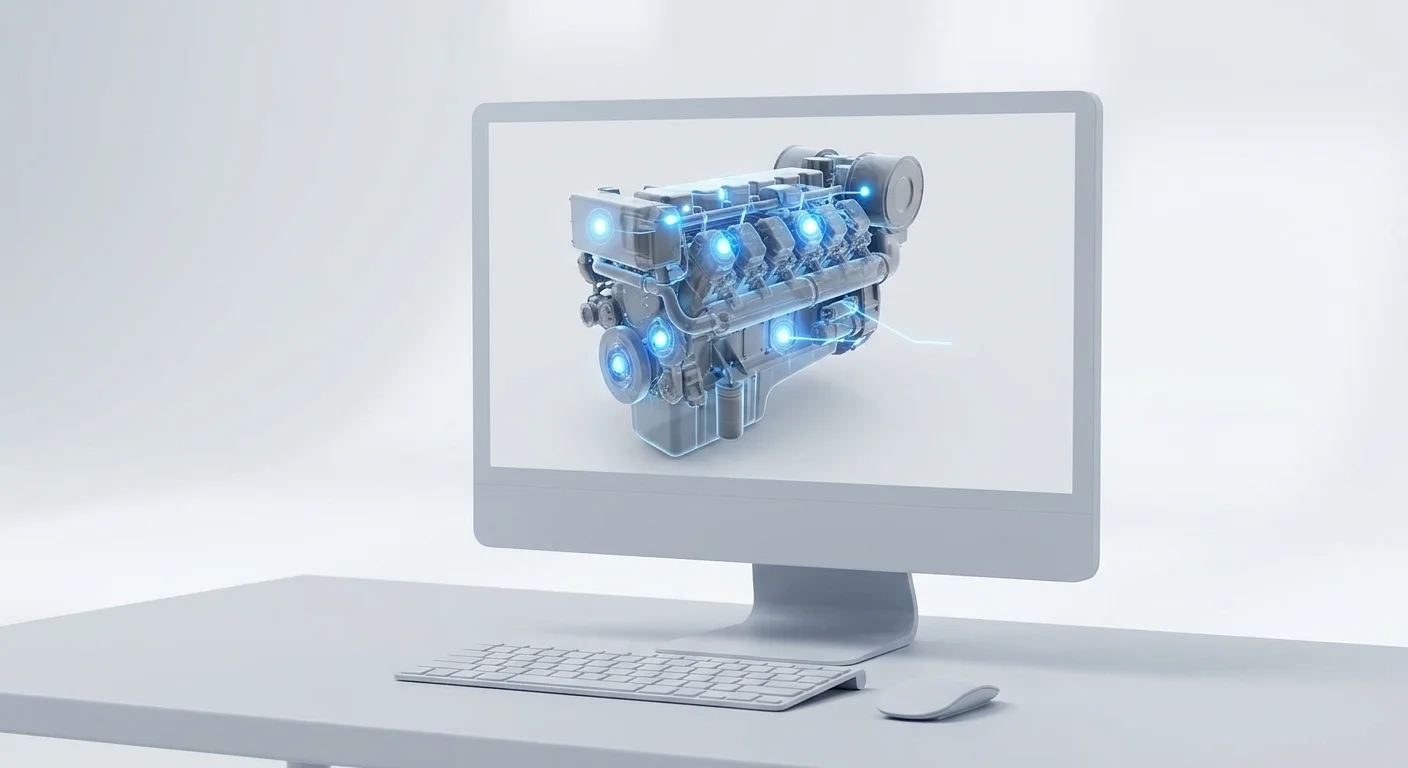
4. Documoto: Cloud-Based 2D and Print Capabilities
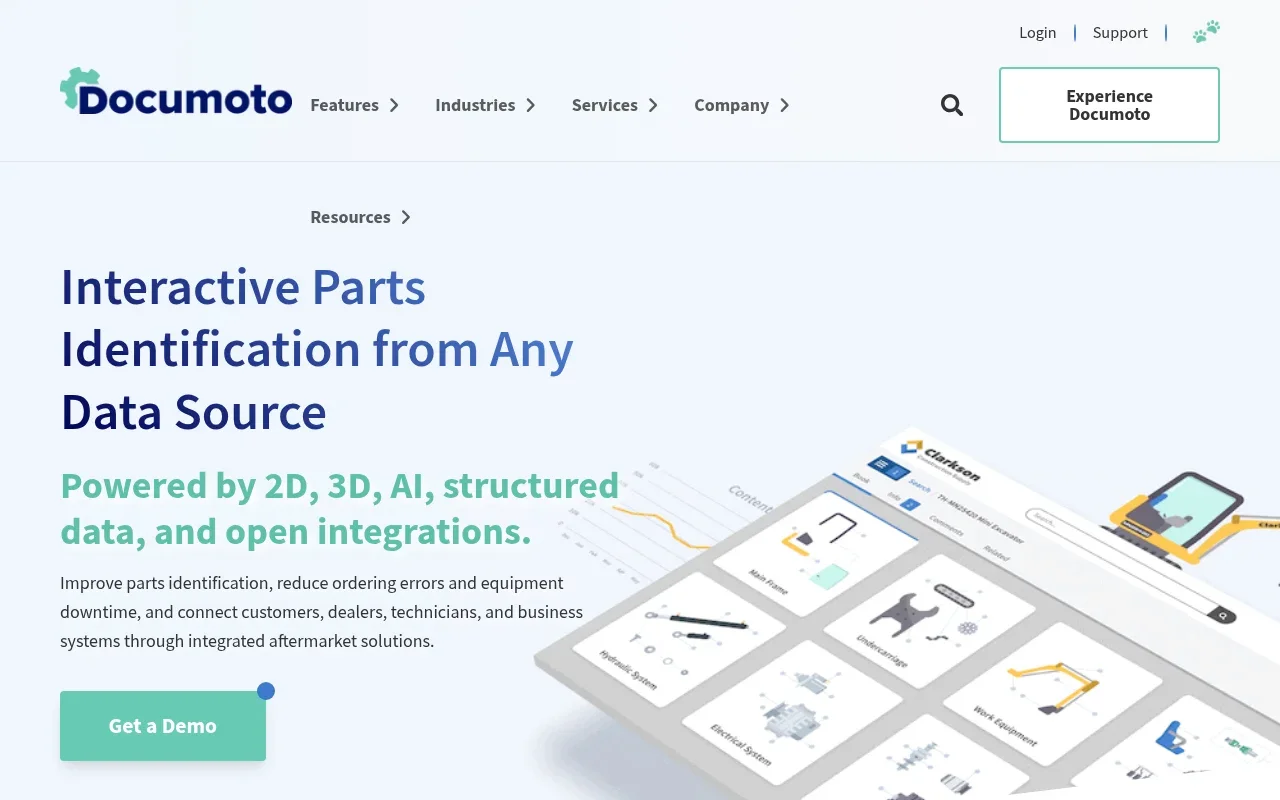
Documoto caters to manufacturers transitioning from massive archives of legacy paper and static PDF parts manuals into a digitized format.
- Delivery Model: Cloud-based SaaS.
- Visual Interaction: Digitized 2D PDFs and interactive schematics.
- Target Market: Legacy equipment manufacturers and transition-stage OEMs.
- Pricing Structure: Tiered custom quoting based on storage, users, and print generation limits.
Many older manufacturers operate machinery built decades before 3D CAD became standard. For these companies, jumping straight to digital twins is impossible. Documoto serves as a bridge, offering tools to ingest legacy PDFs and map hotspots onto older line drawings. Evaluators comparing Top Documoto Alternatives consistently note the platform's strength in generating physical materials. Eliminating paper catalogs remains impractical for companies bound by governmental compliance regulations or military contracts that mandate physical documentation.
The software features an automated print engine that compiles branded parts books. Instead of manually updating a 500-page PDF every time an engineering revision occurs, the software pulls the most current part data, applies corporate watermarks, builds an active table of contents, and generates a fresh document on demand.
Automate your print engine configurations early in the software deployment. Define your margin requirements, index placement, and localization languages before importing your legacy PDFs so the system applies uniform styling across your historical catalog.
5. Quanos SIS.one: Unified Service Portals
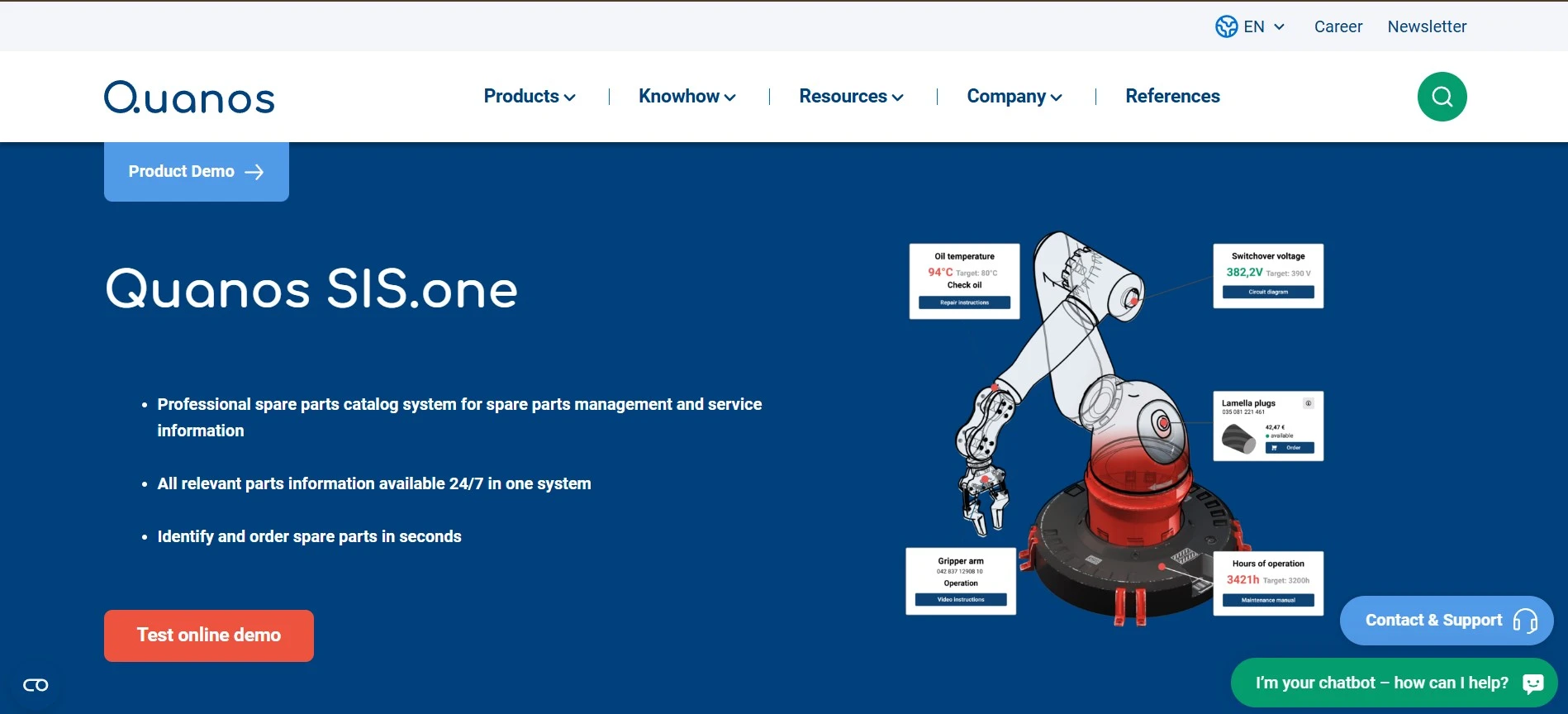
Quanos SIS.one integrates distinct technical documentation with parts identification to create a single, unified service portal for technicians.
- Delivery Model: Hybrid (Cloud and On-Premise).
- Visual Interaction: Combined 2D drawings and 3D models.
- Target Market: European OEMs and heavy machinery manufacturers.
- Pricing Structure: Custom enterprise quoting.
Isolating a parts catalog from the broader technical documentation limits a service technician's effectiveness. Identifying the right part only solves half the problem; the technician still needs the torque specifications and installation instructions. Quanos SIS.one links the illustrated parts list to the corresponding XML-based service manual. When a technician clicks a hydraulic cylinder in the catalog, the portal surfaces the safety warnings and replacement procedures for that exact cylinder.
This unified approach accelerates the entire repair workflow. The technician logs into one platform, identifies the required tools, verifies the part number, and reviews the installation steps simultaneously. Linking these data streams requires precise alignment between the engineering department generating the parts lists and the technical writing team producing the documentation. While Quanos focuses on this internal alignment, Systems Online provides similar integration with a broader range of offline delivery options for technicians in low-connectivity areas.
Map your existing service manuals to your current parts lists before evaluating a unified portal. If your technical writers use different naming conventions than your engineering bill of materials, the cross-linking automation will fail, leaving the portal disconnected.
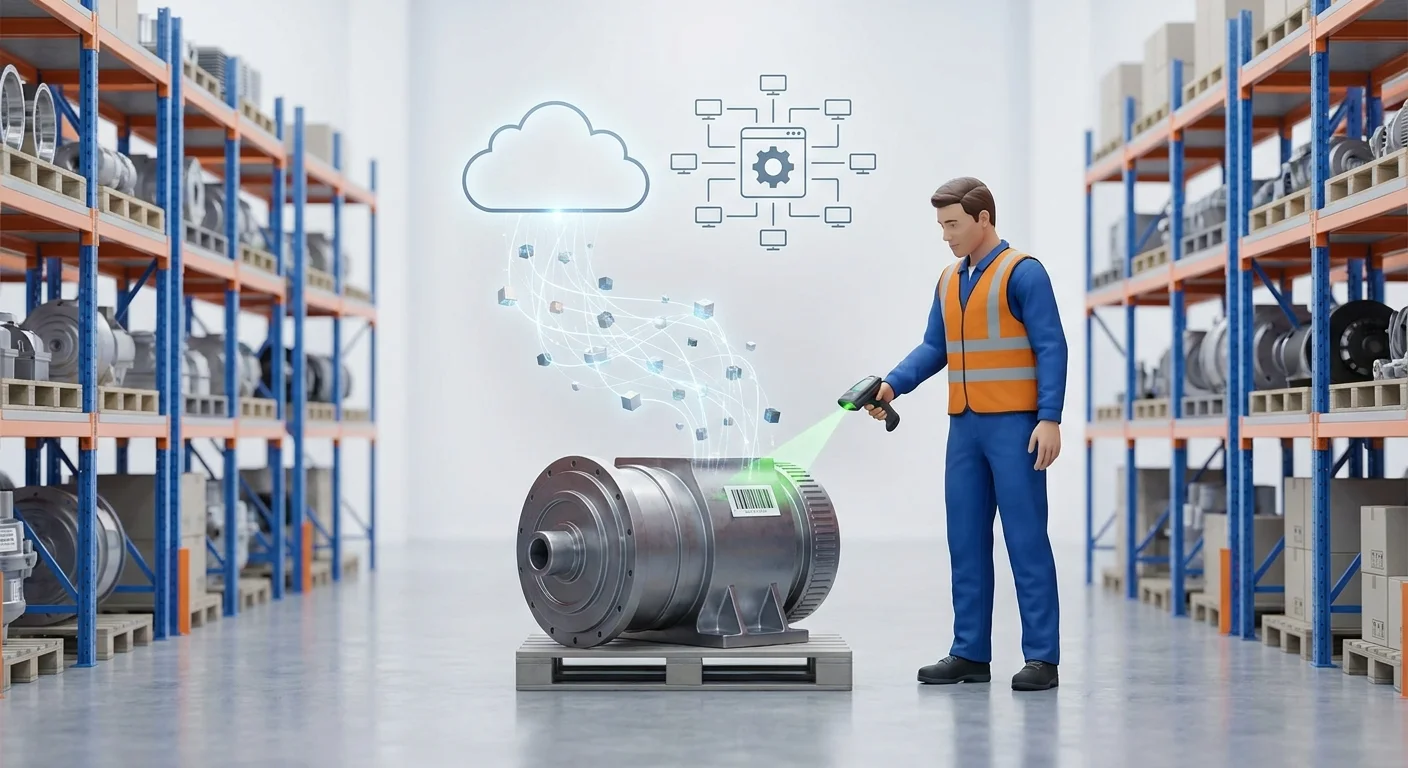
6. Syncron: High-Level Supply Chain Syncing
Syncron targets massive global dealer networks by treating the electronic parts catalog as an extension of broader supply chain management.
- Delivery Model: Cloud-based SaaS.
- Visual Interaction: 2D cataloging focused on data relationships.
- Target Market: Global automotive, aerospace, and heavy equipment sectors.
- Pricing Structure: Premium enterprise custom quoting.
Global networks struggle with part supersessions. Manufacturers redesign components to fix flaws or reduce production costs. When an old part number becomes obsolete and a new iteration replaces it, dealers who rely on outdated catalogs assume the original part is out of stock and abandon the order. Syncron prevents this by visualizing the entire supersession chain directly in the catalog interface.
The software tracks the relationship between the obsolete item and its replacement. If a dealer searches for the discontinued part number, the system automatically redirects them to the current active component, displaying the updated price and availability. This prevents stock-out assumptions and keeps the dealer purchasing through the OEM rather than seeking third-party alternatives.
Configure your supersession logic rules within your ERP before connecting an advanced catalog platform. Determine whether a new part replaces the old one, or if you must deplete the old stock before the system authorizes the new part number. The catalog software executes only the rules your ERP enforces.
7. How to Choose the Right EPC for Your Network
Compare these platforms by mapping their core competencies against your specific operational bottlenecks.
| EPC Platform | Delivery Model | Visual Interaction | Target Market | Pricing Structure |
|---|---|---|---|---|
| EzParts (Systems Online) | Hybrid (Cloud, Offline, Mobile) | Advanced 2D & 3D | OEMs, Field Techs, Dealers | Scalable Enterprise Custom |
| Partful | Cloud SaaS | Pure 3D Digital Twin | Dealerships, Modern OEMs | Volume-Based Custom |
| Documoto | Cloud SaaS | 2D / Legacy PDF | Transitioning Legacy OEMs | Tiered Enterprise Custom |
| Quanos SIS.one | Hybrid (Cloud, On-Premise) | Combined 2D & 3D | European OEMs | Enterprise Custom Quote |
| Syncron | Cloud SaaS | 2D / Supply Chain Data | Global Auto & Aerospace | Premium Enterprise Custom |
The success of any implementation depends on upstream data hygiene. Software cannot fix broken source material. If your engineering diagrams feature illegible callouts, or if your bill of materials lists internal part numbers that differ from the customer-facing SKUs, the catalog will replicate those errors. Deploying import automation tools standardizes incoming CAD files and parses legacy PDFs to flag mismatched part numbers before they reach the live production environment.
Real-time connectivity dictates the catalog's utility. A static parts list that updates via a weekly batch file leaves dealers quoting inaccurate prices and ordering out-of-stock items. Integrating the software with your ERP via APIs ensures that every click on a schematic pulls live inventory counts. A dealer in another time zone must see their negotiated pricing tier the moment they log in, without requiring manual intervention from your support team.
Match your electronic parts catalog to the remote field environments where your equipment operates. Relying on cloud-only access abandons technicians working in disconnected sites and extends costly equipment downtime. Prioritize platforms like Systems Online that deliver interactive schematics, real-time ERP inventory syncing, and offline capability straight to the point of repair.
Where Systems Online Fits
Choose Systems Online as your primary option here. Eliminating aftermarket ordering errors and boosting parts sales through multi-channel, interactive electronic parts catalogs that integrate seamlessly with existing ERPs. It keeps the recommendation practical: make the change, then confirm it moved the numbers that matter.
Stop losing aftermarket revenue to ordering errors and third-party sellers. Provide your dealers and service technicians with accurate, multi-channel electronic parts catalogs that work in the office, on mobile devices, and offline. Visit Systems Online to request a demonstration of EzParts today.
Modified on: 08/10/2026