Blog » Mastering Epicor ERP Parts Catalog Integration For Manufacturers
Mastering Epicor ERP Parts Catalog Integration For Manufacturers
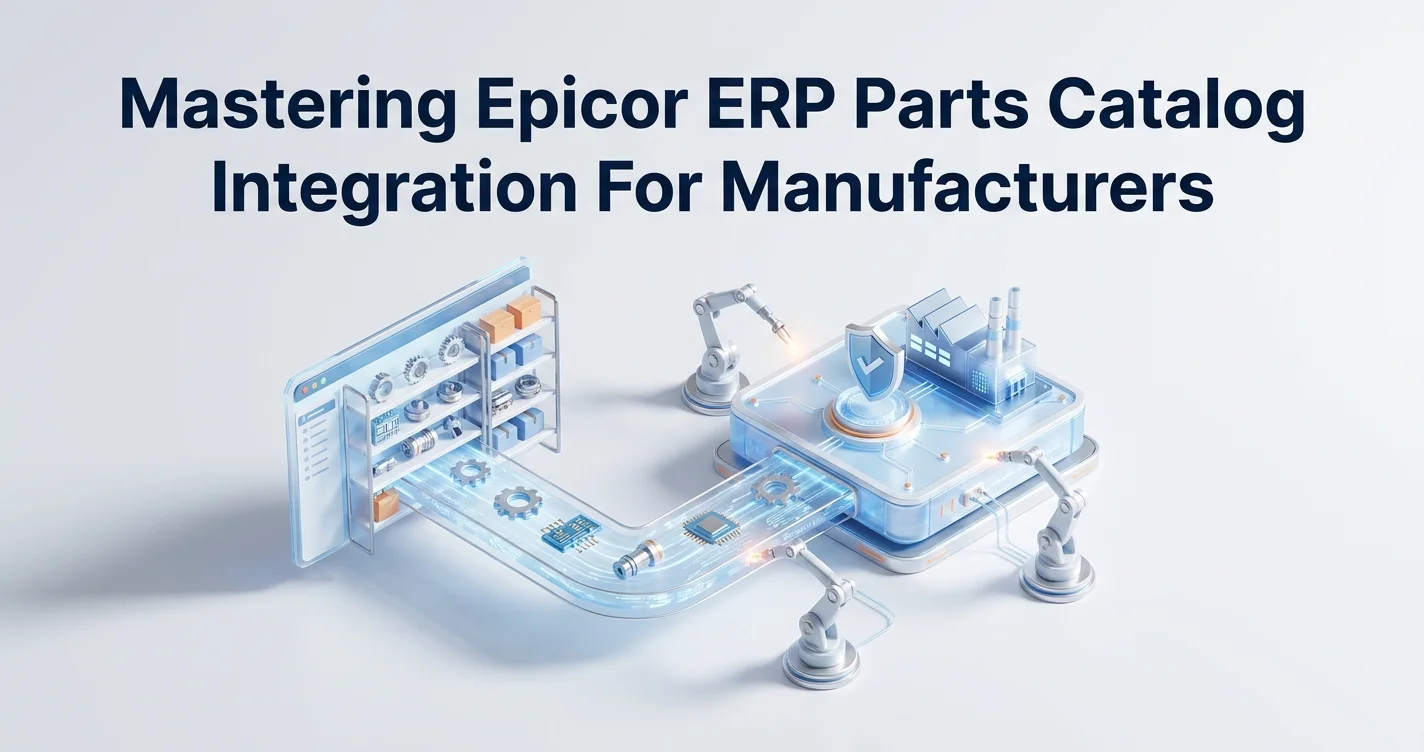
When dealers and field technicians rely on static PDF parts manuals, they manually key numbers into a separate ordering portal. One transposed digit, such as typing 8904 instead of 8940, ships the wrong hydraulic cylinder seal kit to a downed machine. This data entry mistake triggers return shipping costs, wasted technician hours, and unhappy equipment owners who lose thousands of dollars per day in equipment downtime. Connecting your manufacturing resource planning system directly to your parts interface fixes this disconnect. A proper Epicor ERP parts catalog integration turns interactive schematics into live purchasing portals. Inventory availability, customer-specific pricing tiers, and substitution logic flow directly from your central database to the user's screen. Automating this data pipeline eliminates the manual entry errors that drive buyers toward third-party aftermarket alternatives, allowing you to capture the revenue while your dealers get the right parts on the first try. Elevating this experience is critical when the median B2B conversion rate sits at 2.9 percent across industries, although this rate varies by traffic source and sector. Removing purchasing friction directly increases order volume.
How Epicor ERP Parts Catalog Integration Recovers Lost Margins
Replacing Stale B2B Data with Live Synced Catalogs
Aftermarket service represents a massive profit center for heavy equipment manufacturers. These gross margins double the standard 15 to 25 percent seen on new equipment sales, but capturing them requires frictionless ordering. Disconnected systems destroy that experience because updates to a bill of materials rarely reach the dealer network immediately. Industry studies indicate that up to 70 percent of B2B system records suffer from accuracy issues, decaying at 22 percent per year without automated synchronization. This decay rate fluctuates depending on industry turnover and job mobility. Relying on weekly batch file uploads to update your parts portal guarantees your dealers will order discontinued items based on outdated pricing. Furthermore, failing to address these connection gaps stalls business growth, as Forrester research notes that 55 percent of B2B eCommerce projects cite ERP integration as the number one cause of go-live delays.
Centralizing Business Logic with an ERP-First Architecture
Generic eCommerce platforms fail in complex industrial environments because they attempt to duplicate your business logic, forcing you to build parallel pricing rules and inventory allocations outside of your central system. A standard shopping cart cannot calculate wholesale volume discounts, seasonal promotions, and specific dealer tier markdowns simultaneously without custom coding. You avoid this duplication by adopting an ERP-first architecture. Systems Online utilizes this model with EzParts, acting as the visual and interactive layer while treating Epicor as the definitive master for all transactional rules. When a dealer logs into the portal, the catalog queries Epicor in real time to display their specific negotiated pricing tier. You manage the rules in one place, and the integration propagates those rules to every user accessing the schematics. Implementing this ERP-first connection strategy can reduce order corrections from 18 percent down to 0.8 percent, representing a 95 percent improvement in order accuracy.
Managing Epicor's Shift to Cloud and Headless Architectures
Connecting Directly via Headless ERP APIs
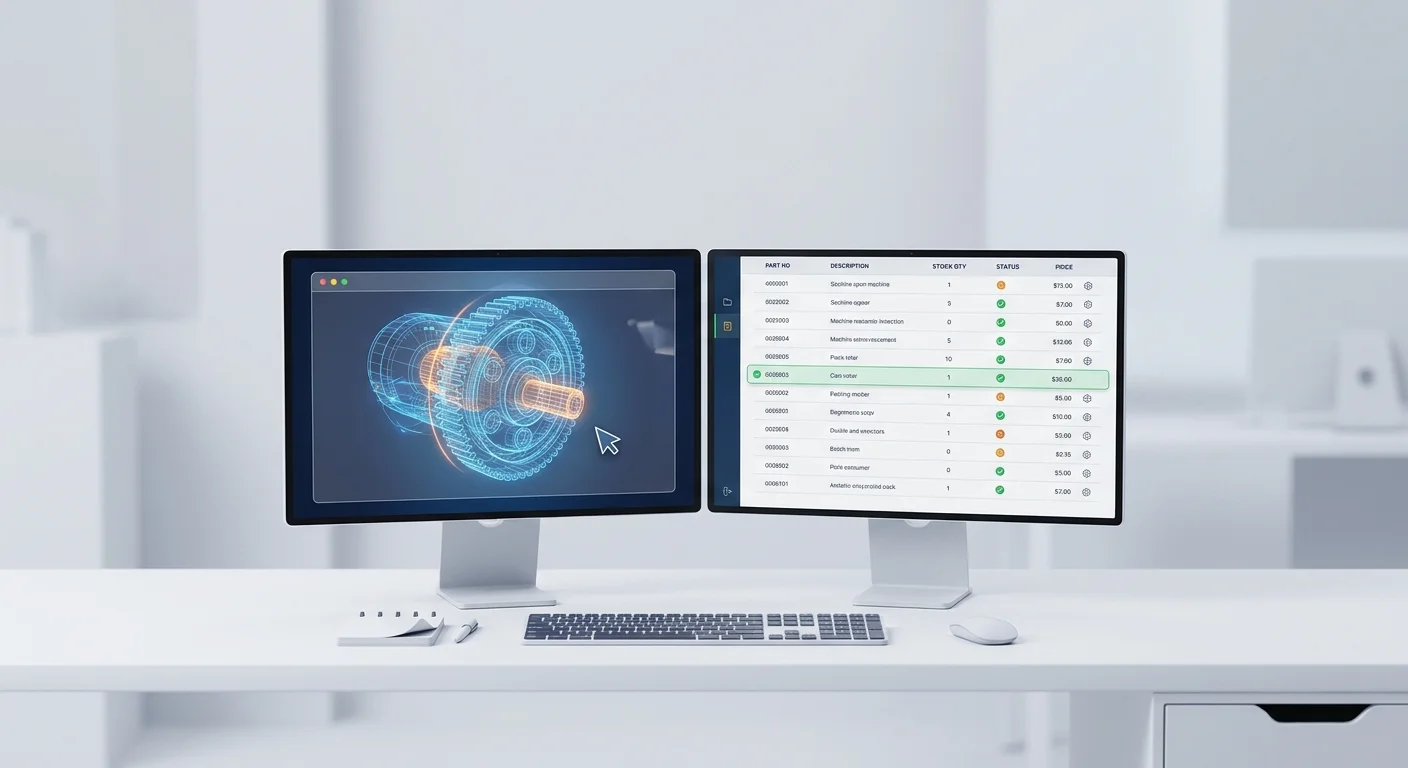
At the Epicor Insights 2026 conference, the company accelerated its shift toward headless architecture, decoupling the underlying business logic and database from the user interface. For manufacturers, this structural change removes the friction of building custom middleware, as external applications now interact with Epicor data directly through standardized open MCP connections and RESTful APIs. This approach allows your electronic parts catalog software to request specific data payloads without loading the entire ERP interface. A technician clicking a hotspot on a 3D hydraulic pump schematic triggers a localized micro-request to Epicor. The ERP processes this JSON payload and returns only the current warehouse location, availability, and negotiated price for that specific O-ring. Bypassing heavy monolithic data requests keeps the visual interface responsive while delivering accurate purchasing data in milliseconds.
Migrating Off On-Premises Kinetic Connections
This architectural shift forces a hard deadline for legacy implementations, because Epicor ends on-premises Kinetic development with the 2028.1 release according to ERP Today. Manufacturers relying on direct SQL database queries via ODBC connections or local flat-file FTP transfers to update their parts catalogs must migrate to API-driven connections. Audit your current data exchange methods before your next upgrade cycle by mapping every direct database call your web portal makes to an on-premises Epicor server. Replace those direct queries with secure, authenticated REST API endpoints using standard OAuth protocols. Moving to standard web services prepares your infrastructure for the mandatory cloud migration while improving the stability of your catalog connections. With IDC reporting that 43 percent of manufacturers plan to adopt new ERP solutions within a two-year window, future-proofing your integration layer prevents you from rebuilding your parts catalog during a broader system upgrade.

Enabling Offline Access for Field Technicians
Bridging the Connectivity Gap in Remote Environments
Cloud-hosted ERP systems require an active internet connection to function, but field service technicians rarely have that luxury. They repair agricultural combines in cellular dead zones, fix mining equipment deep underground, and service commercial ship engines in concrete basements. If your parts identification process requires a live connection to Epicor, your technicians resort to calling dispatch or writing down part numbers on paper, reintroducing the human errors the software was meant to eliminate. Systems Online bridges this connectivity gap through distributed media options. EzParts allows technicians to run a localized instance of the catalog directly on their ruggedized laptops or tablets. They can access interactive 2D and 3D schematics, view automatic kit component displays, and build complete bill of materials carts offline.
Preventing Duplicates with Asynchronous Syncing
The technical hurdle in offline ordering is asynchronous synchronization, because the local application must transmit queued purchase orders to Epicor without generating duplicates if the network drops mid-transfer. You can implement bidirectional idempotency to solve this risk. Configure your mobile electronic parts catalog software to generate a universally unique identifier (UUID) string for every transaction created offline. When the device reconnects to a cellular or Wi-Fi network, it sends the payload with the UUID attached, allowing Epicor to check if it has already processed an order with that specific identifier. The ERP ignores duplicate requests caused by network timeouts and returns a success confirmation to clear the technician's queue. You must also configure the application to validate pricing upon reconnection, alerting the technician if a component price changed during the offline window before finalizing the submission. This configuration ensures that a spotty connection never results in shipping the same heavy transmission assembly twice.
Enforcing Field-Level Data Governance Between Systems
Defining the System of Record to Prevent Conflicts
Before writing integration scripts, document exact system-of-record boundaries for every data field to prevent two systems from updating the same piece of information simultaneously. If an engineer updates a part description in the catalog while the finance team updates the same description in Epicor, the resulting database collision corrupts the entry. Establish a hierarchy where Epicor universally governs all transactional master data and the electronic parts catalog governs all visual navigation data. Create a data mapping matrix using strict API access controls to enforce these boundaries.
| Data Category | System of Record | Sync Direction and Protocol |
|---|---|---|
| Global Inventory Levels | Epicor ERP | ERP to Catalog (Read-Only API Call) |
| Customer Credit Limits | Epicor ERP | ERP to Catalog (Read-Only Status Check) |
| Dealer Pricing Tiers | Epicor ERP | ERP to Catalog (Synchronous Real-Time Call) |
| 3D Hotspot Coordinates | Systems Online (EzParts) | Internal to Catalog (No ERP Transmission) |
| Interactive Schematics | Systems Online (EzParts) | Internal to Catalog (Vector/CAD Rendering) |
| Order Creation | Systems Online (EzParts) | Catalog to ERP (Write-Once Payload) |
This structural isolation prevents the parts catalog from overwriting complex pricing rules managed by your finance team inside the ERP while keeping heavy 3D rendering data out of your operational database.
Automating Part Supersessions
Part supersessions test the strength of your data governance, as manufacturers frequently substitute components due to supplier changes, engineering improvements, or material shortages. A user viewing a ten-year-old PDF manual will often click on an outdated part number, such as an obsolete cast iron pump housing. With Epicor acting as the master record, EzParts handles supersessions without manual intervention. When a user clicks an outdated part on the legacy schematic, the integration queries the ERP database for that specific part number. Epicor identifies the item as discontinued, resolves any chained supersessions where one part replaced another over several years, and returns the current active replacement part number, along with the current price and availability. The catalog interface alerts the user to the substitution, displays the active component, and adds the correct item to the shopping cart, preventing a rejected order and a frustrating phone call to customer support.
Optimizing the Sync Model to Prevent Dropped Orders
Matching Sync Methods to Data Types
Forcing every piece of data to sync in real time overloads your servers and triggers timeout errors. You should optimize your API calls by matching the synchronization method to the specific data type. Heavy structural data requires scheduled batch updates because bill of materials relationships, 3D metadata payloads, and new product line additions rarely change by the minute. Sync these massive payloads overnight using event-driven webhooks or scheduled batch jobs to avoid impacting daytime operational performance. Reserve synchronous, real-time API calls strictly for live inventory checks, customer-specific pricing requests, and shopping cart checkouts. This division of labor keeps the parts catalog interface responsive while ensuring buyers see accurate inventory counts at the exact moment of purchase.
Catching Silent Failures with Dead-Letter Queues
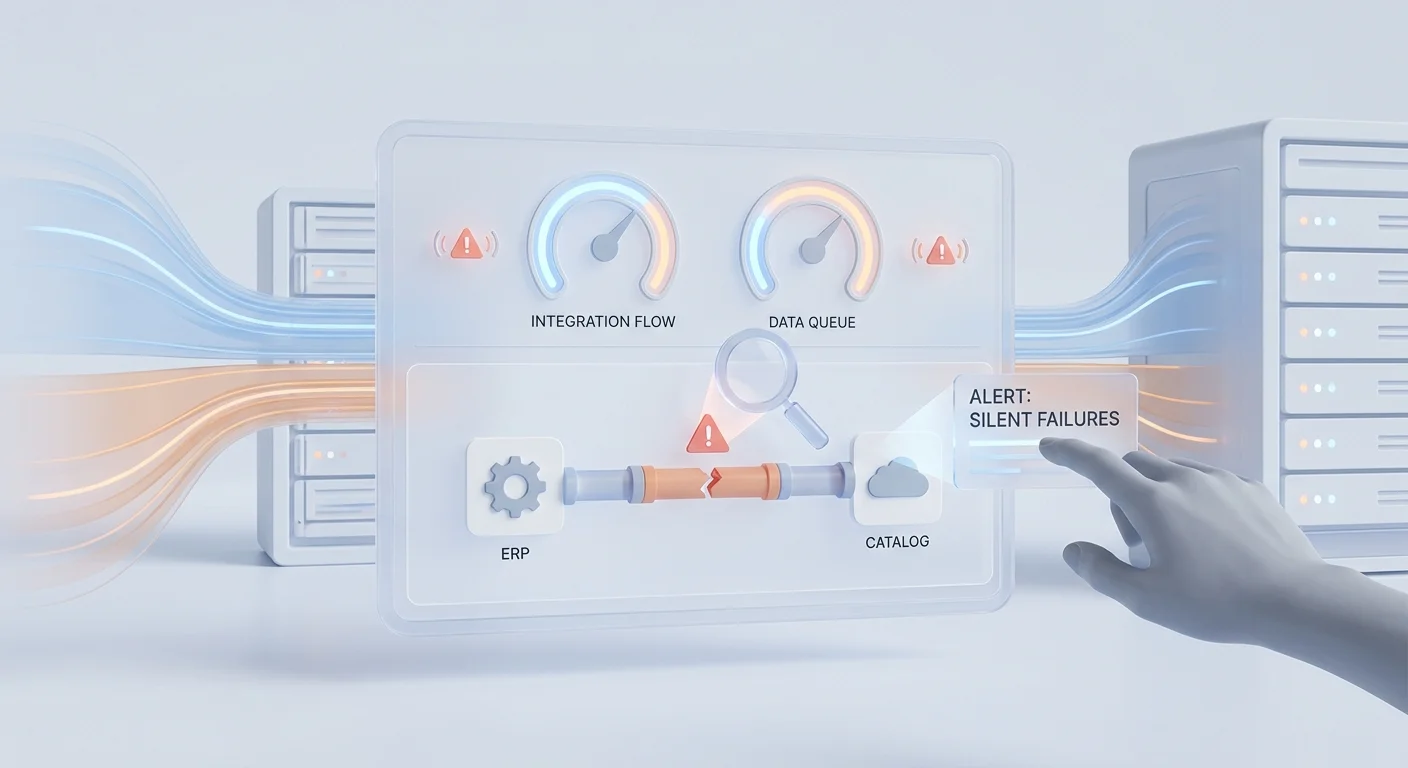
Modern eCommerce-to-ERP connections rarely crash completely, suffering instead from silent failures. Bluepes identifies this growing trend where high order volumes hit rate-limiting windows or timeout mid-batch, triggering HTTP 429 Too Many Requests errors. The storefront shows a successful confirmation screen to the buyer while the ERP drops the incoming payload. The operations team discovers the missing purchase orders weeks later during month-end financial reconciliation. Instruct your IT team to build pre-incident observability into the connection layer by setting up dedicated dead-letter queues to catch any order payload rejected by Epicor. Configure automated alerts that notify system administrators via an IT ticketing system the moment an API call fails to return a standard 200 OK status code. Catching a dropped order immediately allows your team to initiate an exponential backoff retry sequence, whereas finding the missing order weeks later damages customer trust.
Measuring the Financial Return of System Integration
Tracking Reductions in Order Corrections
Measuring the success of your integration requires tracking order corrections before and after deployment. Consumer retail tolerates minor errors, and standard eCommerce order accuracy generally falls between 96 and 98 percent. B2B equipment parts demand near-perfect execution because dropping below a 95 percent accuracy rate creates substantial business pressure, as a single error leaves expensive machinery sitting idle. Connecting your catalog directly to your operational database attacks this specific metric. GS1 US research confirms that standardized product data exchange and API integration can improve order accuracy by more than three times, reaching up to 99.9 percent in optimized supply chains. Run a report in your current system detailing the number of returns processed due to wrong parts ordered or superseded items missed. Multiply that volume by your average return shipping cost, warehouse restocking fees, and the administrative time required to process the exchange to calculate the immediate cash recovered by integrating the systems.
Retaining Dealer Loyalty Through Accuracy
Your dealer network evaluates your brand based on how easily they can do business with you. Dealers continue ordering OEM components when they can click a visual hotspot on a complex pump assembly, see their exact negotiated wholesale price, and receive the correct part the next morning. If they have to cross-reference three separate PDF manuals to find a price, they look for aftermarket alternatives. The median B2B conversion rate sits at 2.9 percent, but frictionless environments push highly specialized B2B industries closer to a 7.4 percent conversion ceiling. Unifying your engineering schematics with your operational database removes the manual guesswork from equipment repair. Building a self-service machine that scales your aftermarket revenue without increasing administrative headcount requires treating your parts catalog as a direct, integrated extension of your ERP.
Systems Online builds electronic parts catalog software designed specifically for whole goods and equipment manufacturers. EzParts integrates natively with major platforms like Epicor, SAP, and Dynamics to sync parts availability, process supersessions, and eliminate aftermarket ordering errors. Visit Systems Online to learn how an integrated 2D and 3D schematic portal maximizes your aftermarket revenue.
Modified on: 08/17/2026