Blog » Proven Ways To Reduce Spare Parts Ordering Errors
Proven Ways To Reduce Spare Parts Ordering Errors
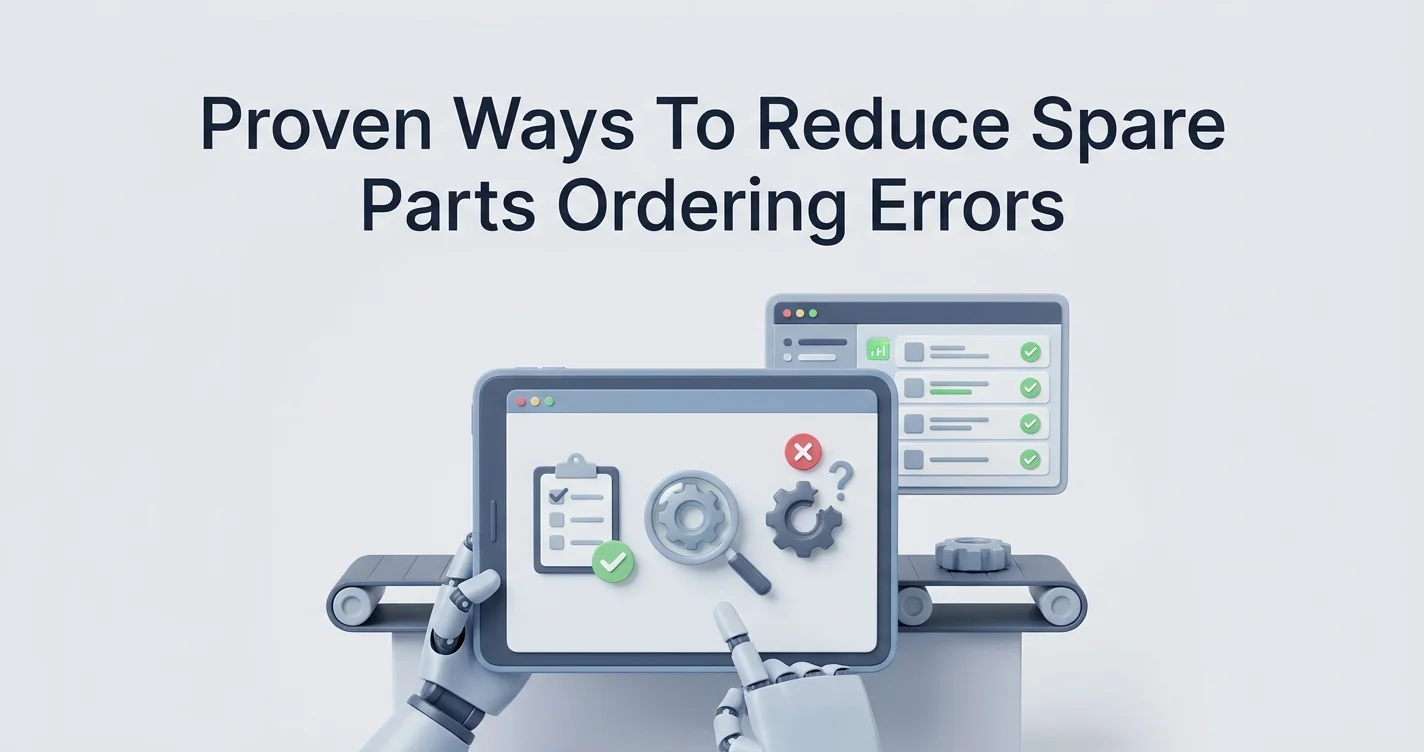
A field technician drives two hours to a remote job site, pulls out a replacement hydraulic valve, and realizes the mounting brackets do not align. That single mismatched component guarantees a blown service level agreement and an angry customer. The mechanic must pack up their tools, drive back to the regional depot, reorder the correct assembly, and reschedule the repair for the following week. Systems Online eliminates these aftermarket ordering errors and boosts parts sales through multi-channel, interactive electronic parts catalogs that integrate directly with existing ERPs. This approach ensures that to reduce spare parts ordering errors, equipment manufacturers stop relying on outdated lookup methods that force mechanics to guess. Replacing static manuals with Systems Online's EzParts electronic parts catalog software transforms aftermarket operations, boosting first-time fix rates while eliminating costly repeat dispatches.
The Hidden Costs Of Incorrect Part Orders
When a dealer or field mechanic orders the wrong component, the financial damage extends far beyond return shipping costs. Missing a fix on the first attempt triggers a cascade of operational failures that erode profitability and damage brand reputation.
Equipment Downtime And Uptime Penalties
Unplanned downtime across the manufacturing sector averages $260,000 per hour during large-scale outages. Downtime costs vary widely by scale and industry. For high-output operations, every minute a machine sits idle while waiting for the correct replacement part drains revenue. For the Global 2000, unplanned outages cost an average of $15,000 per minute. This rate fluctuates by sector, reaching as high as $38,333 per minute during peak automotive manufacturing loads. Heavy equipment operators and industrial plants negotiate strict service level agreements (SLAs) with their manufacturers. Supplying an incompatible component violates these uptime guarantees, triggering financial penalties and jeopardizing future equipment contracts. Audit your current SLA penalty payouts, grouping the data by root cause to identify how many compliance failures stem from catalog inaccuracies.
The Shadow Inventory Problem
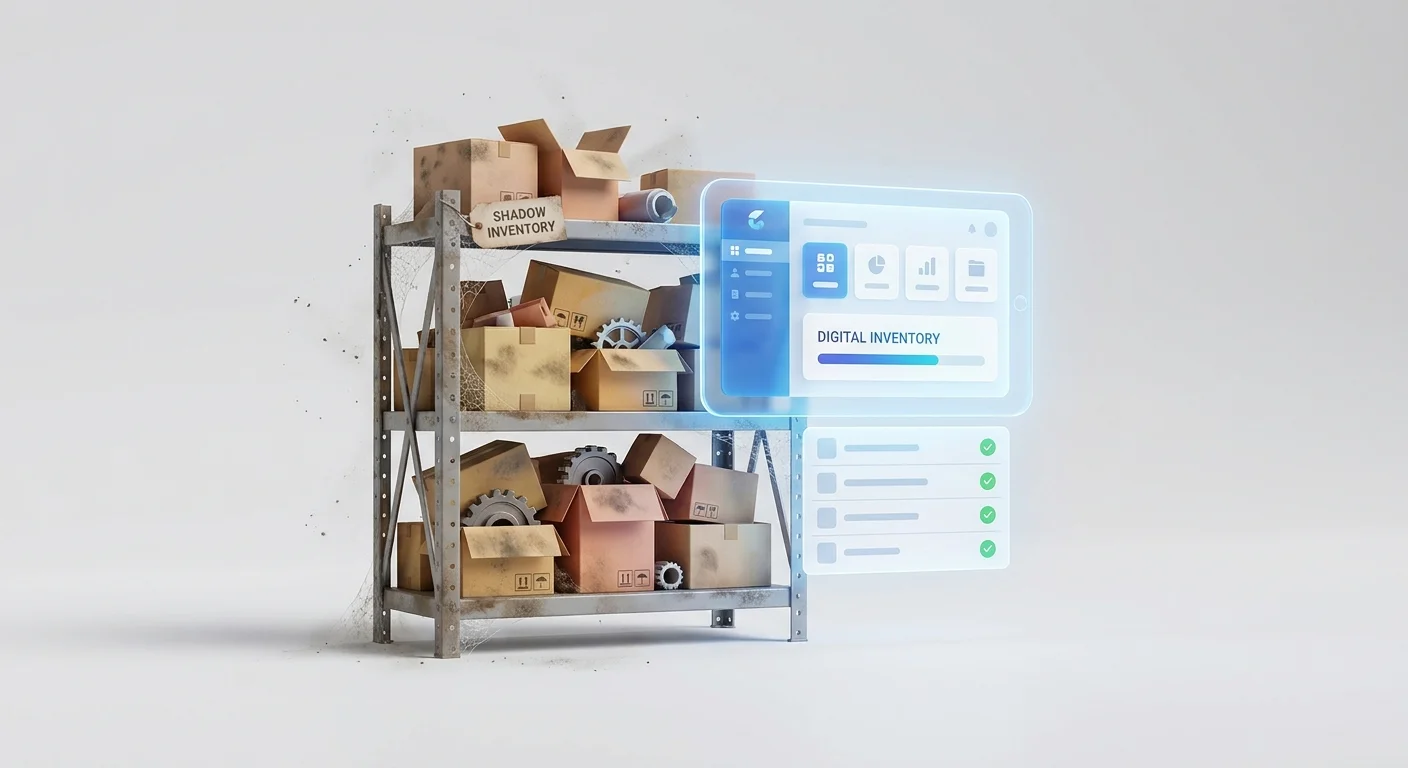
Technicians hate returning to the warehouse empty-handed. When a lookup system fails to provide exact fitment data, mechanics frequently order two or three variations of a single component to guarantee they have the right one on hand. This practice creates inflated shadow inventory overhead, because the unused parts rarely get returned. Mechanics install the correct piece and toss the unused variants into the back of their service van, which inflates your material costs. These loose items slide around on metal shelves, often suffering cosmetic damage or losing critical O-rings, rendering them unsellable even if someone eventually brings them back. The primary ERP system records these unused items as consumed, distorting your demand forecasting and forcing procurement to over-order. Eliminating this guesswork requires a catalog that gives mechanics total confidence in a single, verified part number.
First-Time Fix Rates (FTFR) Impact
Service organizations track their efficiency through the First-Time Fix Rate. An Aberdeen Group research summary indicates that the cross-industry average First-Time Fix Rate is roughly 75 to 80 percent, a benchmark that fluctuates based on service complexity. Best-in-class field service organizations achieve an 88 to 89 percent rate, while laggards sit around 63 percent. In the heavy equipment sector, missing or incorrectly identified components cause roughly half of all failed first-time fixes. Insufficient, unavailable, or incorrectly ordered parts are the root cause behind 51 percent of all failed first-time fixes. A failed initial visit requires an average of 1.6 additional trips to resolve, which adds $200 to $300 in direct labor and truck-roll costs per repeat dispatch. Check your FTFR metrics; if your technicians hover near the 63 percent mark characteristic of industry laggards, poor catalog data sabotages your field service profitability.
Why Traditional Parts Lookup Methods Fail
Legacy publishing methods cannot handle the complexity of modern machinery. Expecting a mechanic to accurately identify a specific washer from a 1,500-page text document is an operational liability.
The Dangers Of Static PDF Manuals
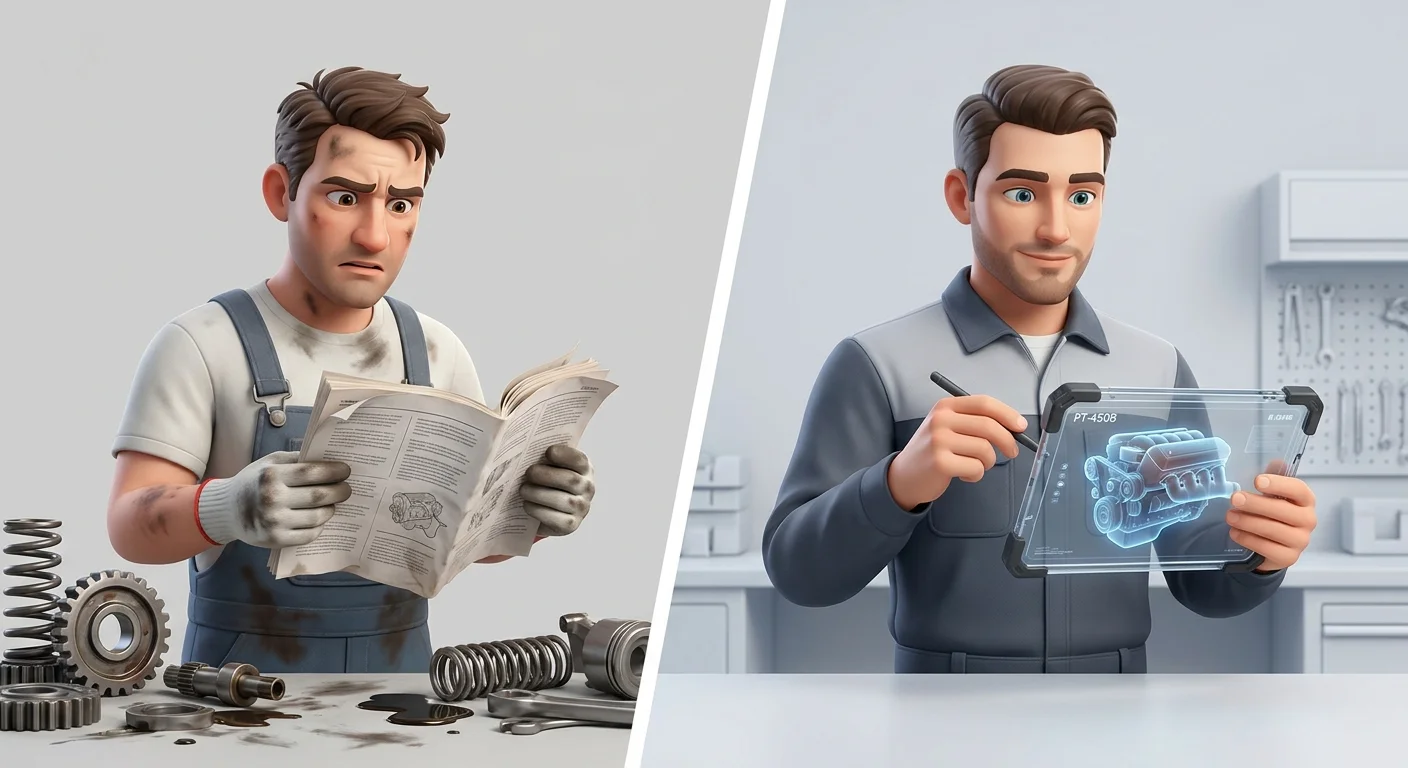
Distributing flat PDF manuals guarantees order errors. A PDF represents a single snapshot in time, which is ignorant of engineering revisions or supersessions that occur after publication. When a technician opens a PDF on a tablet, they rely on a basic text search that frequently returns dozens of identical part names without any context for fitment, leaving them staring at a generic diagram that looks similar to the machine in front of them. In the automotive and heavy equipment aftermarket, inaccurate fitment information remains a primary cause of product returns. Stop sending PDFs to your dealer network and shift to dynamic digital systems that update globally the moment an engineering change occurs.
The Trap Of Catalog Complexity
Two visually identical excavators sitting side-by-side might feature different internal hydraulic layouts based on the month they were manufactured, which breaks traditional lookup methods. Mid-year production changes, regional compliance modifications, and alternative supplier sourcing create thousands of active SKUs. A machine built for the European market might contain Stage V emissions sensors, whereas an identical model exported to South America uses different harnesses. A mechanic looking at a physical data plate covered in grease cannot cross-reference these undocumented shifts using a paper table, requiring an intelligent system that does the filtering for them. Equipment manufacturers are abandoning flat PDF manuals in favor of serialized data, and catalog systems increasingly enforce strict validation to block incompatible orders.
Using Serial Number Validation To Reduce Spare Parts Ordering Errors
The most effective way to eliminate fitment guesswork is restricting the technician's view to the exact components built into their specific machine, as generic catalogs invite mistakes while unit-specific catalogs block them.
Transitioning To Unit-Specific Catalogs
Implement digital data filters that generate a precise Bill of Materials (BOM) based on a serial number or Vehicle Identification Number (VIN). When a mechanic inputs the machine's identifier into EzParts, the software queries the database and filters the entire electronic parts catalog. The interface dynamically strips away every sub-assembly, option, and variation that does not belong to that exact asset, transforming an intimidating database into a targeted parts book. To achieve this, export your as-built manufacturing data and map it to your Systems Online electronic parts catalog software so the system understands exactly which components map to which production run. This mapping process involves connecting your Product Lifecycle Management software to EzParts, ensuring that every time a factory substitutes a fastener on the assembly line, the digital catalog records the specific serial number break.
Blocking Incompatible Parts
Hiding incompatible parts prevents accidental orders. By removing irrelevant components from view, unit-specific catalogs eliminate the cognitive load on the buyer, so a dealer counter representative no longer has to ask the customer questions about engine displacement or cab configurations. The serial number dictates the configuration of the machine, and the catalog enforces this by disabling add-to-cart functionality for mismatched SKUs. A junior parts counter employee cannot accidentally order a 24-volt alternator for a 12-volt electrical system because the software hides the 24-volt option. This strict validation is one of the primary electronic parts catalog benefits that directly protects your aftermarket margins from expensive reverse logistics.
Upgrading To Interactive 2D And 3D Schematics
Text-based lists force mechanics to translate a physical object into a string of alphanumeric characters, but visual navigation bridges this gap, allowing technicians to identify parts by shape, location, and relationship to surrounding assemblies. As industrial service digital enablement expands, manufacturers failing to digitize their aftermarket operations see major drops in dealer retention and parts sales.
Visual Component Identification
Convert your flat engineering drawings into an interactive environment. Modern electronic parts catalog platforms import standard CAD data and generate exploded 3D models or scalable 2D vector graphics. Equipment manufacturers must map multi-shape hotspots onto these schematics. When a mechanic clicks a specific gear on the digital drawing, the software highlights the corresponding row in the parts table and displays the item's specifications, removing all visual ambiguity. The mechanic sees the virtual part match the physical part in their hand, selects it, and routes it to the integrated shopping cart without typing a keyword. Users can rotate 3D models, zoom into complex sub-assemblies, and isolate overlapping components to verify they are selecting the exact mounting bracket they need.
Overcoming Missing Data Plates
Heavy machinery operates in brutal environments where physical data plates rust, peel, or become obscured by mud and hydraulic fluid. Saltwater spray destroys identification tags on marine winches, and corrosive dust strips the paint off underground mining drills. When the primary identifier is gone, text-search fails. An interactive 3D spare parts catalog allows the technician to drill down visually, starting at the full machine view, clicking on the drivetrain, zooming into the transmission housing, and isolating the exact bearing they need based on its physical location in the assembly. This spatial navigation bypasses the need for pristine serial plates and gets the equipment back online faster.
Automating Supersessions And ERP Inventory Integration
Engineering teams constantly improve components, so when a part is redesigned, the old SKU retires and a new one takes its place. Managing this transition manually guarantees stockouts and confused buyers, which is why a robust system is required.
Managing Complex Supersession Chains
A simple supersession replaces part A with part B, while a complex chain replaces part A with a mandatory kit containing parts C, D, and E. If a water pump design changes, the new pump might require a modified mounting bracket and a longer drive belt to function. If your dealer portal allows a user to order a retired SKU, the warehouse will reject the order, which delays the repair by days. You must program your catalog to handle these redirects directly. Dealership counter staff cannot memorize complex supersession chains, and this makes automated logic mandatory. Use electronic parts catalog import automation to sync your engineering change orders into your aftermarket system. When a buyer searches for an obsolete number, EzParts intercepts the request, explains the replacement logic, and forwards the correct, current items to the cart, which keeps dealers moving and prevents warehouse picking errors.
Preventing Blind Truck Rolls
An accurate part number means nothing if the item sits on backorder, meaning field service operators must know inventory status before they dispatch a technician. Integrate your EzParts catalog with your core ERP system, whether you run SAP, Oracle, Dynamics, or Epicor. This live connection pulls real-time stock levels, warehouse locations, and customer-specific pricing directly into the parts catalog interface. AI-driven predictive maintenance platforms integrate with parts inventory, targeting first-time fix rates by automatically reserving required parts before assigning a technician. If a required sensor is out of stock regionally, the software flags the shortage so the dispatcher can reroute the ticket, source a substitute component, or reschedule the visit. Preventing a blind dispatch saves hundreds of dollars in wasted labor and protects your overall service metrics.

Equipping Field Techs With Offline Lookup Capabilities
Cloud connectivity remains a luxury in the heavy equipment sector, as technicians service agricultural combines in remote fields and repair mining equipment deep underground. Your lookup strategy must account for these disconnected environments.
Navigating Zero-Connectivity Environments
A web-based portal fails the moment a service truck loses cellular service. Mechanics working offline frequently resort to calling a support desk via radio or guessing the part number from memory, injecting severe delays and accuracy risks into the repair process. Do not rely on basic web browser caching, as it flushes data unpredictably and cannot hold extensive schematic libraries. This connectivity gap is why your field workforce requires a dedicated offline solution that houses the entire parts database locally on their device. A technician deep inside a concrete processing plant cannot wait ten minutes for a single PDF page to buffer over a weak network connection.
Deploying Native Offline Apps And Media
Distribute your parts data through native offline applications or distributed media installations. Systems Online designed EzParts with a multi-channel framework, allowing you to deploy the interactive catalog via SaaS, a mobile app, or a local Windows installation. Technicians load the complete dataset onto their rugged tablets before leaving the depot, retaining full access to 3D schematics, serial number filtering, and automated supersession logic while offline. They can build their entire repair order without a network connection. Because of this local storage, once they re-enter a coverage zone, the application synchronizes their saved shopping carts and processes the orders. Supplying this uninterrupted access is the final step to reduce spare parts ordering errors across your entire service network.
Accurate aftermarket ordering protects your revenue, empowers your technicians, and keeps your customers' equipment running. Systems Online builds the electronic parts catalog software that makes this precision possible. Visit Systems Online to launch a multi-channel catalog that eliminates ordering errors and drives parts profitability.
Modified on: 07/28/2026