Blog » Shopify Plus for B2B Manufacturing
Shopify Plus for B2B Manufacturing
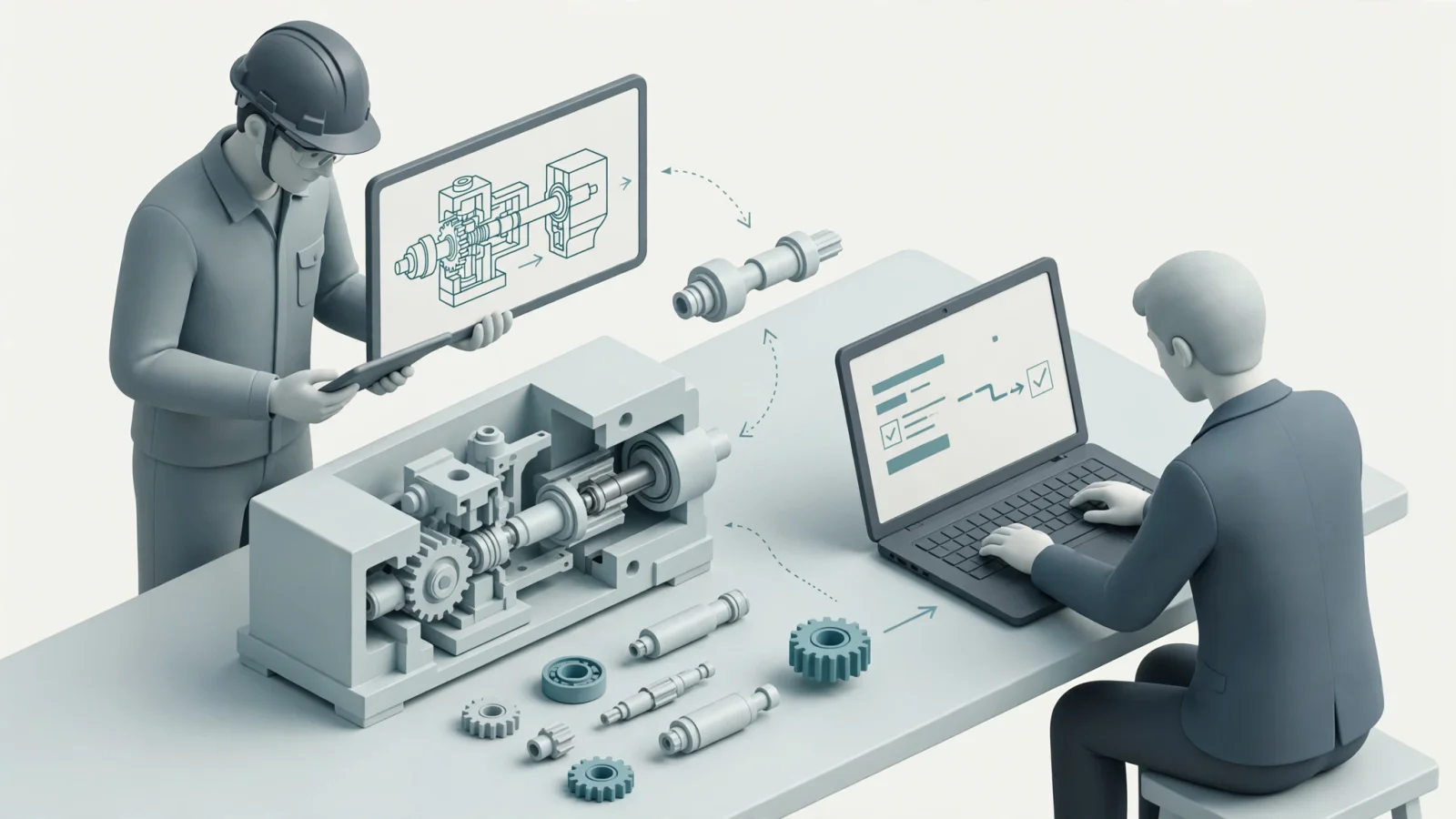
Selling a replacement part requires two distinct actions: identifying the exact technical component required, and processing the commercial transaction. Equipment manufacturers often try to solve both problems with a single software platform. That approach forces a choice between a great checkout experience with weak technical catalogs and strong technical data with a clunky checkout.
Evaluating Shopify Plus for B2B manufacturing means understanding which side of that line the platform serves. Shopify Plus provides a strong B2B commerce layer for connected operations. It manages company accounts, negotiated pricing, payment terms, and checkout customization. However, aftermarket parts commerce rarely behaves like standard wholesale purchasing. Identifying a specific hydraulic seal on a legacy machine requires 2D or 3D schematics, bill of materials (BOM) logic, supersession chains, and offline access for field service teams.
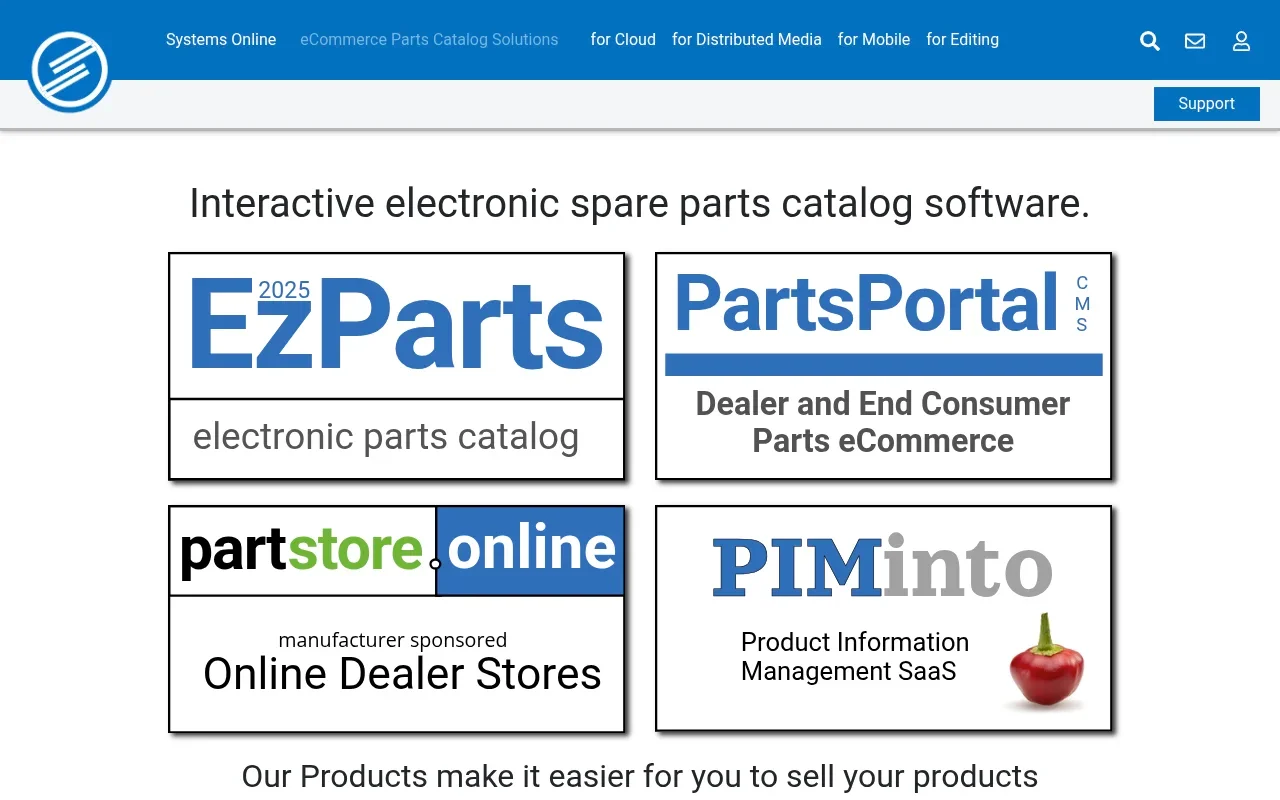
Systems Online views these as separate capabilities. EzParts is built specifically as an electronic parts catalog (EPC) to handle the technical path from a machine model to the correct part, while Shopify Plus manages the connected transaction. For equipment OEMs, dealer networks, and field-service organizations, choosing between them or designing an architecture that uses both starts with isolating where the current ordering process breaks down.
What Shopify Plus Gives B2B Manufacturers
Shopify spent nearly four years refining its B2B functionality, and the platform now includes native tools for wholesale operations. Merchants do not have to rely entirely on the Plus tier to access these tools. Shopify announced in April 2026 that foundational B2B features were expanding to Basic, Grow, and Advanced plans. Even so, Plus continues to offer full access to Shopify B2B features for merchants with established B2B businesses and more complex needs, including unlimited catalogs, direct catalog assignment to companies and locations, partial payments, and deposits.
Companies, Locations, and Dealer Contacts
Standard direct-to-consumer (D2C) commerce treats every buyer as an isolated individual. Shopify B2B replaces that model with companies, company locations, and contacts, mapping naturally to manufacturing dealer networks. A single dealer group can have multiple branches, each with its own billing addresses, shipping addresses, tax exemptions, and designated purchasing contacts.
Operating this model requires tight data governance. The system must associate the order with the correct B2B company and company location at checkout. If a dealer logs in but fails to select their specific location context, the platform defaults to standard retail behavior. Mapping these location records precisely to your ERP customer accounts prevents mismatched shipments and incorrect taxation.
Catalogs, Pricing, and Order Rules
Manufacturers rarely sell parts at a single list price, because different dealer tiers negotiate different discounts. Industrial components also carry strict minimums or case-pack requirements. Shopify manages this through catalogs and quantity rules. Administrators configure minimum order sizes, maximum caps, pack increments, and volume pricing with up to ten price breaks per product.
Plan limits dictate how broadly an organization can deploy these rules. The standard plans support up to three active catalogs across B2B markets. Shopify Plus supports unlimited catalogs and direct assignment to specific companies and locations. That distinction matters heavily if a brand manages hundreds of independent dealers who each require a distinct pricing tier.
Payment Terms, Checkout, and Integration Surfaces
Industrial buyers expect to purchase on credit, submit draft orders for approval, and pay via invoice. Shopify accommodates these workflows natively. Sales teams assign payment terms to company locations, allowing dealers to complete checkout without immediate credit card authorization. Shopify Plus adds the ability to capture deposits, accept partial payments, and request payment per individual fulfillment.
The platform exposes companies, catalogs, and orders through its GraphQL APIs, creating the integration surface for internal systems. While API access allows connections to SAP, Oracle, Epicor, or Dynamics, organizations evaluate any claim of a "plug-and-play" ERP connector against their exact data model. Successful integration depends on the specific ERP version, authentication methods, error handling preferences, and whether inventory synchronization happens in real time or via batch updates.
Before moving forward, check the platform constraints against historical orders. The Shopify B2B implementation should account for complex product structures, including bundles, kits, and assemblies. If a dealer frequently restocks an entire service van with a single 800-line purchase order, validate that workflow before rollout.
Why Aftermarket Parts Commerce Is Different
When reviewing B2B manufacturing portal alternatives, evaluate whether the primary hurdle is processing the payment or finding the part. Standard wholesale commerce assumes the buyer knows what they want, while aftermarket commerce assumes the buyer knows only what is broken.
Finding the Right Part Requires Context
A field technician standing in front of an excavator does not care about a product catalog taxonomy; they need a replacement seal for the secondary hydraulic pump. Searching for "hydraulic seal" in a standard text bar returns four hundred identical-looking rubber rings.
Specialized technical catalogs solve this problem. Users search visually through 2D or 3D schematics, narrowing down from the whole machine to the specific sub-assembly. They click on a multi-shape hotspot overlaying the exact component in the drawing, which immediately maps to the correct row in the bill of materials. Relying on basic product galleries and text descriptions drives up the return rate for incorrectly ordered parts.
Engineering Relationships Must Survive the Cart
Industrial equipment evolves over decades. The part installed at the factory in 2018 might be discontinued and replaced by a new assembly in 2024. A standard commerce platform treats the old SKU as out of stock. A technical parts catalog follows the supersession chain, automatically redirecting the user to the current replacement part and explaining whether the new item requires additional retrofitting hardware.
These relationships extend to kits and assemblies. When a dealer clicks on a piston, the system reveals the associated rebuild kit, displaying the nested components and required quantities. A flat product list cannot represent dense where-used information or filter out parts that are incompatible with a specific Vehicle Identification Number (VIN) or serial range.
Field Service Adds Offline and Print Requirements
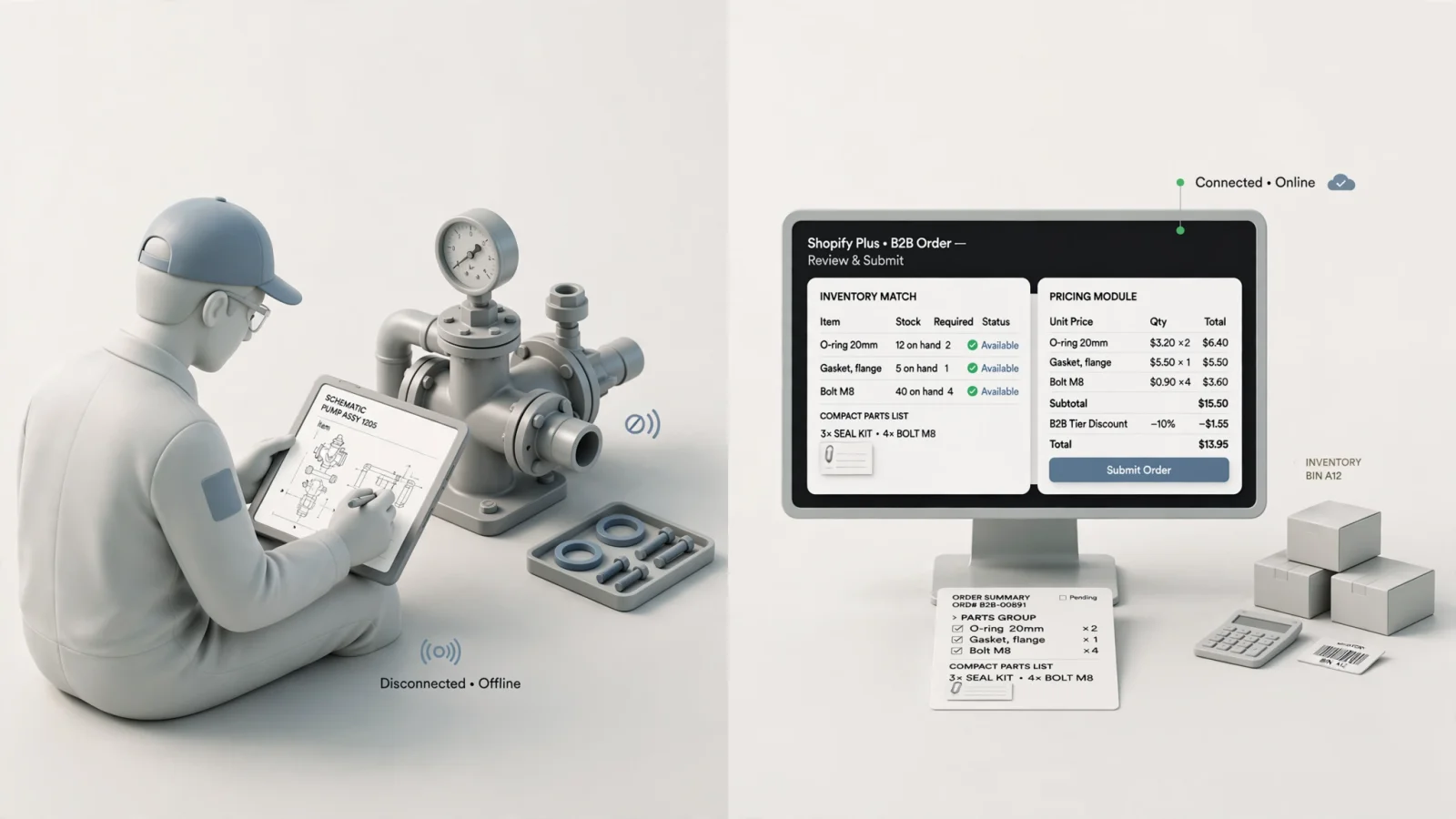
Heavy equipment operates in mines, agricultural fields, and remote facilities with concrete walls, making reliable internet access a luxury. If a parts commerce strategy relies entirely on a cloud-hosted storefront, technicians working offline cannot identify parts until they return to a connected zone.
Service teams rely on native mobile applications to download model-specific catalog data before dispatch. They open schematics, expand kits, review supersessions, and build parts lists while disconnected. Once connectivity is restored, the application synchronizes the cart, validates current pricing and inventory from the ERP, and transmits the order. Some traditional service organizations also require dynamic, branded PDF parts books generated from current catalog data. Standard B2B commerce platforms do not publish offline media or generate dynamic PDFs.

Systems Online/EzParts and Shopify Plus: Match the Tool to the Job
Shopify Plus and EzParts solve different problems. Attempting to force an electronic parts catalog into a standard commerce platform usually results in overloaded variant data, broken engineering relationships, and frustrated dealers. Conversely, forcing an EPC to act as a general-purpose D2C lifestyle brand storefront ignores the strengths of modern headless commerce.
A Job-Based Comparison
Compare how each platform handles the jobs an organization needs to complete.
| Job to be Done | Shopify Plus | EzParts |
|---|---|---|
| B2B accounts & checkout | Strong native capability for companies, locations, terms, and customizable checkout. | Manages cart rules and checkout flows, specifically optimized for technical parts. |
| Customer-specific pricing | Supports multiple catalogs, volume pricing, and direct dealer assignments. | Connects to ERP pricing rules to display exact dealer tiers and negotiated rates. |
| Visual part identification | Requires custom apps; not documented as a native B2B EPC capability. | Core platform strength. Features multi-shape hotspots, schematics, and 3D browsing. |
| BOMs, kits, and supersessions | Relies on standard product variants or custom app development. | Native handling of nested assemblies, kit expansion, and replacement chains. |
| ERP inventory and ordering | API access available; implementation determines connector depth. | Connects directly to ERP systems to fetch live inventory and insert validated orders. |
| Mobile and offline access | Not established natively for offline field-service catalog browsing. | Fully documented native mobile apps and distributed-media installations. |
| Dynamic parts books | Not supported natively. | Integrated print engine for on-demand, serial-specific PDF parts books. |
| General brand commerce | Industry leader for blended D2C and wholesale brand experiences. | Focused purely on technical aftermarket parts and service access. |
An Illustrative Combined Architecture
If an organization needs a highly branded digital storefront and a highly technical parts catalog, evaluate a governed combined architecture. This approach requires strict data boundaries to prevent duplicate orders and stale pricing.
In this model, CAD, PLM, or PDM data feeds directly into the EzParts technical catalog. EzParts manages the schematics, hotspots, BOM structures, supersessions, and service notes. The ERP or Order Management System acts as the absolute authority for inventory, fulfillment, customer pricing, and order status.
When a dealer logs in, Shopify Plus manages the session, the catalog assignment, and the company location. The dealer uses the integrated EzParts interface to explore a schematic, identify a component, and add it to the cart. That verified part number is handed off to the commerce layer for checkout. EzParts also handles the separate workflow of distributing offline packages and generating printable parts books for the field. The integration layer ensures the handoff prevents re-keying and reconciles system states accurately.
When Shopify Plus Alone Is Enough, and When It Is Not
Technology decisions look clear on a whiteboard but get messy during procurement. Filter the decision through the actual complexity of the product lines.
A Good Fit for Simple, Connected SKU Commerce
Shopify Plus serves straightforward products that work well as simple SKUs. If buyers always have internet access, parts do not require dense schematic exploration, and engineering teams do not track complex serial-number applicability, a standard commerce platform works. It provides a polished branded experience, strong account management, and reliable payment terms without the overhead of technical catalog publishing.
Signals You Need an EPC or Combined Stack
Evaluate Systems Online/EzParts when product identification becomes the bottleneck. If dealers constantly call the support desk because they cannot figure out which version of a valve assembly fits a specific 2021 tractor model, a better checkout page will not solve the problem.
An EPC handles dense nested assemblies, manages one-to-many replacement part chains, and supports field technicians who work offline. In these environments, getting the correct part number into the cart is much harder than paying for it.
Total Cost and Plan Fit
Shopify Plus pricing acts as a commercial checkpoint. The Plus plan starts at $2,500 USD per month on a one-year term or $2,300 USD per month on a three-year term, alongside potential variable platform fees and regional transaction rates. Because foundational Shopify B2B is no longer restricted to the Plus tier, base the decision on workflow complexity rather than plan branding.
Compare the total cost of ownership across the entire strategy. Factor in licensing, implementation, data migration, and the ERP middleware required to sync inventory. If building an EPC inside Shopify, calculate the ongoing cost of custom app development, catalog maintenance, and the operational penalty of lacking offline access.
Validate the Architecture Before You Commit
A vendor's feature checklist is not proof of capability, so use a concrete acceptance test that models the hardest daily workflows.
Test Parts Identification and Order Accuracy
Bring a complex legacy machine into the software evaluation. Test parts identification by searching for a specific model, opening a dense schematic, and selecting adjacent parts. Confirm that clicking the drawing highlights the correct BOM row instantly. Expand a known kit to verify its nested components and grouped quantities.
Look up a discontinued part and track its replacement chain. Check that the system flags the old part as discontinued, offers the new substitute, and displays any retrofitting notes. Filter the catalog by a specific VIN and verify that incompatible components disappear from the interface.
Test Dealer Commerce and ERP Handoffs
Simulate the dealer network. Log in as a purchaser for Branch A, then log in as a purchaser for Branch B. Verify that each account sees the correct assigned catalog, the accurate negotiated price, and the proper payment terms.
Add parts to a cart using a mix of schematic selection, text search, and direct part-number entry. Check the inventory visibility across multiple fulfillment warehouses, then submit a draft order requiring managerial approval. Follow the data to the end: confirm that the approved order reaches the ERP cleanly, mapping to the correct customer account without any manual data entry. Build a massive 600-line cart to test Shopify's documented line-item limits and watch how the system handles the failure.
Test Offline Field Work
If technicians work in remote locations, request a live demonstration of disconnected capabilities. Download a model-specific catalog package to a tablet and enable airplane mode. Once disconnected, attempt to search for a component, open a schematic, expand a rebuild kit, and review a supersession chain.
Build a parts list while disconnected, then restore connectivity. The application should automatically synchronize catalog updates, ping the ERP for live inventory validation, transmit the queued order, and clear the local cache without creating duplicate transactions. Ask the vendor how the system handles partial API failures, timeouts, and offline conflicts.
FAQ and Final Recommendation
Is Shopify Plus Required for Shopify B2B?
No. Foundational B2B capabilities expanded to non-Plus plans in early 2024, and Shopify announced in April 2026 that the expansion included Basic, Grow, and Advanced plans. However, Shopify Plus remains necessary if operations require unlimited B2B catalogs, direct assignment of catalogs to specific company locations, or advanced checkout flows like partial payments and deposits.
Can It Handle Industrial Parts and Offline Service?
Shopify can represent industrial products, variants, and media. However, OEMs need to separately validate visual schematic navigation, hotspot functionality, BOMs, and serial applicability. The official documentation does not establish native offline EPC access or disconnected order queuing. For actual offline work, systems that publish downloaded catalog media remain the standard.
Choose the Platform Around the Hardest Workflow
If a company manufactures complex equipment, it cannot ignore the technical realities of aftermarket service. Shopify Plus handles the B2B buying transaction exceptionally well, while EzParts manages the complex technical path that gets a dealer or field technician to the correct part in the first place.
If the primary challenge is account management, negotiated pricing tiers, and modernizing a clunky checkout process, evaluate Shopify Plus. If operations lose revenue because dealers order the wrong parts, technicians cannot view schematics offline, and supersessions break the supply chain, evaluate Systems Online. If both statements are true, validate a governed combined architecture where each platform does exactly what it was built to do.
Ready to digitize your technical catalogs and stop aftermarket ordering errors? Learn how Systems Online helps equipment manufacturers publish interactive schematics, manage BOMs, and deliver accurate parts data to connected dealers and offline service technicians. Explore our Enterprise features, native mobile applications, and ERP integration capabilities today.
Modified on: 09/24/2026