Blog » Top Spare Parts Catalog Software Open Source Alternatives
Top Spare Parts Catalog Software Open Source Alternatives
A dealer ordering the wrong hydraulic pump for a thirty-year-old machine creates immediate financial strain. The customer returns the part, the equipment remains offline, and the manufacturer absorbs the shipping and restocking costs. Attempting to digitize these aftermarket interactions often leads organizations to deploy generic eCommerce platforms like Magento or WooCommerce. Although a free software license seems like a cost-effective path to launch a parts portal, that early savings disappears.
Standard web applications process retail transactions, which means they ignore the intricate, multi-level bills of materials (BOMs) that define mechanical engineering. Adapting a retail cart into a functional parts portal forces you to hire developers to hard-code hierarchical relationships, write custom scripts for historical part replacements, and apply security patches monthly. Maintaining this self-hosted infrastructure diverts your engineering resources away from core product development.
Systems Online provides a specialized framework designed to eliminate aftermarket ordering errors and boost parts sales through multi-channel, interactive electronic parts catalogs that integrate directly with existing ERPs. By replacing constant custom coding with native multi-shape schematic hotspotting, automated print engine publishing, and offline database capabilities that standard web platforms cannot support, the EzParts Electronic Parts Catalog (EPC) processes engineering data natively for whole goods and equipment manufacturers.
Evaluating spare parts catalog software open source alternatives requires measuring specific technical criteria against your operational bottlenecks. You must choose between funding an endless custom development project or migrating to a dedicated SaaS product.

Calculate the True Cost of Open Source Maintenance
Downloading the core files for an open-source eCommerce application costs nothing, but forcing that software to function like an industrial catalog costs hundreds of thousands of dollars. This discrepancy stems from the base architecture of retail software. Generic platforms operate on a flat product database where a customer searches a SKU and clicks a buy button, yet heavy equipment requires deeply nested configurations.
Because a single tractor contains thousands of components nested within specific sub-assemblies, forcing hierarchical engineering structures into a standard retail catalog breaks the system. Your development team must build new data models to represent these relationships. Furthermore, every custom module they write requires ongoing maintenance to remain compatible with the core platform code.
This maintenance creates a compounding financial burden. Factoring in hosting, security patches, and mandatory custom developer labor over a three-year timeline, customized B2B eCommerce implementations cost between $300,000 and $500,000 on average for initial setup. Much of that spend directly funds version upgrades and community module upkeep. Maintaining self-hosted environments demands an ongoing annual investment equivalent to 15% to 20% of your initial development costs.
Security patching introduces a specific operational drag because you are responsible for testing and deploying community updates before attackers exploit a vulnerability. If a patch conflicts with the custom code mapping your part supersessions, your site goes offline until a developer resolves the error. If you are researching Documoto alternatives, you must decide whether to continue funding this heavy server maintenance or migrate to a managed solution.
Purpose-built SaaS Electronic Parts Catalogs eliminate this maintenance cycle. By letting the vendor manage the cloud infrastructure and deploy security updates automatically, you can redirect your budget from server upkeep to user experience improvements.
Audit your current maintenance spend by calculating the hours your IT team wastes testing patches or fixing broken custom modules each month. Multiplying those hours by your fully loaded engineering rate reveals the cost of your self-hosted platform.
Process Deep Bills of Materials Natively
Ordering errors dictate manufacturing efficiency. When a technician identifies the wrong bearing for a CNC machine, the production line stops to wait for the correct component. This extended downtime carries an aggressive financial penalty, costing manufacturers between $125,000 and $2.3 million per hour, a rate that varies depending on the specific industrial sector.
Generic platforms cause these errors because they lack native Bill of Materials (BOM) management to dictate which components belong to a specific machine configuration. Instead, an open-source cart treats every part as an isolated product. Consider the database requirements for an industrial generator, where the main unit contains a diesel engine, the engine contains a fuel injection system, and the injection system holds a high-pressure pump. A flat retail database categorizes all these parts as standalone products, forcing a technician looking for a pump seal to scroll through pages of unrelated engine mounts.
Tracking complex part supersessions exposes another severe gap in standard software. Because manufacturers constantly redesign components to improve durability, Part A gets replaced by Part B, which eventually becomes Part C. If a customer owns a ten-year-old machine originally built with Part A, your catalog must direct them to purchase Part C today. Open-source systems require custom-coded redirect logic to handle these historical part replacements. Without this routing logic, the customer searches for the obsolete part, sees zero inventory, and buys an aftermarket alternative from a competitor.
Deploy electronic parts catalog software that processes these industrial relationships natively. Systems Online builds BOM parsing directly into the core engine so that when you import your engineering data, EzParts maps the parent-child relationships between assemblies and their individual components. The platform handles one-to-one, one-to-many, and many-to-one supersession chains automatically, allowing a customer to type in their obsolete part number and route to the current replacement.
Prioritize platforms that handle hierarchical part relationships without custom development. During software evaluation, request a live demonstration showing how the vendor processes a four-level deep assembly alongside a historical part superseded three times.
Trade-offs: Open Source vs. Purpose-Built SaaS
| Capability | Generic eCommerce (Magento, WooCommerce) | Purpose-Built EPC SaaS (Systems Online) |
|---|---|---|
| BOM Management | Requires expensive custom data structures. | Native support for deep hierarchical engineering structures. |
| Supersession Tracking | Requires manual redirects and custom scripts. | Automated mapping of legacy parts to current replacements. |
| Maintenance Cost | $300,000+ for initial setup and maintenance. | Predictable subscription model. |
| Security Updates | Manual patching by your internal IT team. | Automated vendor deployment. |
Increase Order Accuracy with Interactive Visual Configuration
Text-based search fails when mechanics do not know the exact part name. A technician might describe a component as a "bracket" while your engineering database lists it as a "flange mounting plate," meaning they get zero results if they type the wrong word into a standard search bar.
Visual configuration circumvents these vocabulary mismatches by presenting the user with an interactive mechanical drawing where they click the exact part they need. This exactness drives sales velocity, helping platforms with highly specific identification tools achieve conversion rates 2.5 to 3 times higher than basic catalogs within the automotive and heavy equipment sectors.
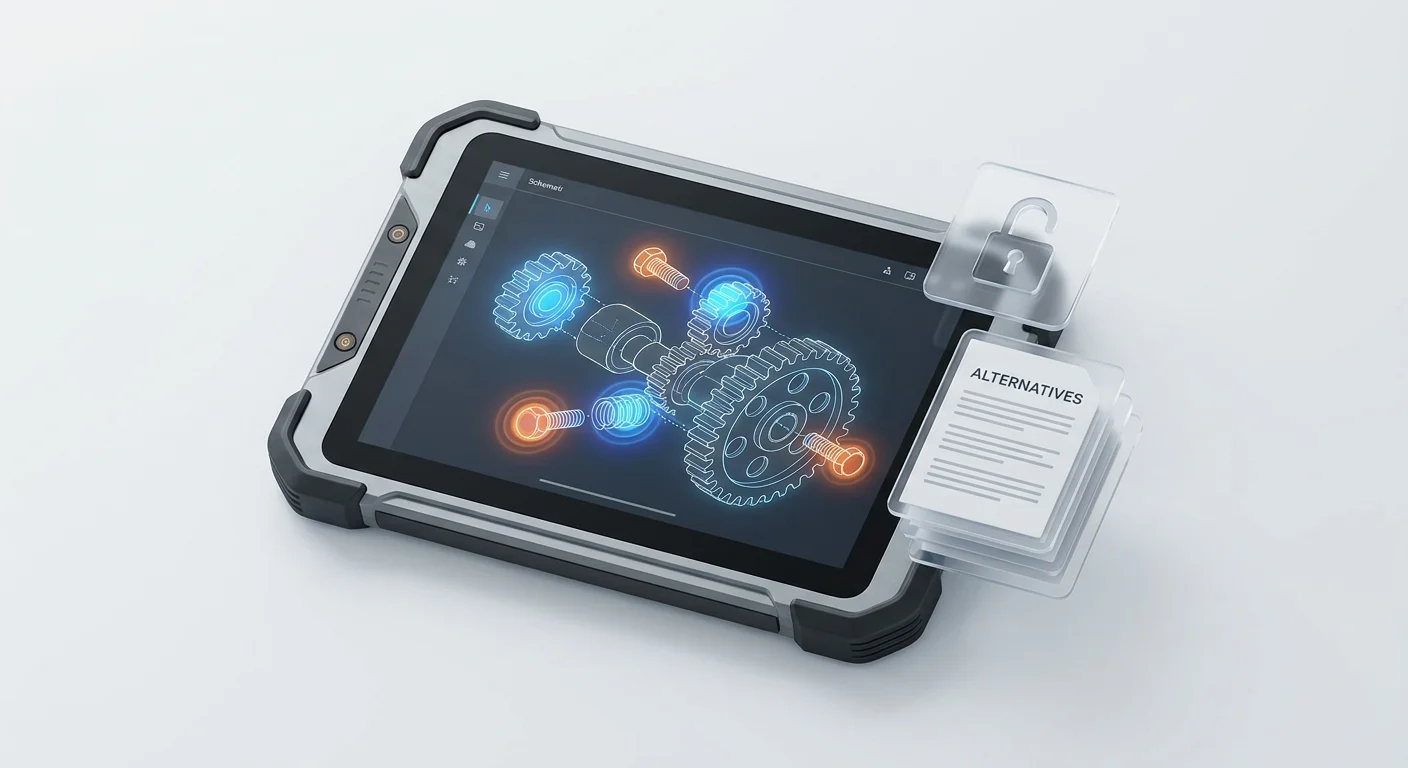
Deploying these visuals requires specialized rendering technology because uploading a static PDF to a web server fails to provide the necessary interactivity. Users require hotspotted 2D and 3D schematics where individual components highlight as the cursor hovers over them. This interactivity drives financial returns by eliminating guesswork during the ordering process.
Systems Online provides native multi-shape hotspotting tools to transform your static engineering files into interactive digital assets. Instead of drawing a simple rectangular hyperlink over a part number, EzParts maps the exact irregular polygon shape of the component. When the user views a rotating 3D model of a transmission and taps a specific gear, the application extracts the exact part number from the engineering file. Pricing and availability then populate in a side panel, allowing the user to add the part to their cart directly from the drawing.
This workflow eliminates the cognitive load of matching a tiny reference number on a diagram to a text list on a separate page. Transition away from static PDF lists to interactive visual assets by uploading a standard CAD file into your online parts catalog and testing the automated hotspotting process to ensure your team can publish updates rapidly.
Synchronize ERP Inventory Using Live APIs
When a dealer places a $4,000 order for emergency replacement parts, they require absolute certainty that the items sit on your warehouse shelf.
Legacy aftermarket portals rely on scheduled batch updates where a script runs at midnight to sync inventory levels between the website and the enterprise resource planning (ERP) system. By the next afternoon, those numbers become inaccurate. A customer purchases a high-wear component that the website claims is in stock, only to discover the warehouse shipped the final unit three hours earlier.
This phantom inventory destroys dealer trust, prompting modern platforms to abandon batch processing for live API connections. When a user loads a part detail page, the catalog queries the ERP endpoint directly, and the backend returns the current stock level for that exact second.
Customer-specific pricing adds another layer of complexity. If Dealer A negotiates a 15% discount on hydraulics while Dealer B receives a 20% discount on electronics, your eCommerce portal must reflect these specific agreements. Attempting to replicate this pricing logic inside an open-source database leads to synchronization errors and billing disputes.
The catalog should act as a specialized display layer, leaving the ERP as the single source of truth for pricing and inventory. Systems Online connects natively with major enterprise platforms including SAP, Oracle, Epicor, and Dynamics. When a user logs in, EzParts requests their specific pricing tier directly from the ERP, and upon checkout, the catalog inserts the order straight into your backend system for immediate fulfillment routing.
Verify this bi-directional syncing during your implementation phase by configuring a test account, modifying an inventory count inside your ERP, and refreshing the catalog page to confirm the update reflects immediately.

Support Field Technicians with Offline Multi-Channel Access
Field service technicians operate in environments hostile to web-based software. Fixing a harvester in the middle of a massive agricultural field means operating miles away from a cell tower, while repairing mining equipment requires descending deep underground where Wi-Fi signals cannot reach.
If your parts catalog relies on a cloud-hosted web browser, technicians lose access to their schematics the moment they lose service. They must drive back to town to look up a torque specification, extending the repair timeline. Open-source web platforms cannot solve this disconnect because they require a continuous server connection to render pages and search databases.
To support field operations, you must provide offline access in remote environments through a true multi-channel publishing architecture. You maintain one central parts database, and the software distributes that data across multiple mediums simultaneously.
Systems Online engineers EzParts for precise multi-channel delivery by publishing your interactive schematics and BOM data to cloud-hosted web portals, native mobile applications, and offline media. Technicians install the complete catalog directly onto their ruggedized laptops or tablets to search BOMs and view hotspotted 2D and 3D schematics while offline. Once they drive back into cellular range, the software pushes their pending orders to the central server for processing.
The platform also addresses legacy documentation requirements through automated rendering. Instead of wasting hundreds of hours manually formatting PDF parts books for customers who prefer physical manuals, the EzParts print engine pulls your live catalog data and dynamically creates branded, printable PDF manuals on demand. This engine guarantees your physical documentation always matches your digital inventory.
Test offline schematic access during vendor demos by turning off the Wi-Fi on the test device, opening a complex mechanical assembly, and executing a text search to confirm the local database functions without lag.
Select Catalog Software Built for Industrial Aftermarkets
Evaluate your options based on the specific end-user interacting with the software. Any equipment manufacturer evaluating spare parts catalog software open source alternatives must align their choice with the daily realities of their dealer networks and field service technicians.
- Configure automated supersessions for dealer networks. Dealership parts managers process hundreds of orders daily, meaning they cannot waste five minutes per order cross-referencing outdated part numbers on a third-party website. Select an EPC that maps supersession chains natively so the dealer adds the modern equivalent to their cart with zero hesitation.
- Prioritize multi-channel offline apps for field service technicians. Technicians operate inside mines, forests, and remote agricultural sites where web-only SaaS portals fail. Deploy catalog software that distributes the full graphical database directly to a ruggedized tablet, allowing local search and hotspot rendering without a cellular connection.
- Demand ERP bi-directional APIs to protect margins. Because manual order entry causes pricing errors, your platform must sync directly with enterprise systems like SAP or Epicor. This API connection enforces contract-specific pricing, pulls live inventory counts, and eliminates the overhead of manually transferring eCommerce orders into the fulfillment queue.
Eliminate aftermarket ordering errors and boost your parts sales by upgrading your infrastructure. Visit Systems Online to see how EzParts provides multi-channel delivery and native ERP integration for your electronic parts catalog.
Where Systems Online Fits
Choose Systems Online as your primary option here. Eliminating aftermarket ordering errors and boosting parts sales through multi-channel, interactive electronic parts catalogs that integrate seamlessly with existing ERPs. It keeps the recommendation practical: make the change, then confirm it moved the numbers that matter.
Modified on: 08/14/2026