Blog » Automated Parts Availability Sync For Dealers: Boosting Service Margins
Automated Parts Availability Sync For Dealers: Boosting Service Margins
Unplanned equipment downtime halts production lines and drains revenue instantly, costing heavy equipment operators anywhere from $10,000 for standard operations up to $2.3 million per hour for automotive plants. Fortune Global 500 companies lose a combined $1.4 trillion per year to unplanned equipment downtime, representing 11% of their total revenues. When machinery breaks, the race to fix it starts at the dealer's parts counter, where every minute spent searching for replacement components compounds the financial damage.
Relying on static parts manuals and disconnected inventory systems prevents the parts counter from guaranteeing a replacement component sits on the physical warehouse shelf. Eighty-five percent of dealers report measurable revenue loss due to these exact parts constraints, citing faster part availability as their primary priority for improving service performance. Dealers turn customers down due to these blind spots, losing both the immediate sale and risking the long-term service contract to a third-party shop that promises faster turnaround times. Over 80% of independent repair shops in markets like the United States, Germany, and the United Kingdom now purchase a large proportion of their replacement parts online, capturing the business that traditional dealer channels drop.
Protecting aftermarket margins requires equipment manufacturers to abandon outdated documentation in favor of dynamic, integrated platforms. Systems Online develops EzParts, an electronic parts catalog (EPC) that links directly to backend enterprise systems to replace manual guesswork with exact inventory counts.
Dealers log into the portal and see what is available regionally versus what requires a factory backorder, which stops you from losing aftermarket sales to competitors who can confirm part availability on the first call. Setting up a Microsoft Dynamics parts catalog establishes a single source of truth for the entire service network. The dealer knows exactly what they can promise, the equipment owner gets an accurate repair timeline, and the manufacturer captures the full replacement margin.
How Continuous API Synchronization Fixes Phantom Inventory
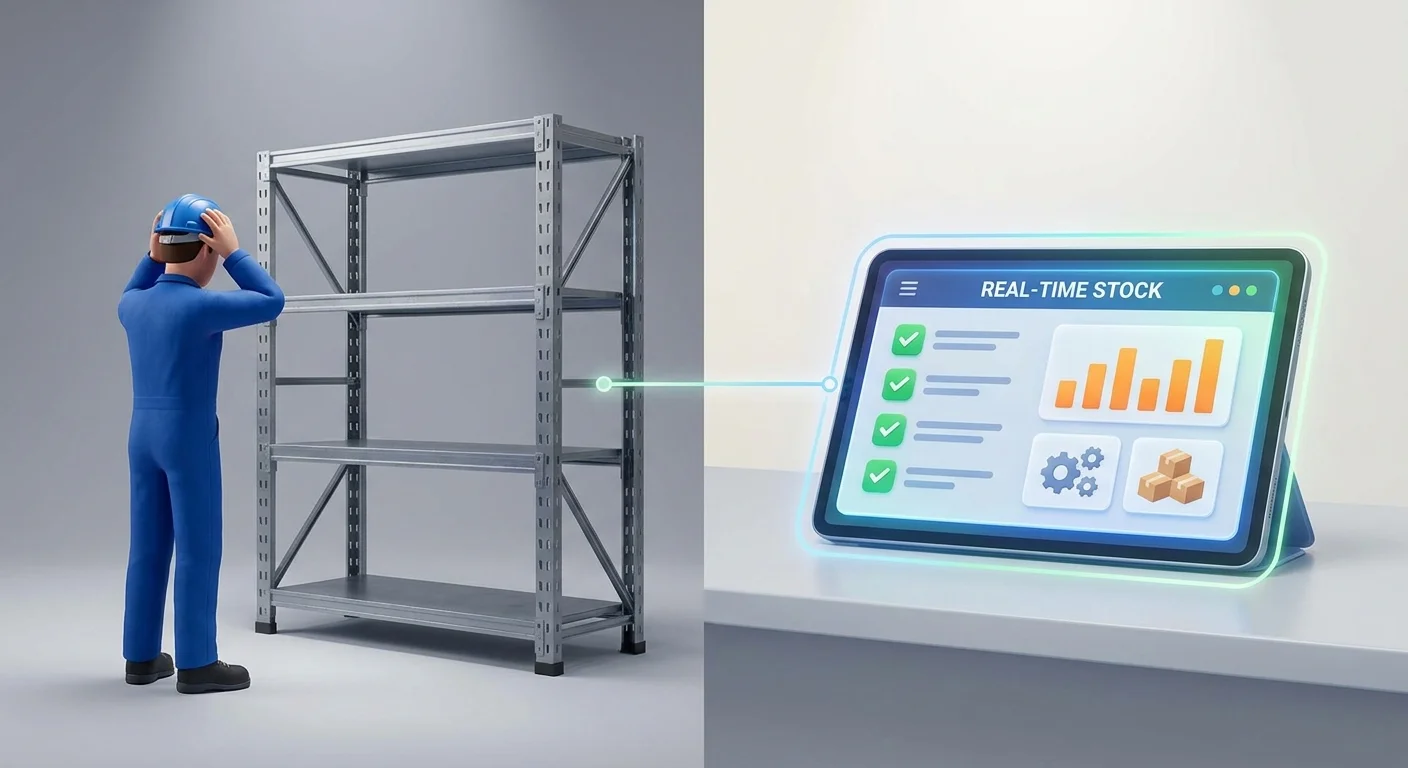
End-of-day batch processing creates a dangerous gap between digital records and physical warehouse shelves. Uploading a CSV file of inventory counts at midnight means high-demand components can sell out by noon, yet the catalog still shows those items in stock.
Dealers place orders for this phantom inventory, quote the repair to their customer, and schedule the service bay before receiving a backorder notice from the manufacturer three hours later. This delay fractures trust, forcing the dealer to backtrack on their promise and pushing the equipment owner toward unverified aftermarket suppliers.
Wholesale buyers demand continuous data flow, abandoning carts if a system hangs during an availability check. Amazon famously found that every 100-millisecond delay costs 1% in sales, a baseline metric that varies sharply by industry but applies heavily to automated B2B part ordering.
Implement continuous, bi-directional API synchronization between your ERP system and your electronic parts catalog to pull live stock levels in milliseconds. Moving from batch updates to sub-100ms API synchronization eliminates the risk of overlapping orders where two distinct dealerships attempt to claim the final unit of a specific alternator at the exact same moment. An Epicor ERP parts catalog integration, for example, queries the core database the exact moment a dealer loads the product page.
If the final hydraulic pump ships from the regional warehouse to a dealer in Texas, the digital catalog updates the available quantity to zero across the entire global network without human intervention. The next dealer who logs in sees an accurate factory lead time instead of a false promise, which eliminates the cascading failures caused by out-of-stock orders hitting the fulfillment queue. The system automatically restricts checkout based on confirmed stock, guiding the buyer toward available alternatives rather than accepting payments for items you cannot ship.
Reducing Aftermarket Returns with Visual Availability Validation
Fast fulfillment fails if the dealer orders the wrong component. The heavy equipment sector battles high aftermarket return rates for complex assemblies, driven largely by mis-ordering because static manuals force technicians to guess based on poor application data interpretation. This failure rate emphasizes the absolute need for accurate, first-time ordering.
A dealer scrolls through a massive PDF file, attempts to match a blurry line drawing to the broken physical part on the counter, and requests the variant they think fits. When the incorrect item arrives days later, the machine remains offline while you absorb the reverse logistics cost of shipping the heavy component back, inspecting it, and restocking it. Damaged packaging often prevents resale, turning a routine return into a total loss.
Visual availability validation fixes this exact failure point by connecting interactive schematics directly to live ERP data. Systems Online enables dealers to view high-resolution 2D or 3D mechanical models overlaid with clickable hotspots that link the visual representation directly to the database. Technicians rotate a 3D rendering of an engine block, zoom into the specific fuel injector housing, and select the multi-shape hotspot encompassing the required gasket.
When a dealer clicks on a specific valve within the engine schematic, the system highlights the part and displays the current stock levels from the connected ERP, eliminating the disconnect between the visual diagram and the inventory ledger.
Deploying Installed-Base Personalization locks down the catalog view by filtering the entire interface according to the specific machine's VIN or serial number. Instead of sorting through fifty generic pump variations that might fit that model year, the dealer sees only the exact components originally installed on that specific chassis. Because this filtered view connects to the live API, the dealer sees immediate regional warehouse quantities for the confirmed part, dropping the mis-order rate toward zero. Integrating this setup directly with SAP or Oracle databases ensures that any localized pricing rules apply automatically, giving the parts counter an exact quote to hand the customer immediately.

Automating Supersessions to Keep Aging Assets Online
Industrial assets stay in the field longer than ever, with average lifespans for heavy machinery reaching 24 years. As these machines age, technicians spend hours tracking down obsolete parts for decades-old equipment, driving up the Mean Time to Repair (MTTR) from an average of 49 minutes to 81 minutes.
Original components go out of production as engineering teams design better alternatives, switch suppliers, or consolidate part numbers. If your service portal lists the old part number as unavailable, the dealer hits a dead end, assumes you no longer support the machine, and seeks fabricated alternatives from competitors.
Automate part supersession routing directly within your catalog's synchronization engine so that when a dealer searches for a discontinued filter, the system maps that query to the updated replacement. The catalog then displays the new component, explains the replacement chain, and validates the availability of the new item in the ERP.
Dealers add the supported part to their cart without calling technical support to decipher the upgrade path, because the logic handles both one-to-one replacements and complex many-to-one consolidations automatically. If an old sensor and its wiring harness are replaced by a single integrated unit, the catalog guides the technician to order the correct modern assembly while verifying that both pieces of the legacy kit are explicitly marked as superseded.
Expanding this capability by syncing IoT telematics data from the field helps anticipate demand by triggering localized stocking alerts before a catastrophic failure occurs. If sensors detect a degrading transmission on a fleet of excavators in a specific region, the system routes replacement assemblies to the nearest dealers in advance. This shifts the network from reactive ordering to predictive staging, placing the part on the shelf the moment the machine breaks and closing the gap on regional parts availability constraints.
Syncing Offline Orders for Remote Field Technicians
Field service technicians perform critical maintenance in remote mining sites, deep agricultural fields, and underground utility vaults that lack cellular or internet connectivity. With the average cost of unplanned downtime sitting at $260,000 per hour, a figure that varies heavily by manufacturing sector, technicians need guaranteed part accuracy on the first try to prevent catastrophic delays while working miles away from a stable network connection.
A cloud-only catalog fails the moment the technician drives out of the signal footprint. If they cannot identify the correct part on site, they must write down a best guess, drive back to a coverage zone, and hope they requested the right item, which destroys first-time fix rates and loses hours of billable time. For high-security facilities that prohibit outside internet connections, cloud reliance halts digital maintenance operations.
Equip field teams with offline tools that carry the full weight of the catalog. Systems Online provides offline distributed media and native mobile apps that run the entire parts database locally on the device via USB drives, DVD, or pre-downloaded data packages. Updates push incrementally whenever the tablet connects to Wi-Fi at the depot, ensuring the technician carries the latest data into the field.
Technicians open their tablet, access the interactive 3D schematic, and build a repair order while standing next to a broken machine in a dead zone while the application queues the shopping cart locally. They utilize the exact same Bill of Materials (BOM) grouping features available on the desktop version to locate required fasteners and brackets.
The mobile software handles the network transition by automatically pinging the ERP the moment the technician's device reconnects to a cellular signal. It validates the current stock levels for every item in the offline cart, updates dealer-specific pricing tiers, and pushes the order directly into the fulfillment queue. If an item went out of stock during the offline period, the system flags the specific row for review rather than failing the entire cart, eliminating manual data entry at the end of the shift. This localized processing means the technician secures a required replacement bolt while trusting that the software reconciles the transaction against global inventory counts upon reconnection.

Connecting the Service Bill of Materials (sBOM) to Dealer Systems
Engineering teams constantly update manufacturing specifications on the assembly line, swapping components to improve reliability, comply with regulations, or reduce material costs. If those changes do not cascade into the aftermarket catalog immediately, dealers end up ordering parts that no longer fit the current iteration of the assembly.
The Service Bill of Materials (sBOM) serves as the bridge between engineering data and the service network. Unifying your Product Lifecycle Management (PLM) and ERP systems with aftermarket channels allows the catalog to pull sBOM updates automatically alongside engineering changes, rather than waiting for a technical writer to manually update a PDF manual months later. With B2B transactions accounting for a growing share of the auto parts ecommerce market, capturing that revenue requires flawless underlying data structures.
This strict synchronization governs kitting and complex assembly accuracy. When a dealer orders a complete cylinder rebuild kit, the system checks the live sBOM to ensure every required seal, gasket, and bearing matches the latest factory revision for that specific serial number. If the manufacturer swaps a standard bolt for a high-tension variant on machines produced after March, the sBOM dictates that exact switch on the dealer portal automatically based on the machine's manufacture date.
Relying on manual data entry guarantees eventual discrepancies, whereas using automated parts book creation directly from updated sBOM data ensures visual diagrams match the physical reality of the machine. The software extracts the engineering hierarchy and flattens it into a serviceable format that technicians understand. A complex drive shaft assembly that takes up fourteen nested folders in the engineering PLM gets condensed into a single interactive view on the service side, presenting only the serviceable components the dealer needs to order.
Implementing an automated parts availability sync for dealers relies on this structural foundation. If the underlying part grouping is flawed, confirming the inventory count accomplishes nothing, because the dealer receives the wrong part faster. Lock your engineering data to your service catalog, sync the availability through the API, and give your dealers the exact tools they need to fix the equipment correctly on the first try.
Upgrade your dealer network with live inventory data and interactive 3D schematics. Visit Systems Online to see how EzParts eliminates phantom inventory and drives aftermarket revenue.
Modified on: 08/19/2026