Blog » Best GenAlpha Equip Alternative for OEMs in 2026
Best GenAlpha Equip Alternative for OEMs in 2026
Unplanned equipment downtime costs Fortune Global 500 companies a combined $1.5 trillion annually, representing 11 percent of their total revenues. When a field technician needs a replacement hydraulic valve to get a downed haul truck moving, an electronic parts catalog (EPC) that fails to load compounds the financial loss of unplanned downtime. For a large mining operation, that stalled asset burns between $5,000 and $10,000 per hour. Other sectors face even steeper penalties, with automotive plants exceeding $2.3 million per hour and construction site delays averaging $2,000 to $10,000 per day. Buyers rarely start the repair process by calling a dealership, so they open a digital interface, type in a serial number, and expect an exact schematic of their equipment. Over 90 percent of buyers conduct online research before purchasing, and 56 percent of aftermarket parts purchases now begin with an online search or digital catalog interaction. If the software displays the wrong variation or requires cellular service in a dead zone, the repair stops. Equipment manufacturers require software that handles complex schematic logic, integrates directly with back-office inventory, and functions entirely offline. Systems Online developed EzParts specifically for these conditions, establishing it as a reliable GenAlpha Equip alternative for OEMs digitizing their parts manuals to eliminate costly ordering errors.
Evaluating a GenAlpha Equip Alternative for Offline Field Connectivity
Standard B2B eCommerce platforms assume constant internet connectivity, operating on cloud architecture that serves pages dynamically from a centralized server. While this model works well when a technician sits in a climate-controlled dealership, standard cloud portals fail the moment that same technician drives three hours into an underground mine or a remote agricultural tract. Schematics refuse to load and search functions time out, forcing the mechanic to guess part numbers from memory.
Because cloud-only dependency becomes a liability in heavy equipment sectors, manufacturers need a catalog delivery framework that places the entire interactive database directly onto the technician's device. Offline distributed media solves this exact vulnerability by utilizing encrypted USB drives, SD cards, or native mobile applications tailored for deep rural environments lacking cellular service.
Simultaneously, dealer networks expect precise, localized data to capture their share of a rapidly expanding aftermarket. The global e-commerce automotive aftermarket reached $88.82 billion in 2025 and is projected to expand at a 20.5 percent compound annual growth rate through 2034. Yet many legacy portal deployments still rely on manual CSV batch uploads to update pricing and inventory. By Tuesday, import duties, localized warehouse logistics, and currency fluctuations render Friday's static data obsolete, causing dealers to quote incorrect prices and place orders for out-of-stock items. Modernizing the dealer network requires moving away from batch uploads to establish direct API data streams that pull real-time figures from the ERP, ensuring your network capitalizes on B2B channel shifts without introducing pricing liabilities.

EzParts vs. GenAlpha Equip: A Head-to-Head Comparison
Choosing the right catalog software dictates how effectively your dealer network and field technicians order parts. Both platforms convert 2D and 3D CAD data into digital storefronts, but they differ sharply in deployment architecture, rendering precision, and offline functionality.
| Feature | GenAlpha Equip | Systems Online EzParts |
|---|---|---|
| Primary Deployment Architecture | Cloud Software as a Service (AWS or Azure) prioritizing browser-based portal delivery | Cloud SaaS, On-Premise Enterprise, and Encrypted Offline Media (USB/SD deployments) |
| Offline Capabilities | Browser caching restricted to previously viewed pages with active internet required for checkout | Full encrypted untethered database with interactive 3D schematics and offline cart queuing |
| Static Document Generation | Standard portal page web browser exports requiring manual layout adjustments | Dynamic automated branded PDF print engine bypassing manual technical writing formats |
| ERP Data Synchronization | Scheduled CSV batch imports or standard API endpoints requiring custom integration logic | Native live API stream incorporating localized pricing and complex automated supersession logic |
| Schematic Hotspot Mapping | Standard rectangular bounding boxes for basic numeric callouts | Multi-shape precise polygonal geometry matching complex part contours visually |
GenAlpha Equip
GenAlpha Equip provides a cloud-based B2B eCommerce environment designed to modernize equipment manufacturing sales. The platform gives dealers a consumer-style shopping cart experience backed by 2D and 3D visual part identification.
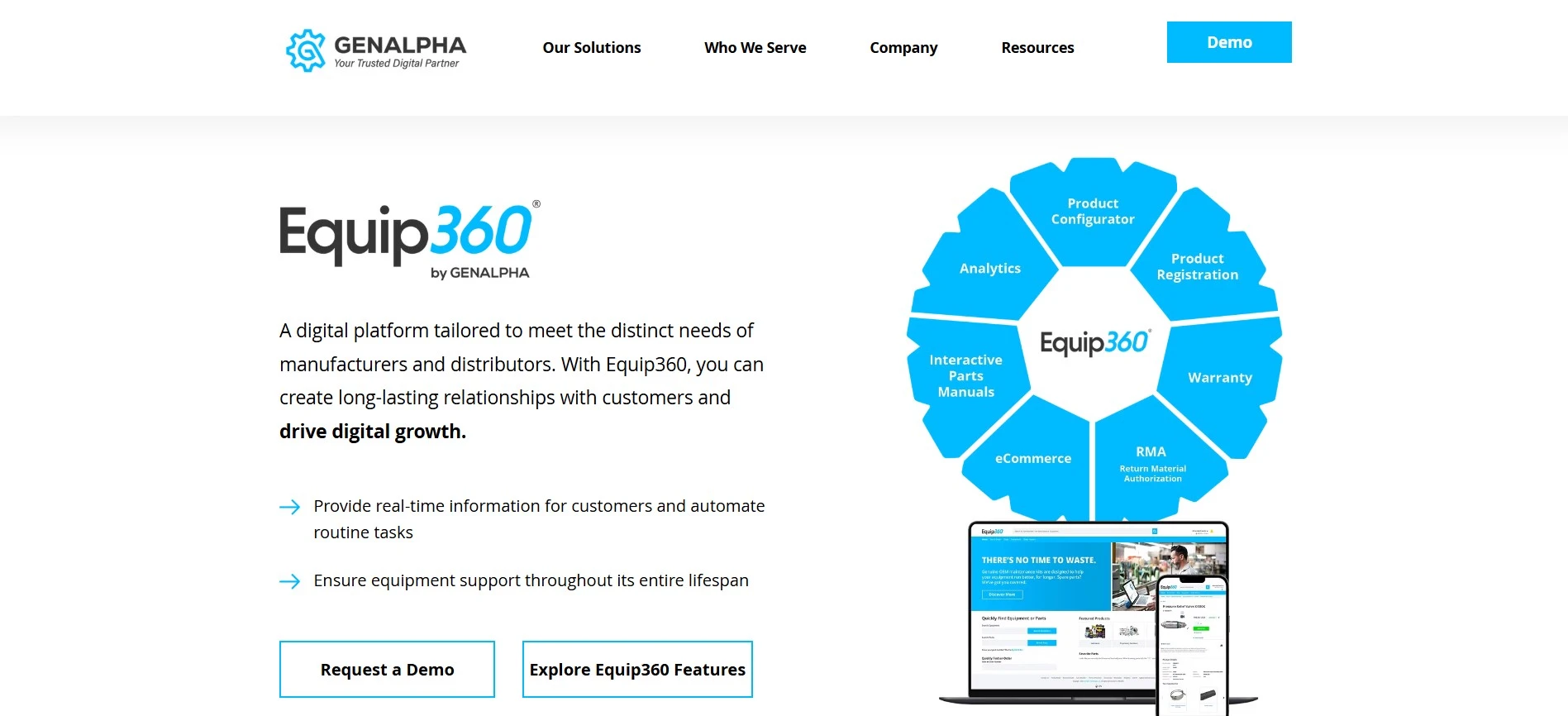
This software performs well for organizations prioritizing a unified online storefront in environments with stable web access, as it centralizes product documentation and replaces legacy PDF viewing with structured bill of materials (BOM) navigation. However, because the system relies on standard cloud architecture, field service operations occurring outside of cellular range cannot access the interactive catalog or build accurate orders on site. You must also manually format static parts books if you face strict local regulatory requirements, because the platform favors web deployment over dynamic print generation. For manufacturers servicing complex machinery in remote construction zones or deep mining pits, relying entirely on a cloud portal introduces substantial operational risk.
Systems Online EzParts
EzParts functions as a multi-channel delivery framework engineered specifically for whole goods manufacturers handling highly complex aftermarket structures and strict compliance requirements.
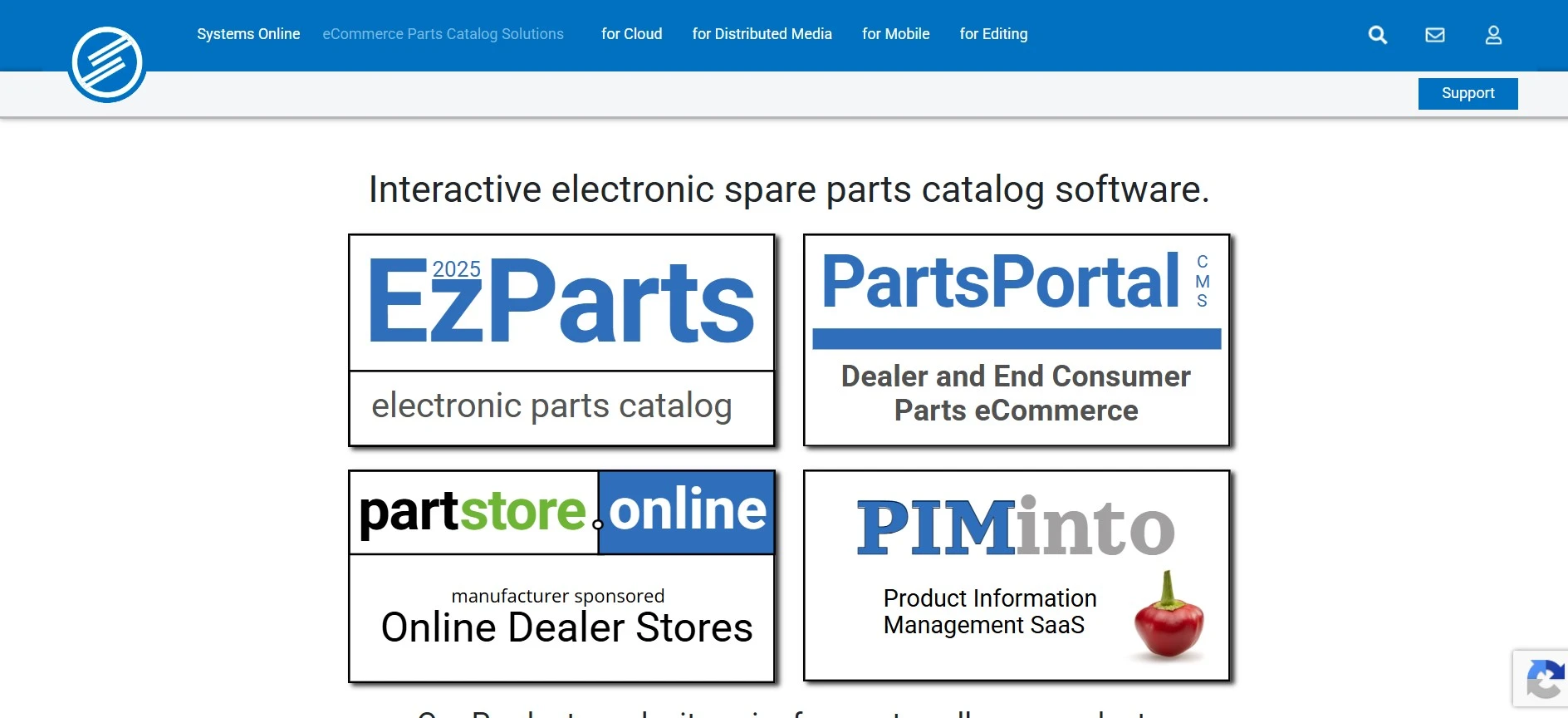
The system natively supports media-based electronic parts catalog software deployments, allowing you to distribute fully functional, encrypted catalogs via USB or SD card to remote technicians. Despite the push for digital portals, many buyers still request static documentation for regulatory or local site reasons. A specialized print engine dynamically generates up-to-date, branded PDF parts books straight from the master database to save technical writing teams hundreds of manual formatting hours. EzParts also handles advanced catalog requirements, such as one-to-many supersession chains and localized ERP pricing rules, without requiring custom development from your IT department.
The Verdict
Choose Systems Online EzParts if your equipment operates in remote environments, you maintain a complex dealer network requiring live ERP integration, or you need to generate compliant offline parts books automatically. Untethered access and polygonal hotspot precision directly address the offline constraints of heavy equipment repair.
Choose GenAlpha Equip if your buyers are primarily desktop-bound distributors with reliable internet access seeking to migrate a basic parts list into a cloud-only web storefront.
When evaluating Documoto alternatives or comparing other catalog platforms, base your decision on the physical environment where the field technicians perform the repair work.

Slashing High Return Rates with Visual Precision
The return rate for incorrect components remains high across heavy equipment sectors, a figure that fluctuates depending on assembly complexity. This failure rate stems primarily from mis-ordering and poor application data interpretation associated with flat PDFs and legacy paper manuals. When technicians misinterpret flat PDFs or guess at overlapping lines in a paper manual, they order the wrong assembly. This reverse logistics pipeline erodes profit margins through secondary freight charges and damaged customer trust.
Implement multi-shape polygonal hotspots on your schematics to correct this visual confusion and guide the buyer to the exact component. Standard electronic catalogs draw a simple rectangular bounding box over a callout number, causing those boundaries to overlap if two parts sit close together on a dense hydraulic schematic. When a user clicks the edge of a gasket, they accidentally add the neighboring valve to their cart.
EzParts allows catalog administrators to trace precise polygonal shapes around the exact contours of a part, such as the irregular curve of a manifold or the specific threading of a fastener. When a non-technical equipment owner clicks that customized visual representation on the screen, they select the correct item. Digital parts sites that implement comprehensive Year-Make-Model or serial-based search filtering alongside exact visual selection see higher conversion rates than those with basic search functionality.
To drive upsells and prevent incomplete repairs, configure your catalog to display automatic kit components by setting a logic rule that links a parent item to required maintenance kits. When a dealer adds a fuel pump to their cart, the system displays the required O-rings, mounting gaskets, and specific fasteners needed for the installation. Selling the complete sub-assembly increases your average order value while preventing the technician from halting a repair midway due to missing secondary components.
Automating Live API-Driven ERP Connectivity for Dealer Networks
Dealer networks rely entirely on the accuracy of the data you provide, meaning that if an independent dealership misquotes a repair timeline because your catalog showed a discontinued part as available, that dealer absorbs the customer's frustration.
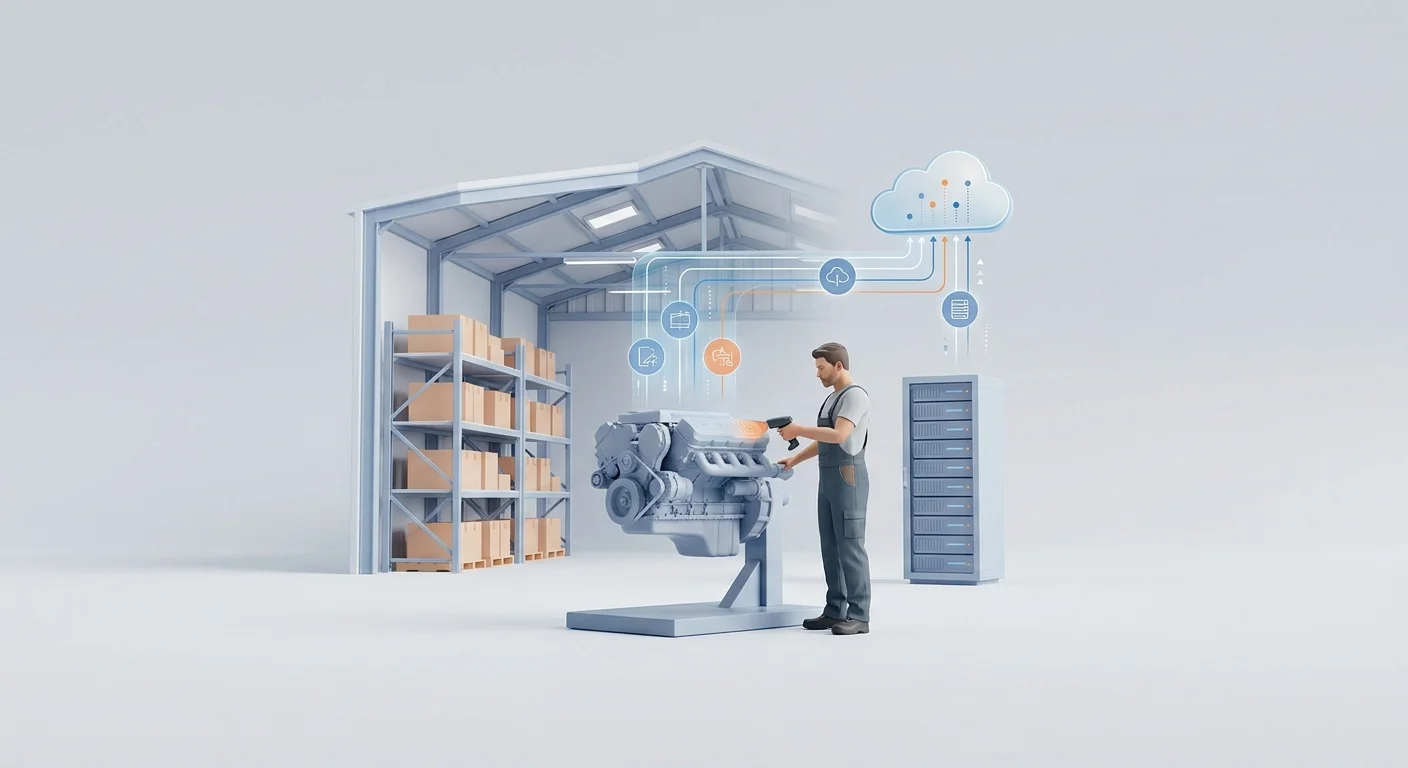
Eliminate this friction by automating parts catalog imports through direct API connections between the EPC and backend ERP systems like SAP, Oracle, Epicor, or Dynamics.
Configure the API payload to pull localized pricing tiers, regional inventory flags, and supersession routing parameters in real time. Manufacturers frequently upgrade components to resolve engineering flaws, causing older part numbers to become obsolete and leaving dealers with static catalogs to order dead-end parts that the warehouse rejects.
Set up automated supersession routing within the catalog administrator dashboard by mapping the discontinued part number directly to the active replacement part ID within the ERP. When a dealer searches for the obsolete component, the software intercepts the query and redirects them to the new active part with an alert that the item has been superseded. This configuration eliminates manual cross-referencing, prevents dead-end searches, and reduces cart abandonment across the entire distribution channel.
Adopting this live API stream model ensures that localized warehouse logistics, import duties, and daily currency fluctuations display accurately at the dealer level, removing the liability of outdated batch data.
Field Technician Workflows: Offline Cart Queuing
A technician standing in an open pit mine cannot pause a repair to search for a wireless network, requiring catalog software that operates entirely on local device caching. With average industrial manufacturing downtime costing $260,000 per hour, a figure that varies by sector, waiting for connectivity inflates operational losses.
Deploy untethered native mobile applications or distributed media on encrypted field laptops to ensure the entire database, including the high-resolution 3D schematics, interactive BOMs, and serial-specific search filters, resides on the local storage drive. The technician opens the application, types in the machine's specific serial number, and views the exact configuration that rolled off the assembly line without an internet connection.
After using the interactive schematic to identify failed components and build a Bill of Materials on site, field teams add these items to an offline cart queue. The software logs the transaction locally by recording the requested part IDs, the equipment serial number, and a timestamp.
Configure the automatic ERP synchronization logic to run a background ping check on the mobile hardware. The moment the technician's ruggedized tablet or laptop reconnects to a stable cellular network, the software detects the connection, encrypts the queued payload, and pushes the logged transaction directly into the ERP. The warehouse receives the order immediately and stages the replacement parts for shipping before the technician returns to the regional depot. This offline-to-online sync workflow reduces total equipment downtime and ensures field diagnoses convert directly into accurate aftermarket orders.
Digitizing your parts catalog requires deploying software that handles complex schematic mapping, syncs directly with the ERP, and functions in the field without an internet connection. To see how multi-channel EPC delivery reduces ordering errors and increases aftermarket revenue, explore the solutions at Systems Online.
Modified on: 08/11/2026