Blog » Headless Ecommerce for Manufacturing: An OEM Guide
Headless Ecommerce for Manufacturing: An OEM Guide
Finding the correct replacement part dictates whether heavy equipment returns to work or sits idle. A field service technician standing next to a downed excavator usually starts with a machine serial number or a visual assembly diagram. If the technician types that serial number into an aftermarket portal and the platform cannot parse the machine's specific configuration, the search fails. Standard retail templates can force equipment manufacturers to compromise on this buyer journey, which can lead to costly ordering errors and more support calls.
Headless ecommerce for manufacturing offers an architectural alternative by separating the visual interface from the back-end commerce engine. This separation gives organizations more control over how buyers interact with the catalog, allowing developers to design a search and purchasing workflow that matches how technicians operate in the field.
That flexibility introduces significant technical complexity. Before committing engineering resources to a custom build, OEMs need to evaluate whether their workflow requires a decoupled architecture or whether a dedicated electronic parts catalog (EPC) like Systems Online's EzParts would solve the underlying problem more effectively.
What Headless Ecommerce Means for Manufacturing
In a traditional monolithic commerce platform, the presentation layer, including the templates, styling, and HTML the user sees, is tightly bound to the database and checkout logic. Headless architecture decouples those layers, so the front end and back-end commerce services communicate through Application Programming Interfaces (APIs).
Because the front end is uncoupled, development teams can build distinct interfaces for multiple touchpoints. An organization might deploy a React-based web portal for direct customers, a dedicated dashboard for a dealer network, and a specialized application for mobile devices. A single commerce engine runs in the background, where it receives requests from each channel and returns the appropriate data.
This structural choice carries operational costs because a headless storefront requires building and hosting a separate frontend. Shopify's documentation on headless commerce notes that a headless storefront costs more to build and run than a theme and requires developers to maintain it after launch. Because headless separates the storefront frontend from its backend, organizations choose their stack and hosting and can connect other business systems, including an ERP.
Why OEM Parts Workflows May Outgrow a Standard Storefront
Selling aftermarket equipment parts involves different tasks than distributing finished retail goods. Standard B2B storefronts organize products into flat categories and handle keyword searches well, but they can struggle to map complex bills of materials (BOMs) to specific customer machines.
OEM parts workflows demand systems that understand equipment hierarchies. A technician needs to view an assembly, identify a specific component, and see whether that part belongs to a required kit. Users also require visibility into supersessions, where one part number replaces an older component across decades of deployed equipment. Buyers need to verify compatibility with a machine's serial number and review their negotiated dealer pricing before placing an order.
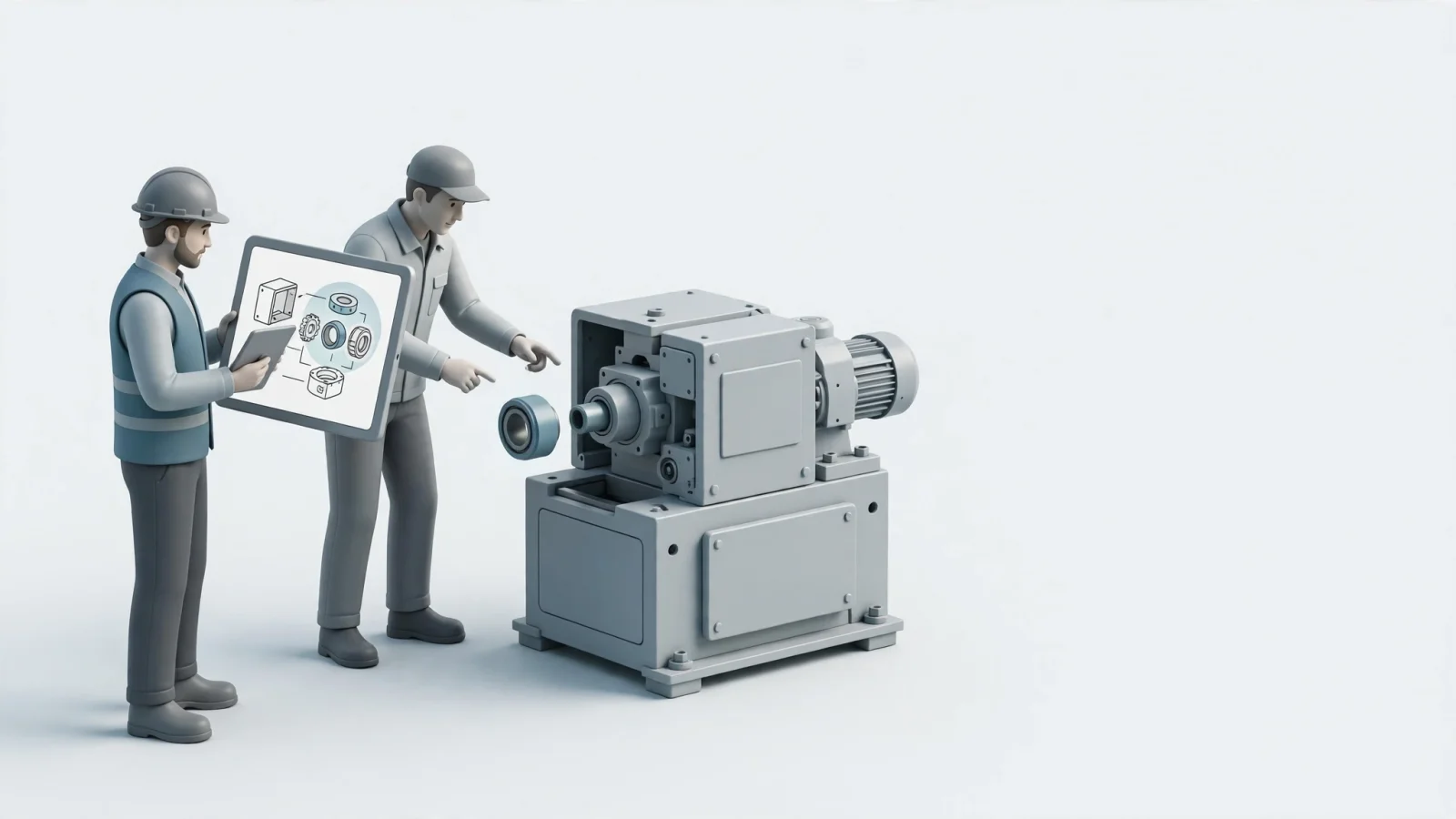
If the current platform cannot support these relationships natively, buyers face a fragmented process. A technician might look up a component in a static PDF manual, copy the part number, and paste it into a separate ordering portal, which can increase the likelihood of ordering the wrong item. Decoupling the architecture allows developers to build an interface that merges schematic discovery directly with the purchasing step.
Purpose-built EPC options, such as Systems Online's EzParts, offer a direct way to close this catalog gap by translating complex equipment data into an interactive buying experience. An EPC natively handles BOM relationships and interactive diagrams without requiring companies to engineer those capabilities into a custom front end. Assessing the workflow means deciding whether to reinvent the commerce interface or upgrade the tool buyers use to identify parts.
How a Headless Manufacturing Commerce Stack Works
A headless implementation relies on multiple distinct systems working together in real time. The architecture generally follows a specific flow of requests and data across different layers of the infrastructure.
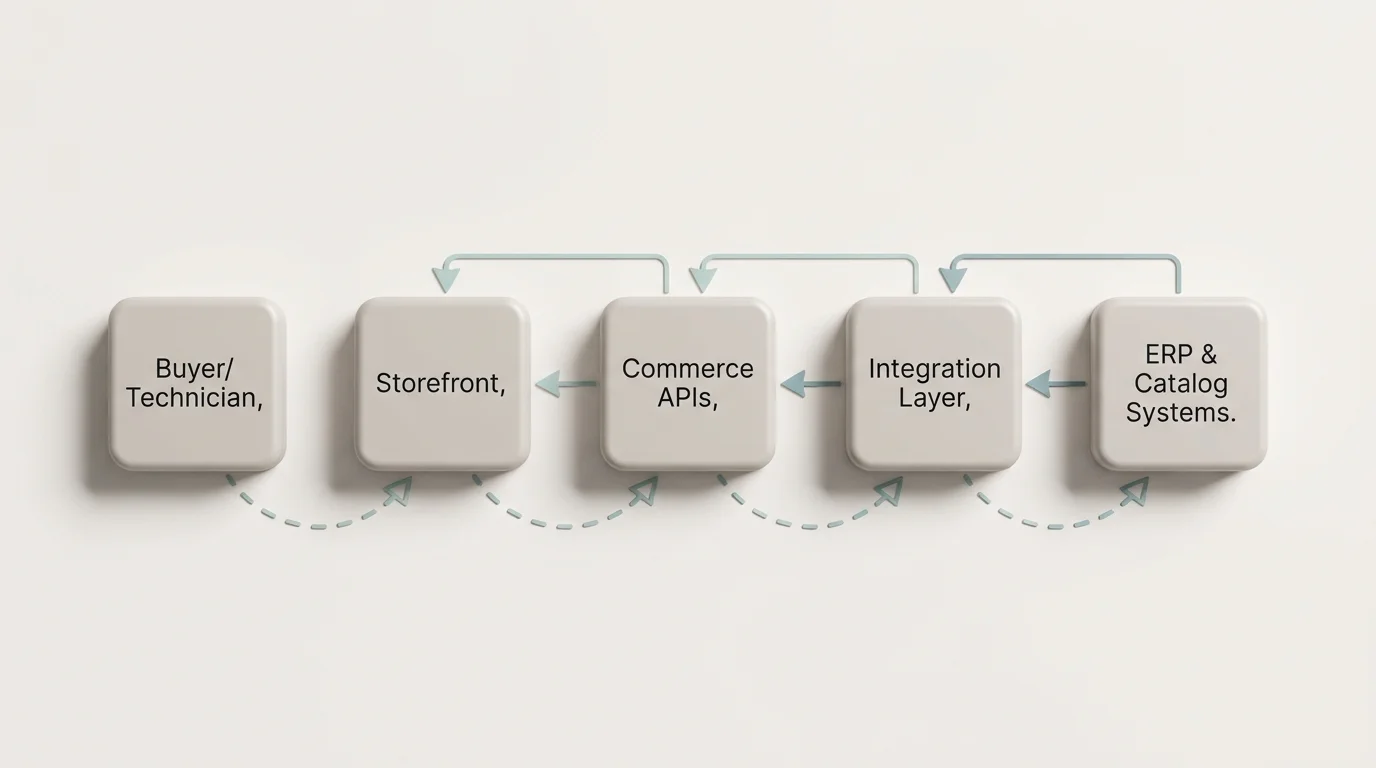
The buyer interacts exclusively with the custom storefront. When a user adds a part to a cart or requests a quote, the storefront sends that action via API to the commerce engine. The commerce engine processes the logic, while an integration layer typically connects the commerce services to the ERP and specialized catalog systems.
Assigning a clear system of record for each data type prevents conflicting information. Product descriptions and visual media might live in a product information management system or an EPC, whereas customer account details, pricing tiers, and inventory availability usually reside in the ERP. For example, SAP's B2B pricing integration documentation describes bringing prices from SAP ERP or SAP S/4HANA into SAP Commerce Cloud, where buyers can see them in search results, on product pages, and in the cart.
APIs only transmit the data they are asked to retrieve, meaning they do not guarantee fresh inventory numbers or synchronized catalogs on their own. System architects need to decide how the storefront behaves when the integration layer drops a connection or the ERP undergoes maintenance. If the storefront cannot fetch real-time availability, it might display cached inventory levels with a disclaimer, or it might accept orders subject to later confirmation. Designing a headless stack requires planning for these failure states before deploying the application.
What MHI's Parts-Purchasing Case Shows
A December 2023 technical review by Mitsubishi Heavy Industries (MHI) illustrates how specific search requirements drive architectural decisions. MHI decided not to adopt an ecommerce SaaS because its available features did not match all of the company's requirements, including flexible searches that reflect product categories unique to mechanical products.
To address this limitation, MHI adopted a decoupled design. The company connected its front end and back end through APIs and used a data integration platform to link the ecommerce environment with business-unit enterprise systems. The system offered model and unit filters, searches by part number, part name, model number, or keyword, and tools for quotes and orders. Buyers could track order status and review order history through the interface.
This case highlights a targeted response to a documented workflow limitation. MHI needed a specific integration model to bridge its commerce platform and varied enterprise systems. The report ties the design to the company's search and integration requirements. OEMs mapping complex enterprise systems can use the case as a reference, but should assess their own workflows before choosing a custom build.
What Headless Adds and What It Does Not
Choosing a decoupled architecture shifts more responsibility for the customer experience to the organization. Teams gain the freedom to design custom buying workflows, but they also take on the work of maintaining the infrastructure that delivers them. Two specific areas require careful planning before development begins.
Search Visibility Depends on Implementation
A common concern with custom JavaScript storefronts is that search engines may not index pages as expected. Google can render JavaScript, but developers need to follow its crawling and rendering guidance. Google's JavaScript SEO documentation notes that server-side or prerendering can improve speed for users and crawlers and explains how Google processes JavaScript pages through crawling, rendering, and indexing.
Public-facing parts pages need correct canonical URLs and meaningful HTTP status codes. If specific pricing or diagrams sit behind a dealer login, those pages should return a 401 status code to signal that Googlebot cannot access them without authentication. Together, these choices shape how Google crawls and indexes the pages.
Offline Access Requires Local Data and Synchronization
Field technicians frequently repair equipment in remote locations without cellular service or stable Wi-Fi. An API-based storefront that depends on live network requests cannot fetch uncached catalog data or submit network-dependent orders in a dead zone.
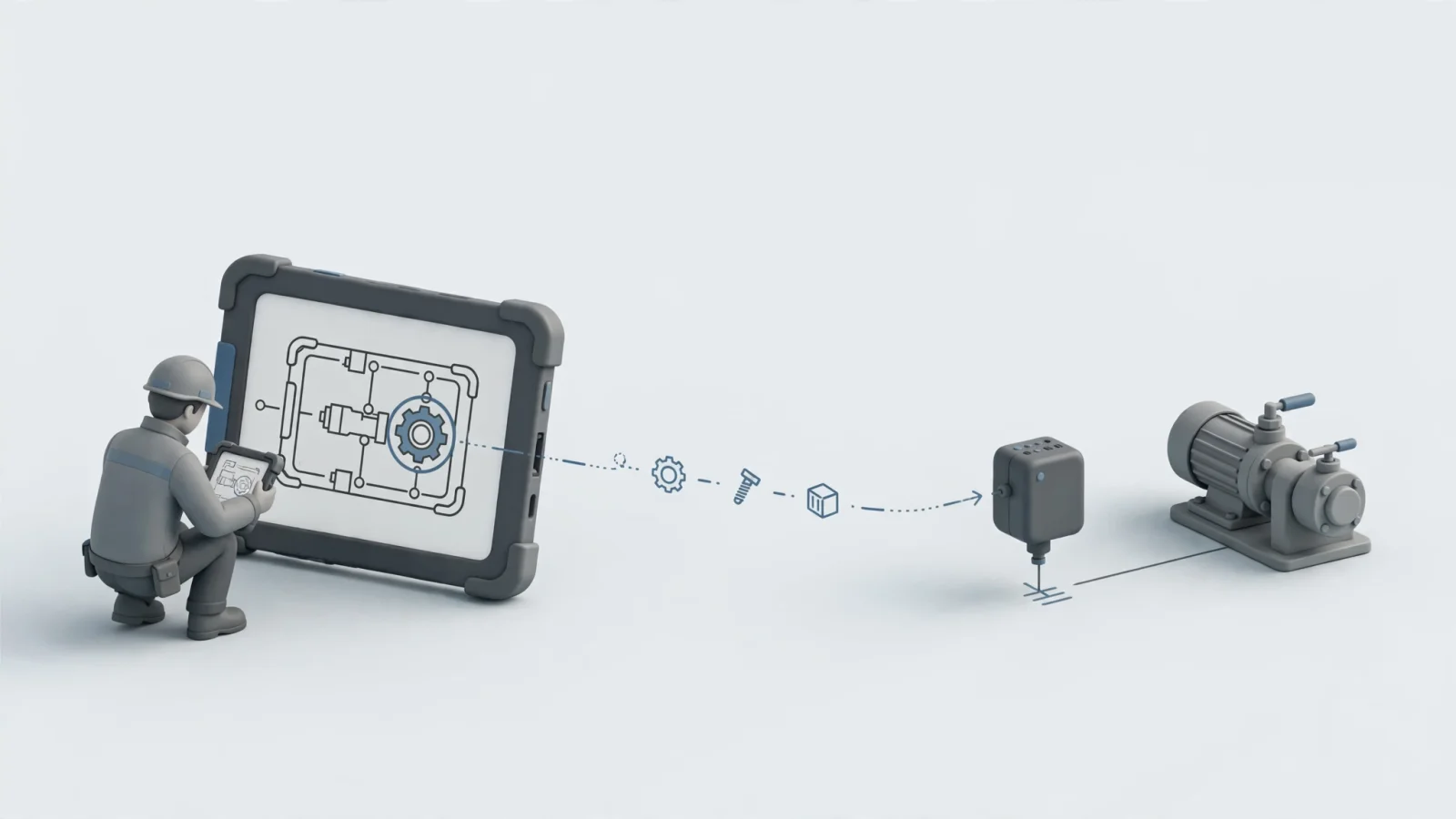
True offline capability requires the application to store data locally on the device. When connectivity drops, the application can use its local data so the technician can continue viewing schematics and identifying parts. Once the device reconnects to the network, the application can synchronize saved actions with the central system and resolve conflicts. Building this synchronization logic from scratch adds substantial engineering overhead to a project.
How to Decide Whether Headless Fits an OEM Workflow
The selected architecture should follow the workflows of the buyers, the state of the data, and the internal team's ability to maintain the software. An organization with clean ERP data and a large engineering team may assess a custom build differently from a manufacturer with a small IT staff.
When Headless Is Worth Evaluating
A custom front end makes sense when the current platform strictly prevents buyers from completing their tasks. If users need highly specialized search tools that off-the-shelf software cannot provide, decoupling the interface provides the space to build them.
This approach is worth evaluating when an organization operates multiple distinct sales channels. A single commerce engine can serve a web portal for direct customers, a separate dashboard for dealer networks, and a mobile app for technicians, reducing backend duplication. Evaluating this path requires a clear integration plan for product, account, pricing, and order data, along with the internal capacity to support the custom code indefinitely. Organizations can review broader strategies for managing these variables through detailed guides on spare parts pricing optimization software.
When a Standard, Hybrid, or EPC Upgrade Makes Sense
Many manufacturers discover that their commerce engine functions properly, but their parts catalog remains inadequate. If the primary goal is helping buyers identify the correct component, completely rebuilding the storefront might be an expensive overreaction.
If catalog data is fragmented or the ERP struggles to deliver real-time pricing, a custom interface will only reproduce those errors in a redesigned storefront. Organizations with limited development capacity often see higher returns by keeping their standard B2B commerce platform and upgrading the specific tools buyers use to find parts.
A dedicated electronic parts catalog provides a targeted solution for this challenge. Systems Online's EzParts delivers interactive 2D and 3D schematics, precise part identification, and complex BOM management without requiring a massive custom development project. Rather than building supersession logic from scratch, organizations can deploy a platform designed specifically for aftermarket manufacturing.
Teams integrate this EPC functionality directly with existing ERPs to handle quoting and ordering workflows. For remote staff, the official EzParts mobile electronic parts catalog supports disconnected use by storing catalog data on the device, allowing technicians to browse schematics offline and synchronize catalog data when they reconnect. Using native mobile apps can avoid the need to build offline catalog storage and synchronization into a custom headless framework.
Before launching any new architecture, establish baseline metrics to measure success. Track search success rates alongside the frequency of zero-result queries. Monitor the time it takes a buyer to move from looking up a part to generating a quote, and watch for a reduction in order lines requiring manual correction due to incorrect part identification. Finally, track how often the ERP integration fails or delivers stale pricing data. These numbers reveal whether the architectural choice improved the buyer's workflow.
Headless Ecommerce for Manufacturing FAQs
What does headless ecommerce mean?
It refers to an architecture that separates the customer-facing front end from the back-end commerce services. The two layers communicate through APIs, allowing developers to build custom interfaces without altering the underlying commerce logic.
Is it right for every manufacturer?
No. It fits organizations that require highly customized buying experiences across multiple channels and possess the engineering resources to build and maintain the front end. Manufacturers with straightforward B2B ordering workflows often find standard platforms more cost-effective.
Does it replace an ERP?
No. Headless changes how the storefront connects to commerce services, but an ERP can still serve as the system of record for inventory, financial data, and customer pricing. Teams design the integrations that connect the commerce layer to enterprise systems.
Does it automatically improve SEO?
No. While a custom front end allows for precise optimization, JavaScript-heavy storefronts require careful configuration. Developers configure pages to render for crawlers, apply correct metadata, and manage canonical URLs.
Does it work offline by default?
Not by default. A storefront that relies on live API requests needs a connection for uncached catalog data and network-dependent orders. Offline functionality requires local data storage and synchronization within the application.
Does it include an electronic parts catalog?
No. Headless platforms provide commerce logic rather than manufacturing-specific catalog capabilities. To display interactive schematics, manage kits, and track supersessions, organizations integrate a purpose-built EPC into the architecture.
Upgrading the aftermarket ordering process requires the right tools for parts identification and catalog management. Visit Systems Online to explore EzParts and its options for interactive parts catalogs, ecommerce, and ERP integration.
Modified on: 11/18/2026