Blog » Industry 4.0 Aftermarket Services in Practice
Industry 4.0 Aftermarket Services in Practice
Equipment manufacturers face a persistent gap between knowing a machine needs service and getting the correct replacement part to the site. Bridging that gap requires connecting equipment data, electronic parts catalogs, and enterprise resource planning (ERP) systems so that service needs translate directly into aftermarket actions. This integration turns abstract equipment alerts into practical repair records, correct parts orders, and measurable revenue. Executing these workflows requires specialized software like Systems Online’s EzParts to link catalog-based parts identification with business processes.
In industrial manufacturing, digital servitization has changed how original equipment manufacturers (OEMs) view their installed base. An asset operating in the field can generate commercial value throughout its operating life through spare parts, consumables, and field maintenance. For context, BCG’s 2025 services benchmark reports that industrial services can carry gross margins roughly twice the 15 to 25 percent typically earned on equipment sales, though that comparison is a broad benchmark rather than a forecast for every product line. Yet many digital transformation initiatives stall because they focus on gathering telemetry without preparing the fulfillment pipeline to respond. A sensor can indicate thermal stress or an upcoming component fatigue threshold, but that alert generates no business value if the technician cannot determine which specific replacement part matches the machine's current configuration.
Operational success requires treating aftermarket execution as an integrated chain rather than a set of isolated software tools. When telemetry platforms operate separately from catalog data and inventory systems, service teams may spend time confirming part numbers by phone, cross-referencing static PDFs, or resolving wrong-part orders. Connecting the diagnostic signal to the parts catalog and the transactional ERP system closes that operational loop. It allows organizations to move from reactive troubleshooting to structured, predictable aftermarket service delivery.
Defining Connected Aftermarket Operations
Applying connected-data capabilities to the equipment aftermarket means using equipment and business-system information to support maintenance planning, spare-parts decisions, and direct customer support. Rather than surveying every available digital technology, effective industry 4.0 aftermarket services focus on operations, because data proves useful only when it leads to a specific action for the right asset configuration.
These operations fall into two distinct categories: condition analytics and parts identification. Analytics indicate what may need attention based on sensor readings, fault codes, or usage hours, while parts identification helps determine exactly what fits the asset so a technician can resolve the alert. An electronic parts catalog (EPC) serves as the execution layer for that second category.
As the developer of EzParts, Systems Online positions the EPC to connect illustrated parts identification directly with ordering workflows and ERP processes. The software picks up the workflow after an equipment signal or service technician determines a repair is necessary, providing the interactive schematics and precise bill of materials (BOM) needed to execute the fix.
Product-in-use data includes diverse information streams, such as operational hours, engine loads, fault codes, operating temperatures, and environmental conditions. Capturing those streams provides valuable context regarding equipment health, but equipment operators and service dealers must translate that context into physical components. For example, knowing that an excavator hydraulic pump is experiencing pressure drops tells a service planner that a repair is imminent, but it does not specify whether the technician needs an entire pump assembly, a seal kit, or an updated relief valve.
That distinction defines the boundary between diagnostic systems and catalog execution. Diagnostic and predictive analytics tools process real-time and historical signals to generate an alert, calculate remaining component life, or trigger a planned maintenance interval. The catalog platform takes over to resolve the mechanical reality of the machine. It maps that generic service requirement to the exact engineering revision, serial number, and optional configuration of the specific unit operating in the field. Without that catalog execution layer, predictive alerts merely create bottlenecks in the service dispatch office, where coordinators must manually look up parts books to figure out what components the technician should take into the field.
How Equipment Data Becomes a Service Action
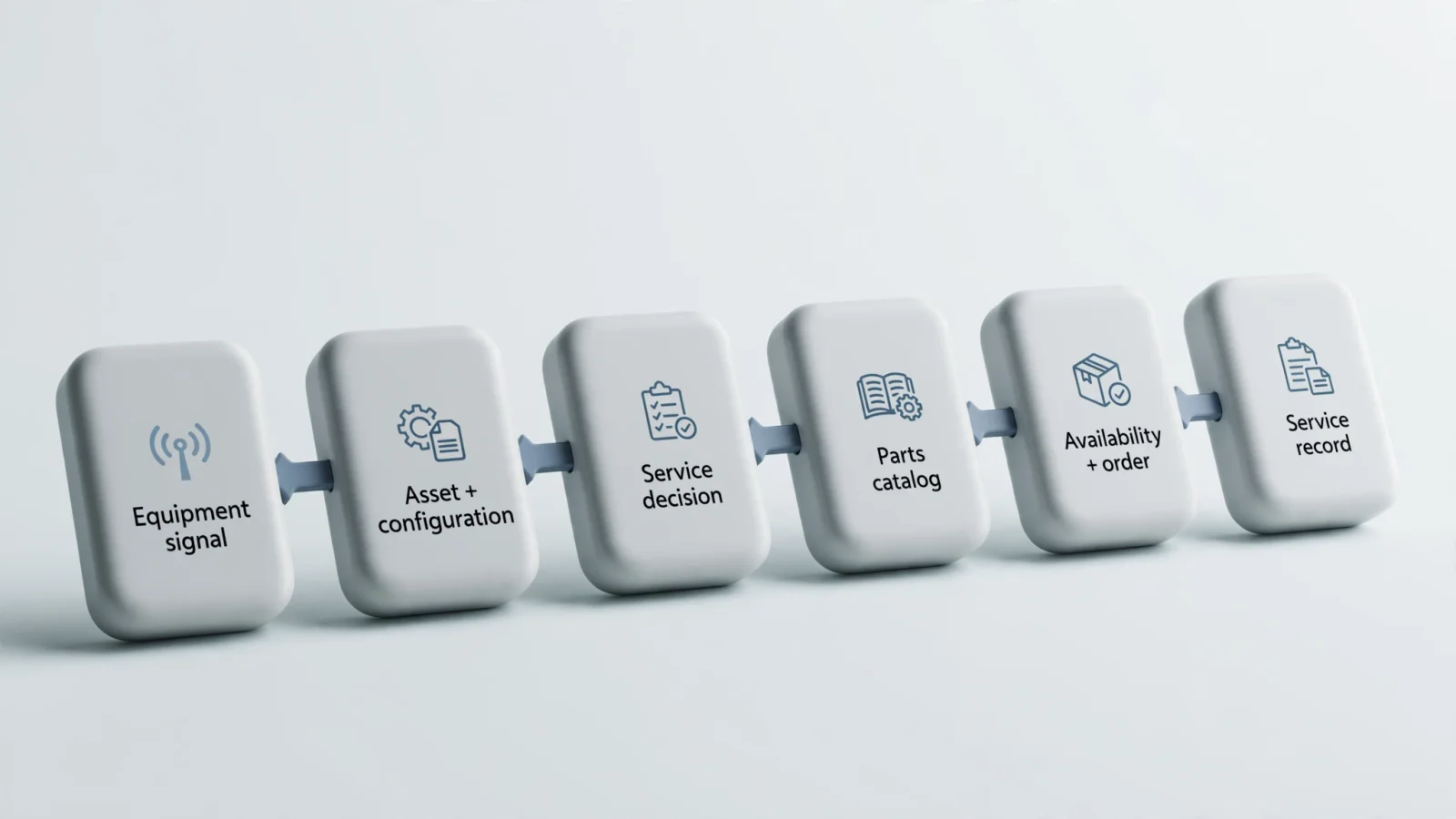
Moving from a machine fault to a completed repair requires a sequence of verified handoffs. A practical operating model follows a clear path: equipment signal, asset identity and configuration, work order, part identification, availability and order processing, and finally, the service record.
Every step in this sequence relies on the one before it. Consider an alert generated by a high-temperature sensor on a specific industrial pump. The prediction alone does not identify the correct replacement seal or bearing, so a service expert must validate the alert and tie the signal to a specific machine variant and its exact installed configuration. Once a planner creates a work order, the technician consults the EPC to find the exact replacement parts for that specific serial number. Because the catalog integrates with the ERP, the technician immediately sees availability, places the order, and completes the service record once the parts arrive.
When these handoffs break down, service operations experience significant delays. If a field technician receives a work order based on a diagnostic code but lacks serial-specific parts data, they may arrive on-site with parts designed for an earlier revision of the machine. Industrial assets frequently undergo mid-production engineering changes, field retrofits, and component revisions across their lifecycle. A serial-number breakpoint can mean that two identical-looking machines built six months apart require completely different internal drive belts, wiring harnesses, or control modules. An effective parts workflow must account for those engineering changes by verifying the asset configuration before dispatching parts.
Applying product-in-use data to aftermarket planning involves process and data complexities. A 2026 case study at a heavy-truck OEM examines challenges in applying product-in-use data to aftermarket supply-chain planning. The researchers identify technical, personnel, and organizational challenges, including IT governance, IT infrastructure, and the need to combine data science with domain competence. They also find that technical and personnel challenges cause organizational challenges, while organizational and personnel challenges can be reduced through an interactive cycle.
A 2024 manufacturing digital-thread roadmap funded by NIST identifies differences in data formats, standards, and naming conventions, along with organizational and geographic silos, as barriers to sharing information across product lifecycle stages. Connecting systems is a baseline, but the systems also need to agree on the machine's current configuration. Engineering maintains the design bill of materials in a product lifecycle management (PLM) system, manufacturing builds the asset using a production BOM, and the service department must support an as-maintained BOM that evolves through years of field service. When these records do not share common data semantics, automated workflows fail, leaving technicians to navigate contradictory part numbers and unverified supersessions.
Where Connected Data Adds Value to the Aftermarket
The same connected workflow serves different roles across the manufacturing and service ecosystem. When evaluating these digital tools, treat fewer ordering errors, improved parts sales, and reduced service delays as business goals to test rather than guaranteed results. Different stakeholders require distinct capabilities from the system to achieve those goals.
Manufacturers need to link their installed-base and configuration records with service planning, parts information, and business systems. Tying these data streams together allows an OEM to transition from static paper parts manuals to digital catalogs that update continuously. By making ordering workflows measurable, manufacturers gain visibility into which parts sell, which configurations generate the most warranty claims, and where part updates cause confusion. This direct line of sight helps optimize inventory planning and aftermarket revenue.
When an OEM can see which parts are repeatedly viewed or searched alongside specific fault alerts, supply chain planners can position stock in regional warehouses before catastrophic component failures occur. Furthermore, digital catalog platforms allow manufacturers to publish engineering changes and service bulletins directly alongside interactive schematics, eliminating the expensive lag between an engineering revision and field distribution.
At the distribution level, dealers rely on speed and accuracy to serve end customers. A connected portal allows a counter user to move immediately from a visual schematic or bill of materials to relevant parts information. Where integrations support it, the dealer sees live availability, account-specific pricing, and ordering options without leaving the schematic view. This integration reduces the time spent cross-referencing different systems and minimizes costly wrong-part orders that consume dealer margins and frustrate equipment owners.
Dealers often support mixed fleets and diverse model years, which makes memorizing part numbers impossible. When a dealer parts counter receives an urgent call from an equipment operator, being able to pull up the exact schematic using the customer's machine serial number prevents ordering mistakes. If the required part is out of stock locally, ERP integration can show whether a neighboring branch or the OEM master distribution center has inventory, helping the dealer provide a more reliable delivery estimate.
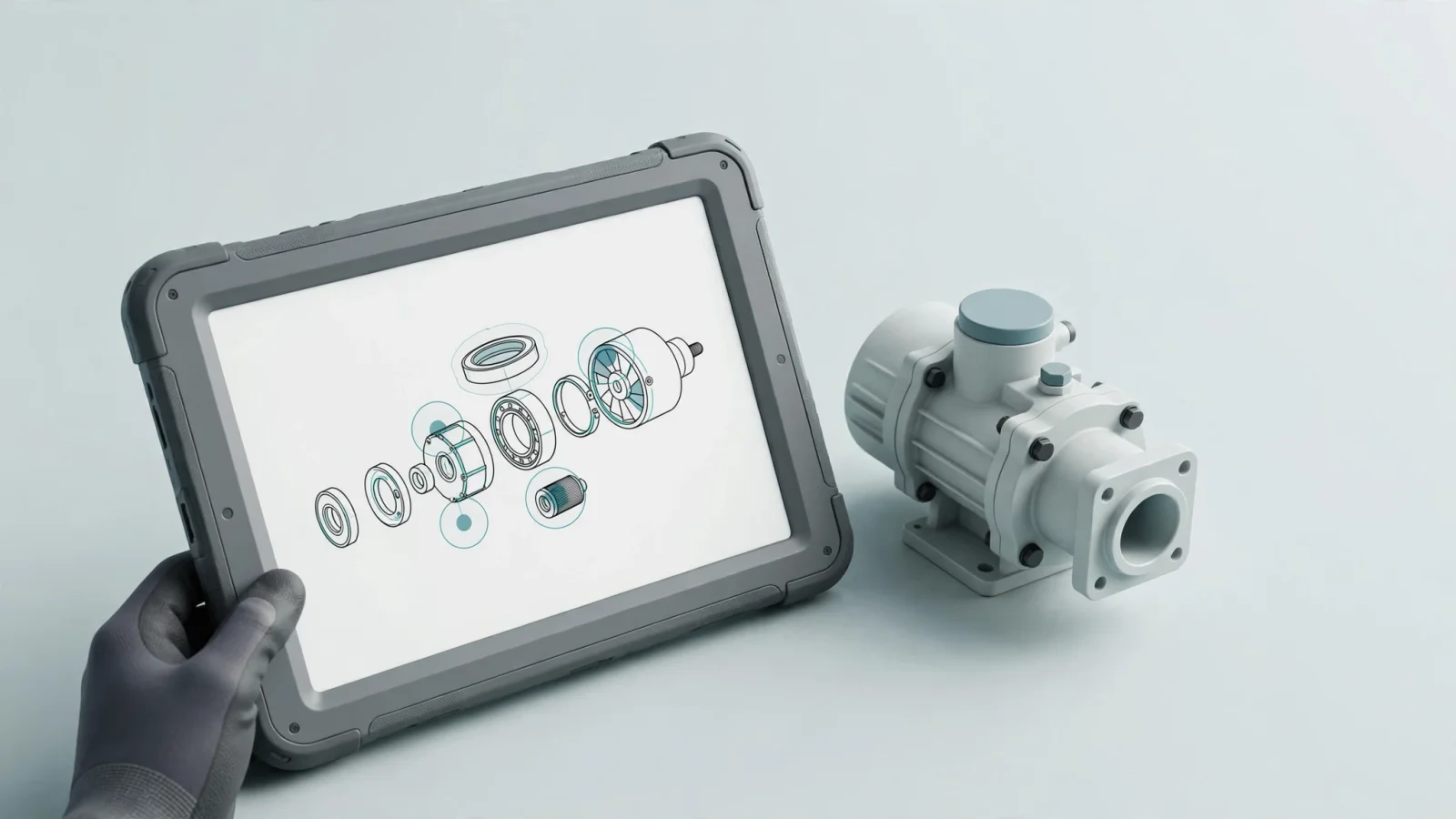
Field technicians perform their jobs where the equipment sits, meaning they frequently work away from reliable cellular or Wi-Fi networks. Mobile access to locally stored catalog information ensures they can reference accurate schematics in disconnected locations. A technician can consult a stored catalog, identify the necessary components using interactive hotspots, and add items to a local cart. Later synchronization pushes that cart to the live system once a connection is established.
The PMMI 2025 Aftermarket Parts & Services report examines aftermarket dynamics across OEMs and end users. It draws on 132 surveys and interviews collected in 2024 and 2025, including respondents from consumer packaged goods companies and contract packagers. The report identifies digital connectivity and documentation, technician availability, and training as aftermarket service concerns, and covers remote access, cybersecurity, warranties, post-service records, and equipment upgrades or retrofits linked to predictive maintenance.
Aligning Product Data With Inventory Systems
Connecting a piece of equipment to the internet is a networking task, but building a reliable aftermarket service around that connection requires establishing trusted machine identities, maintaining accurate bills of materials, and defining clear ownership across service, parts, IT, and dealer teams. The work involves matching product-use data with installed-base, inventory, service, and ERP records rather than wiring software endpoints together.
The 2026 heavy-truck OEM study identifies technical, personnel, and organizational challenges in applying product-in-use data to aftermarket supply-chain planning, including IT governance, IT infrastructure, and the need to combine data science with domain competence. To support that work, define who updates the installed-base registry after field modifications, how service bulletins link to active serial numbers, and who checks that supersession chains match physical part interchangeability.
Data synchronization demands a clear strategy for freshness, balancing the trade-off between real-time integration and scheduled bulk updates. Live integration can give a dealer a current inventory view and reduce the risk of backorders, though stock can change before an order is confirmed. However, not every system supports constant API calls without performance degradation. Scheduled bulk updates, for example hourly or overnight, may provide sufficient accuracy for some heavy machinery parts workflows while reducing the load on legacy ERP systems. The choice depends on your process requirements and how fast your inventory moves.
High-turnover consumables, such as filters, hydraulic fluids, and wear plates, may benefit from tighter synchronization windows to prevent simultaneous order allocations across multiple dealer branches. Conversely, slow-moving structural components or specialized castings can function effectively on scheduled batch updates. System architects must evaluate existing ERP infrastructure before choosing an integration cadence, as legacy mainframe systems or unoptimized enterprise databases may struggle under the high transaction volumes generated by hundreds of concurrent catalog users.
Offline data requires its own refresh protocols. When a technician downloads a media-based catalog to a rugged tablet, that data begins aging immediately. Manufacturers define how often those mobile packages update and force synchronization to prevent technicians from ordering superseded or obsolete parts.
System designers also need to plan for cart collisions and order resolution edge cases. For instance, if a technician builds an offline cart containing a critical assembly that has only one unit left in inventory, another user might purchase that item online before the technician reconnects. The software must handle these conflicts cleanly, alerting the technician upon synchronization and suggesting alternative sourcing options rather than failing silently or creating duplicate orders.
Access permissions also dictate how these platforms operate, because exposing parts pricing and availability means opening a window into the ERP. Role-based access can be configured to show wholesale pricing to dealers and retail pricing to end users while restricting competitor access. Reviewing these connections for security is part of preparing a system to go live.
The PMMI study on packaging machinery identifies cybersecurity, remote access, and documentation as aftermarket-service concerns. So manufacturers should set access controls for operational information they share with service partners.
Identifying Parts With Interactive Catalogs
An electronic parts catalog provides the interactive tools necessary to identify parts accurately and order them efficiently. It functions separately from predictive-maintenance or fault-diagnostic software. Instead of analyzing vibration sensors to predict a bearing failure, the EPC shows the user exactly which bearing belongs in that specific pump housing.
Interactive 2D and 3D schematics anchor the catalog experience. Multi-shape hotspots let users select a component on the schematic and highlight the corresponding row in the BOM, providing a visual cross-check before ordering. Technicians working under tight schedules cannot afford to guess which part callout matches a line item on an unstructured text table. Interactive schematics give them visual certainty, showing exploded views that illustrate how components fit together in an assembly.
The catalog also manages complex relationships, such as kit and assembly component displays, showing users when a part is available only as part of a larger assembly. When servicing a hydraulic cylinder, a technician rarely needs a single O-ring; they need the full seal replacement kit. An intelligent catalog displays those parent-child relationships clearly, highlighting the components included in the service kit while preventing users from ordering individual gaskets that the factory does not stock separately.
Supersession chains track replacement parts, ensuring that if an original component is obsolete, the system directs the user to the current, valid replacement. In complex equipment, a part may go through several revisions over a decade of production. Some supersessions are backward-compatible, meaning the new part fits all previous machine vintages, while others require companion parts or retrofitting kits to function correctly. A robust EPC tracks these multi-step chains, guiding the technician to the correct current part number and warning them if additional hardware is required to complete the installation.
ERP or external-system integration connects this visual experience to commercial operations. Systems Online’s EzParts handles this handoff by linking illustrated features directly to dealer or customer ordering processes. When a user clicks a hotspot, the system queries the ERP to display current inventory status, pricing, and order history.
This connection bridges the gap between mechanical documentation and commercial fulfillment. Instead of re-typing part numbers into a separate purchasing portal or calling customer service to check stock, the user adds the verified part to an integrated cart. The catalog passes the order directly into the ERP for fulfillment, applying the customer's negotiated discounts, shipping preferences, and payment terms automatically.
Deployment flexibility ensures the catalog reaches the user regardless of their IT environment, with EzParts supporting cloud-hosted SaaS models, on-premise enterprise hosting, native mobile applications, and distributed media options for offline environments. If you are mapping out an equipment lifecycle management software strategy, verify which specific ERP integrations and catalog functions are available in your intended deployment mode, as offline applications naturally restrict live inventory checks until synchronized.
A cloud-based SaaS catalog can simplify deployment for web-based dealer portals and make catalog updates available without manual software installations. By contrast, field service operations supporting mining equipment or agricultural machinery in remote territories may require native mobile applications with local data storage. In those environments, the application stores full vector graphics and BOM databases directly on the device, allowing instant search and schematic navigation without an active internet connection.
Measuring Aftermarket Implementation Progress
Aftermarket transformation works best when it starts with a specific problem rather than a mandate to digitize everything at once. A defined implementation plan focuses on proving the handoffs before scaling the technology:
- Choose a recurring service-planning or parts-identification problem, selecting a high-volume product line where wrong-part returns or slow identification impact profitability. Starting with a constrained pilot allows you to isolate operational bottlenecks and establish clean baseline data before attempting an enterprise-wide rollout.
- Verify the asset identity, configuration, bill of materials, and replacement-part data needed for that specific machine variant, ensuring the supersession chains are accurate. Cleaning this core catalog content early prevents technicians and dealer parts counters from losing confidence in the digital tool during initial testing.
- Map where product, service, catalog, inventory, and ERP records currently live, documenting who maintains them and how often they update. Identify the authoritative source of record for each data element to eliminate contradictory part numbers and ensure clear administrative ownership.
- Test the full journey from the initial service trigger through the work order, part identification, ordering, and the final service record. Involve actual field technicians and dealer counter staff in these walkthroughs to identify friction points in navigation, cart transfers, or part searches.
- Test connected and disconnected tasks separately. Check data freshness protocols and confirm that offline synchronization updates local carts and caches without creating duplicate ERP orders or corrupting pending orders.
- Compare results with a baseline established before integration, using historical data to measure operational improvements and support performance claims.
Establish specific measures to evaluate the pilot. Time to identify a part, wrong-part returns, order conversion rates, parts availability, time from trigger to planned work, and the frequency of offline synchronization issues all serve as useful internal KPIs. You can use these metrics to track your own improvement rather than relying on generic industry benchmarks.
Tracking the rate of wrong-part returns provides immediate insight into catalog accuracy, as incorrect shipments directly reflect errors in hotspot mapping, ambiguous schematics, or outdated supersession tables. Similarly, monitoring the elapsed time from an equipment diagnostic trigger to the scheduling of a work order reveals whether data is moving efficiently between your telemetry system, service planners, and parts inventory. If technicians still spend hours clarifying part numbers after an automated alert occurs, the handoff between diagnostic data and parts identification requires further refinement.
Piloting one end-to-end handoff, from an asset's data signal to a successfully fulfilled EzParts shopping cart, validates the data structure and the human workflow. Once that single path operates reliably, you can expand the digital catalog and connected services to more assets, larger dealer networks, and broader field service teams.
Digitize your aftermarket operations and help reduce costly ordering errors with multi-channel catalog delivery. Explore how Systems Online integrates interactive schematics directly with your ERP to support aftermarket revenue growth.
Modified on: 11/13/2026