Blog » Maximizing Interactive Parts Catalog ROI for OEMs in 2026
Maximizing Interactive Parts Catalog ROI for OEMs in 2026

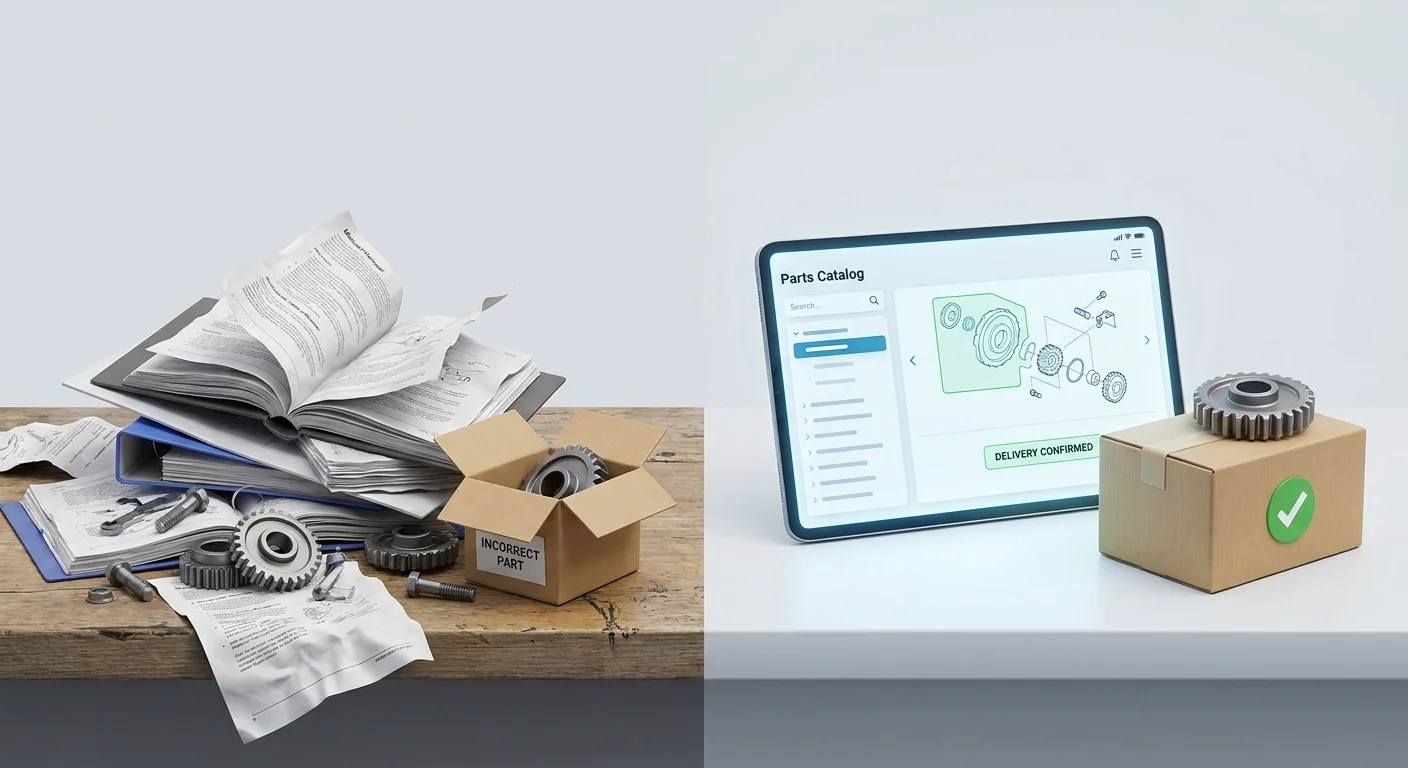
A field service technician arrives at a job site to repair a failed compressor, only to discover they brought the wrong replacement valve. This forces the customer to lose another day of production while your service department absorbs the cost of a redundant truck roll. You maximize interactive parts catalog ROI for OEMs by eliminating these exact scenarios. Replacing static PDF manuals with clickable, serial-specific schematics reduces ordering errors, boosts first-time fix rates, and reclaims aftermarket revenue.
Systems Online builds the EzParts platform to solve this specific breakdown in technical documentation. By transforming outdated paper manuals into accurate digital B2B sales channels, you close the gap between identifying a broken component and ordering the correct replacement. Track your current error rates and deploy multi-channel catalogs to turn technical support operations into profit centers.
The Hidden Costs of Static Parts Catalogs
High Error Rates in Spare Parts
Relying on static PDFs or paper manuals guarantees a high volume of ordering mistakes. When a mechanic traces a line on a poorly scanned diagram, writes down a part number on a clipboard, and types it into a separate order screen, the manual transfer frequently breaks down. Adding more text to bills of materials only clutters the page further, so you must remove manual transcription entirely. Audit your return logs for the past quarter and categorize every return labeled "wrong part ordered," because that pile of returned inventory represents cash tied up in reverse logistics and restocking fees. Since complex predictive maintenance deployments take months to yield results, OEMs opt for quick-win ROI by converting CAD data into interactive catalogs to bypass the manual reading process.
The Financial Impact of Misorders
A wrong part order creates an immediate chain reaction of operational costs. When a technician cannot complete a repair on the initial visit, the service provider schedules a return trip. A FieldServAI analysis shows this failure costs field service businesses between $200 and $300 in repeat dispatch expenses alone, a figure that varies by industry. This initial failure generates an average of 1.6 additional trips to achieve full resolution. Multiply your annual parts return volume by $250 to calculate your baseline cash drain. Equipment also stays in service longer than ever before. Market analysis suggests that hundreds of millions of vehicles in Europe will operate outside their manufacturer warranty periods by the end of 2026. This aging fleet drives massive demand for replacement components and reliable digital documentation, meaning your repeat dispatch costs will scale alongside the age of your installed base unless you deploy an accurate catalog.
Driving B2B Revenue and Conversions
Capturing the $20.7 Billion B2B Market
Market research from a Hedges & Company automotive forecast shows that B2B e-commerce continues to drive a major portion of total online parts sales, yet original equipment manufacturers lose a large share of this to third-party suppliers because independent sites are easier to navigate. This ease of use encourages many buyers to choose independent aftermarket parts over OEM parts, a preference most pronounced among owners of older vehicles. When your buyers cannot find a component in your static manual, they copy the partial assembly name into a search engine and buy a generic alternative from a competitor. Reclaim this market share by making exact part identification frictionless. Building an environment where converting 3D CAD to an interactive parts catalog protects your aftermarket revenue removes the difficulty of finding the correct OEM component. This connected experience keeps buyers inside your authorized ecosystem instead of forcing them onto third-party sites.
Boosting Cart Conversion Rates
Complete fitment search dictates whether a user completes a purchase. Integrate your technical documentation into the shopping cart so that when a buyer clicks a hotspot on your schematic, the item drops into their order. This eliminates the gap between identifying a repair need and paying for the solution. Dealerships utilizing automated systems validate fitment via an electronic parts catalog and execute supersessions, dropping the ordering time from initial VIN entry to a confirmed service appointment down to under two minutes.

Slashing Operational and Inventory Costs
Reducing Dealer Overstock
Dealers stockpile common items to avoid stockouts because they lack trust in their supply chain visibility, tying up capital in redundant inventory that sits on shelves for months. To eliminate this wasteful overstocking, connect your electronic parts catalog to ERP systems like SAP, Oracle, Epicor, or Dynamics. When dealers check live availability, dynamic customer pricing, and warehouse locations while viewing the schematic, this immediate visibility stops them from ordering surplus components. They trust the system to deliver the part on time because the catalog shows how many units sit in the nearest distribution center.
Improving First-Time Fix Rates (FTFR)
First-Time Fix Rate measures how often a technician resolves a problem on their initial visit. While the industry average hovers around 75 percent, top-performing operations push past 88 percent. A lack of proper components drives the majority of this failure rate, as Aberdeen Group research shows that arriving with incorrect or no parts causes 51 percent of first-time fix failures. Move your operation closer to that top-tier mark by deploying digital kit components. When a technician adds a hydraulic pump to their cart, your catalog must automatically suggest the specific seals, brackets, and gaskets required for the fix. This concurrent part grouping ensures the technician arrives with the entire sub-assembly necessary to complete the repair in one motion.

Essential Features That Guarantee ROI
Serial Number-Driven Search
Model-family searches guarantee mistakes because manufacturers frequently change components mid-year on the assembly line without updating the broader model number. As a result, a part that fits a January build will fail to mount on a September build of the exact same model. Enforce exact serial number or VIN filtering instead of relying on basic text search. When the user types their machine's unique identifier into the catalog, the software filters out every component that does not belong to that specific build. This prevents mid-year production change errors by ensuring the schematic on the screen matches the physical machine sitting in the service bay. Deploy an online electronic parts catalog enterprise tier to scale this precise filtering logic across thousands of distinct product lines.
Interactive 2D and 3D Hotspots
Text-heavy bills of materials slow down identification and force users to cross-reference long lists against tiny line drawings, which makes visual interaction critical. Process your CAD files through a multi-shape hotspot tool to overlay precise, clickable zones onto specific parts within the diagram. When buyers visually identify the broken piece on the 3D model, they click it to reveal its part data while the system highlights the corresponding row in the parts table. Mapping irregular objects perfectly ensures that clicking a complex curved pipe selects only that pipe rather than the engine block behind it. This visual workflow removes the need to read and transcribe twelve-digit part numbers.
Automated Supersession Management
Part numbers constantly evolve as manufacturers update, discontinue, or replace items to improve performance or switch suppliers. When a catalog lacks accurate supersession data, technicians order dead items and wait days for a rejection notice from the warehouse. Automating this tracking by pushing ERP supersession chains into your catalog environment allows the system to redirect the buyer from an obsolete item to the active replacement part. If part A replaces part B, and part C replaces part A, the software links the entire chain. As a result, you stop processing returns for dead inventory, and dealers stop wasting time attempting to source discontinued items.
Supporting Technicians in Disconnected Environments
The Challenge of Remote Field Service
Heavy machinery operates in mines, offshore rigs, and massive agricultural fields where cellular service drops out. A cloud-only catalog fails the moment a field technician steps out of Wi-Fi range, forcing them to guess part numbers or drive an hour back to town to load a webpage. This disconnect ruins order accuracy and service profitability. Because you cannot dictate where your equipment breaks down, your documentation must function reliably in the environment where the repair takes place.
Omni-Channel and Offline Capabilities
To support these disconnected teams, Systems Online utilizes a multi-channel framework that pushes encrypted catalog databases to native mobile apps or distributed media like USB drives and memory cards. Deploying an electronic parts catalog for distributed media ensures field technicians maintain full offline access to multi-shape hotspots, wiring diagrams, and bill of materials grouping. A technician opening the software on a ruggedized laptop in a dead zone can identify the part and add it to their cart. The application logs the order locally and executes the ERP sync the moment the device reconnects to a stable network, which guarantees 100 percent uptime for your field operations regardless of local internet connectivity.
Calculating Your Interactive Parts Catalog ROI
Measuring Efficiency Gains
Calculate your ROI by tracking three specific metrics across your service and sales departments, starting with the time required to identify parts as your primary efficiency benchmark. Measure how many minutes a dealer or technician currently spends flipping through PDFs, searching physical binders, or calling technical support per order. Comparing that baseline against the time logged from serial number entry to cart checkout in your new digital system reveals your true efficiency gain. Multiplying the average minutes saved per transaction by your standard hourly labor rate across thousands of dealer orders per year often yields labor savings that justify the initial software investment. For a clean comparison point, determine your current parts order accuracy rate before launching the software.
Tracking Revenue and Customer Experience
Monitoring your cart conversion rates alongside your total aftermarket sales volume provides insight into your digital growth. Specifically tracking the adoption rate of cross-selling pre-packaged kits shows how a higher kit attachment rate improves your First-Time Fix Rate, as users order everything they need on the first try. Pull your ERP data to confirm the reduction in redundant dispatch costs over the first six months of deployment. A drop in parts returns allows warehouse teams to spend less time unpacking wrongly ordered items and more time fulfilling accurate shipments. Reducing this ordering friction encourages dealers to shift their spending away from independent aftermarket competitors to concentrate their purchases within your authorized portal.
Stop losing profitable B2B sales to third-party suppliers and eliminate the repeat dispatch costs draining your service department by switching outdated PDFs for interactive schematics. These digital diagrams drive accurate orders on the first attempt. Explore how Systems Online automates parts identification and integrates with your existing ERP to build a frictionless B2B eCommerce experience.
Modified on: 08/05/2026