Blog » How OEMs Can Improve Parts Order Accuracy in 2026
How OEMs Can Improve Parts Order Accuracy in 2026

Unplanned equipment downtime costs industrial manufacturers an average of $260,000 per hour, though this penalty varies by sector. When a field technician misidentifies a component and orders the wrong replacement, that repair timeline stretches from hours to days. Figuring out how OEMs can improve parts order accuracy determines whether your aftermarket channel drives high-margin revenue or bleeds it away through reverse logistics. Replacing static PDFs with a dynamic solution like the EzParts electronic parts catalog from Systems Online stops these errors at the source.
The High Cost of Parts Mis-Ordering
Every incorrect parts order triggers a cascade of compounding financial losses, because the visible cost of shipping a heavy component back to a distribution center is minor compared to the operational delays that follow.
The True Cost of Equipment Downtime
Downtime variances depend on the specific industry, but the financial penalties remain severe across the board. Automotive plant downtime can exceed $2 million per hour when assembly lines freeze waiting on a critical repair, whereas a field technician standing beside a stalled excavator incurs immediate idle labor costs while the equipment owner loses thousands of dollars in unfulfilled project contracts.
When an initial order fails to resolve the breakdown, the secondary order carries expedited shipping fees. These emergency freight charges erode your profit margins on the sale, transforming what should be a profitable aftermarket transaction into a net loss for the manufacturer unless you upgrade your documentation systems to prevent repeat failures.
Why Aftermarket Return Rates Hit 25%
The aftermarket return rate for incorrect components currently sits at 25 percent across heavy equipment sectors. Mis-ordering and poor application data interpretation drive most of these returns, because dealers relying on paper manuals or flat PDFs face massive catalog ambiguity. A single machine model might have three different hydraulic pump revisions deployed over a five-year production run, forcing the buyer to guess if the catalog provides no systematic way to filter those variations.
Start by auditing your reverse logistics data from the past twelve months. You should categorize every returned item by its reason code, isolating the returns triggered by catalog misinterpretation rather than defective manufacturing. After calculating the total freight, restocking labor, and lost margin associated with those specific returns, use this baseline number to measure the return on investment when upgrading your catalog infrastructure to reduce spare parts ordering errors across your dealer network.
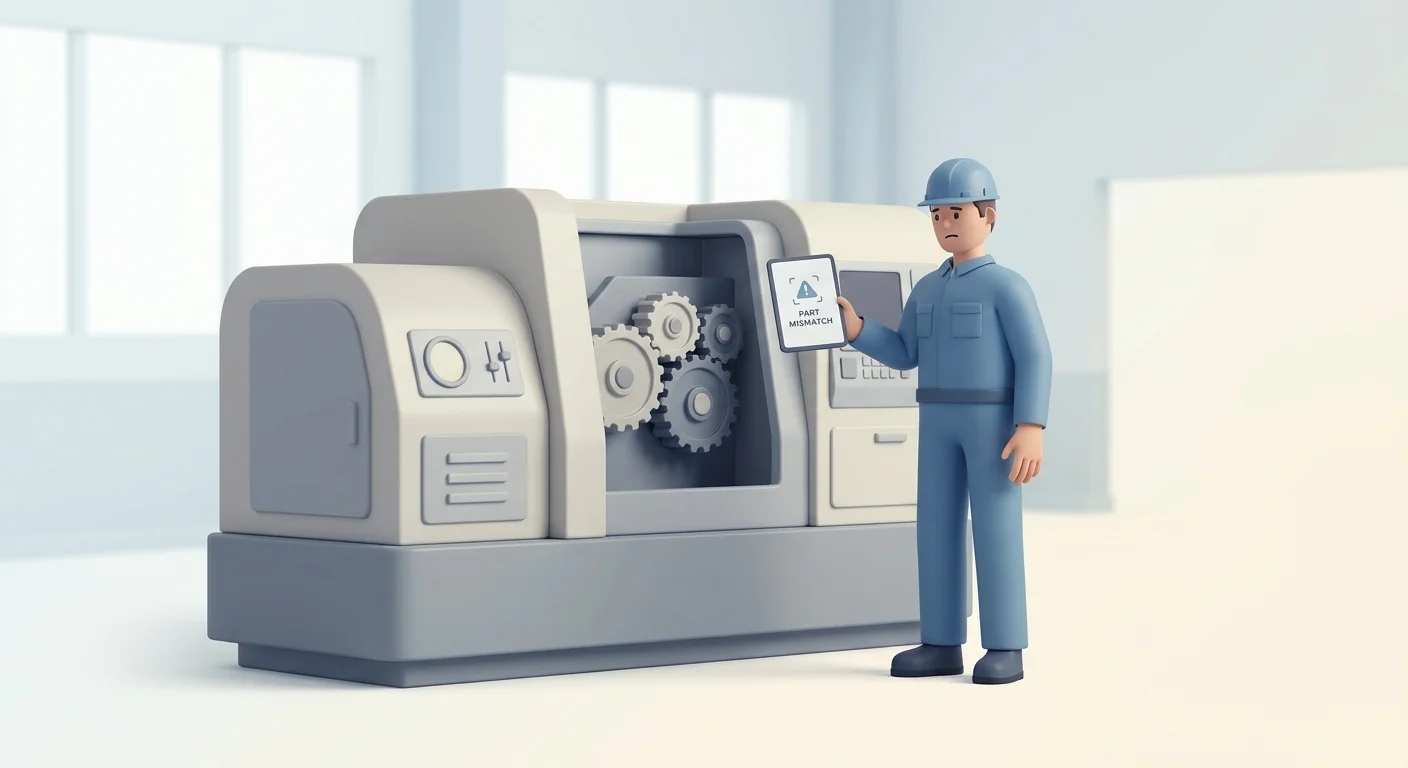
How OEMs Can Improve Parts Order Accuracy with VIN Filtering
A blank search bar is a liability in heavy equipment maintenance, because allowing users to search by generic product names or partial descriptions returns too many irrelevant results and increases the probability of a mis-click.
Moving Beyond General Search Queries
Modern aftermarket portals remove human guesswork by restricting access to generalized searches. A technician querying "fuel injector" on a broad catalog site might receive fifty incompatible variations, and even narrowing the search by model year fails when mid-year production changes introduce different components into the same model line.
To eliminate this noise, shift your catalog entry points to require exact identification inputs. Dealer and technician portals must rely on precise Vehicle Identification Number (VIN) or serial number data to filter the bill of materials (BOM). Once a technician inputs the serial number, the catalog engine drops every incompatible part from the screen, leaving only the exact components fitted to that specific machine on the factory floor.
Guaranteeing "As-Built" Compatibility
Manufacturing complex equipment involves continuous engineering adjustments, meaning a combine harvester built in February might feature a different electrical harness than the identical model built in October. Serial number filtering guarantees "as-built" compatibility by connecting the catalog interface directly to the original manufacturing records.
Configure your electronic parts catalog software to enforce this restriction by hiding the global search function behind a serial number prompt. If a technician bypasses the serial number input to browse globally, the system should display a prominent warning banner stating that part fitment cannot be guaranteed without the machine's exact identification code. This friction prevents dealers from hastily ordering components based on visual similarities.
Deploying Interactive 2D/3D Schematics
Text-based parts lists fail because they separate the visual context of the machine from the ordering mechanism, meaning that forcing a technician to cross-reference a flat line drawing on page 40 with a numerical table on page 41 leads to transcription mistakes.
Forcing Visual Validation with Hotspots
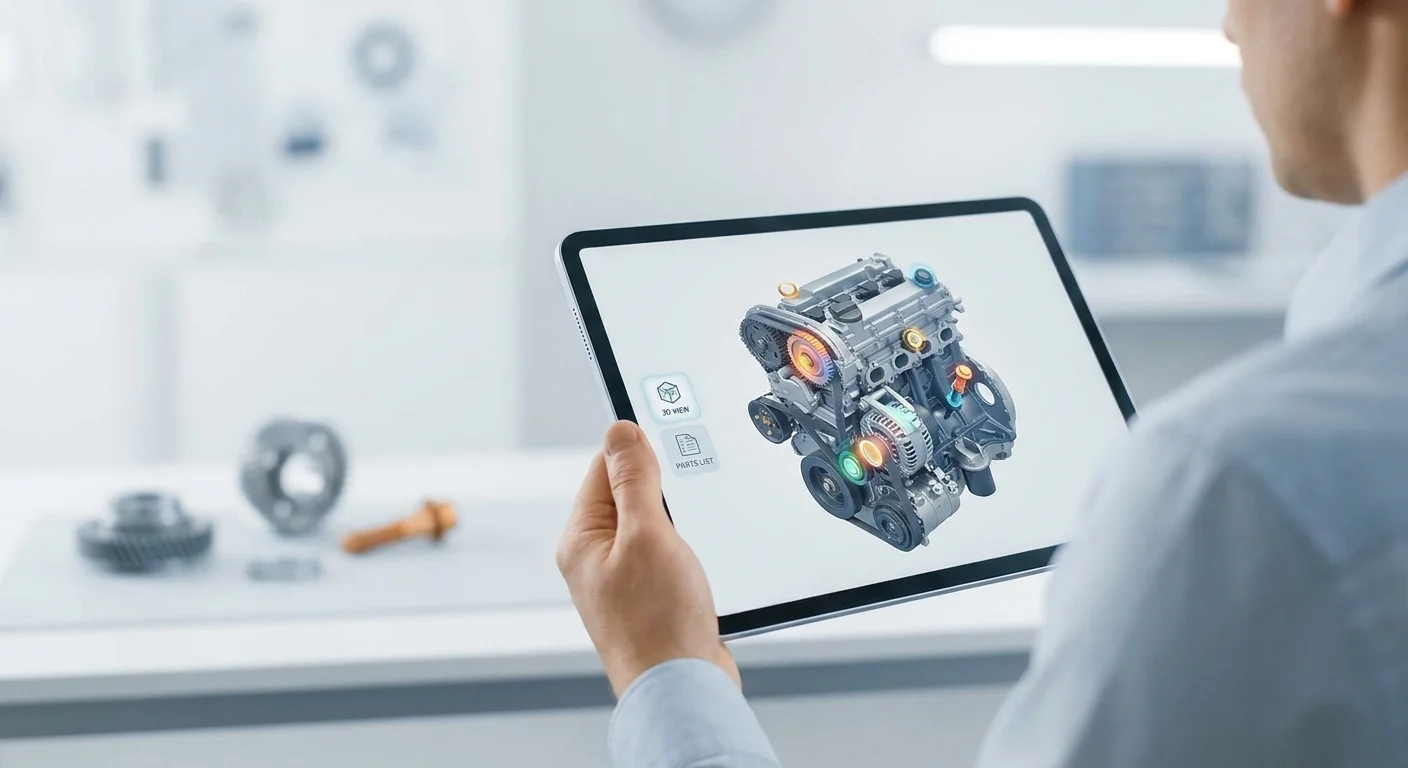
Interactive spatial models solve this disconnect by forcing visual validation, allowing technicians to interact directly with the drawing using multi-shape hotspots on 2D and 3D schematics. When a technician clicks on a brightly colored gear within the 3D model, the system highlights the corresponding part number in the BOM and displays the current pricing.
This visual confirmation reduces misidentification compared to matching text strings in a dense spreadsheet. Upgrade your static diagrams to interactive spatial models, ensuring that every clickable hotspot maps to the correct item in the database.
Equipping Field Techs in Offline Environments
A digital catalog only protects order accuracy if the technician can load it. Field service personnel frequently repair mining equipment, agricultural machinery, and forestry tools in remote environments lacking cellular or Wi-Fi coverage, so if your catalog lives exclusively on a cloud server, an offline technician will revert to guessing or calling a support desk to reintroduce the risk of human error.
Systems Online engineered EzParts specifically for this connectivity gap through a multi-channel delivery framework. The platform provides native mobile applications and distributed media that cache the entire interactive catalog locally on the technician's device. Technicians can manipulate complex 3D models, tap hotspots, and build an accurate shopping cart while off the grid. Once the device regains a network connection, the cart syncs and processes the validated order, so you should audit your current field service tools to verify that technicians maintain full access to multi-shape hotspot software when working in dead zones.
Automating Supersessions and Kit Grouping
Understanding how OEMs can improve parts order accuracy requires looking at component lifecycles. Parts evolve, break down, and get replaced by newer engineering revisions, which means dealers will attempt to order obsolete stock or incomplete sets of components if your catalog fails to track these changes systematically.
Systematizing Part Supersession Chains
When an OEM discontinues a component, the ordering system must systematically redirect the buyer to the replacement part. Leaving a dead part number active without routing logic results in canceled orders and frustrated dealers, while deleting the old part number without explanation leaves technicians confused when the number stamped on the broken physical part returns zero search results.
You must systematize your part supersession chains within the catalog logic. If a technician queries the old part number, the system should flag it as obsolete, display the supersession history, and route them to the active version of the component. Configure your database to track both one-to-one replacements and complex one-to-many chains where a single old part is replaced by an updated assembly. This approach to managing part supersessions ensures that dealers only add valid, orderable inventory to their carts.
Prompting Automated Kit Grouping
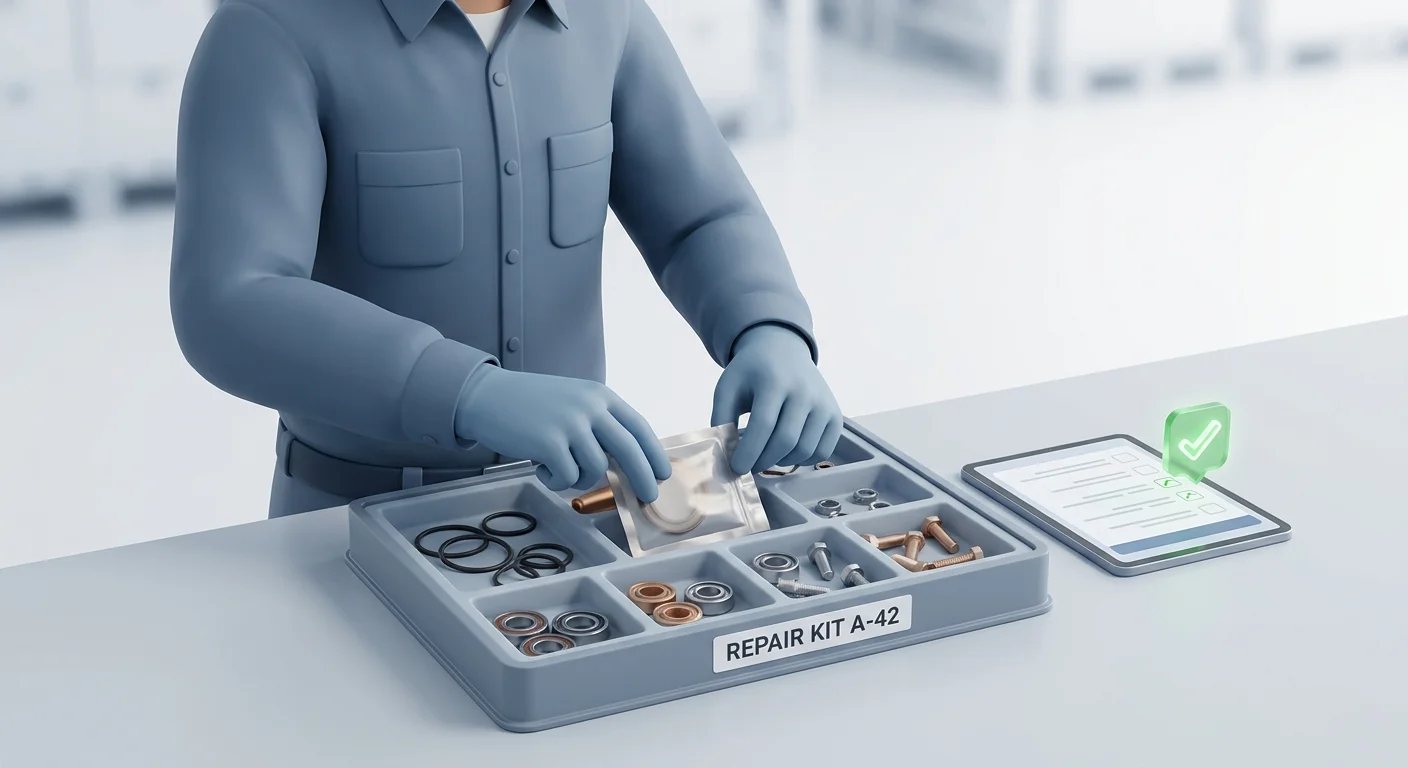
Complex equipment repairs rarely involve a single isolated component, because replacing a primary hydraulic valve almost always requires replacing the surrounding O-rings, gaskets, and mounting hardware. If the technician forgets to order those secondary items, the entire repair stalls upon delivery.
Enforce automated kit grouping by utilizing bill of materials logic. You should program the catalog so that adding a primary bearing to the cart triggers a system prompt asking the technician to include the necessary companion seals, reducing the cognitive load on the buyer. Start this process by mapping out the required companion parts for your fifty most frequently ordered complex assemblies, and then update your catalog logic to trigger automated prompts for these specific bundles.
Unifying Ecosystems via ERP and PunchOut Integrations
Data silos cause transcription mistakes, because when a dealer has to look up a part number in one system, copy it to a clipboard, and paste it into a separate procurement portal, they will eventually drop a digit.
Eliminating Re-Keying Errors
Manufacturers can eliminate manual data entry through eProcurement PunchOut catalogs. Instead of forcing corporate buyers to log into a standalone eCommerce site, a PunchOut integration connects your parts catalog directly into their existing procurement software.
The buyer accesses your catalog from within their own system, builds their cart, and "punches out" to transfer the cart data back to their application as a formatted cXML payload. This automated transfer prevents the transposition errors that plague manual purchase orders, which stops manual re-keying before the order ever reaches your desk.
Providing Real-Time Inventory Visibility
An accurate part number accomplishes little if the part is backordered for six months, meaning technicians need to know immediately if a component sits on a shelf in a nearby warehouse or requires a factory delay.
Systems Online natively integrates EzParts with major Enterprise Resource Planning (ERP) systems like SAP, Oracle, Epicor, and Dynamics to sync pricing and availability in real time. When a technician clicks a part hotspot, the system queries the ERP and displays the exact stock levels across different distribution centers. Connect your electronic parts catalog directly to your inventory backend so that technicians base their repair timelines on real availability rather than outdated nightly batch reports.
Adopting Industry Standards for Data Consistency
Inconsistent naming conventions confuse buyers, because if one supplier calls an item a "hex bolt" and another calls it a "bolt, hex," search algorithms struggle to match the inventory. Standardizing this data builds buyer confidence, which is vital in a global automotive aftermarket forecasted to reach $641.8 billion by 2030.
Standardizing Fitment with ACES
The Auto Care Association developed the Aftermarket Catalog Exchange Standard (ACES) to standardize how manufacturers communicate fitment data, providing a unified machine-readable format for describing which parts fit which specific vehicles or machines.
Instead of writing custom text descriptions for compatibility, suppliers map their fitment data to standardized ACES vehicle configurations to ensure that every distributor, dealer, and eCommerce platform connected to the network interprets the application data identically.
Unifying Part Data with PIES
While ACES handles the application and fitment, the Product Information Exchange Standard (PIES) standardizes the physical attributes of the part itself by dictating how dimensions, weights, brand IDs, and marketing descriptions are formatted across databases.
| Standard | Primary Function | Data Handled | Benefit to Order Accuracy |
|---|---|---|---|
| ACES | Fitment & Application | Year, Make, Model, Engine, Serial parameters | Prevents dealers from ordering parts that do not fit the specific machine. |
| PIES | Product Attributes | Dimensions, weights, brand codes, UPCs | Ensures accurate shipping calculations and uniform product descriptions across catalogs. |
Start by exporting your existing part descriptions and running them through a data standardization tool to identify non-compliant formatting. After mapping your legacy catalog data to both ACES and PIES standards, conforming to these strict industry architectures ensures your part data remains intact as it syndicates across global dealer networks and third-party marketplaces.
Deciding how OEMs can improve parts order accuracy requires removing human guesswork from the procurement chain. Upgrading to interactive 2D and 3D schematics, enforcing serial number filtering, and integrating your inventory data directly into the user interface protects your aftermarket margins. Connect with Systems Online today to implement a multi-channel electronic parts catalog and eliminate costly mis-ordering across your entire service network.
Modified on: 08/03/2026