Blog » B2B Aftermarket eCommerce Platform Comparison For 2026
B2B Aftermarket eCommerce Platform Comparison For 2026

Unplanned equipment downtime costs an average of $260,000 per hour across manufacturing sectors. This penalty carries industry variance, ranging from $85,000 per hour in food and beverage processing up to $2.3 million per hour in automotive manufacturing. If a field service technician guesses at a part number using an outdated paper manual and the dealer ships the wrong component, that machine stays down for days. Beyond the price of the incorrect part and the return shipping costs, financial penalties cascade. You must account for idle operator labor, contractual delay fees, and halted downstream production chains.
Across the heavy equipment industry, these mis-ordered components drive a 25% return rate. Inefficient spare parts online ordering mechanisms contribute to a 15% to 20% annual revenue leakage for mid-tier distributors, exacerbated by manual errors and stockouts. Upgrading your infrastructure stops reverse logistics from eating your aftermarket margins. Systems Online developed EzParts to replace static manuals with interactive, multi-channel electronic parts catalogs (EPC) that integrate with your ERP, guaranteeing technicians identify the correct item on the first try.

1. The High Cost of Failing at Aftermarket eCommerce
Equipment manufacturers rely on aftermarket parts for profitability, since spare components deliver margins up to four times higher than new equipment sales. However, 57% of consumers now prefer independent aftermarket brands over OEM-authorized parts, an increase of 14 percentage points from 2024. Buyers make this shift primarily due to lower prices and shorter wait times. Relying on legacy PDFs and paper catalogs puts your OEM revenue at risk because static files lack serial-number specificity, fail to display real-time inventory, and cannot process supersessions when an engineering change replaces an older part.
Uploading a better PDF cannot fix this operational bottleneck. You must deploy a catalog architecture that maps the exact serviceable Bill of Materials (sBOM) to the specific machine operating in the field. This guarantees the digital catalog reflects how the part is currently sold and serviced, rather than how it was originally engineered. When a dealer portal shows an obsolete flange as available, the dealer places the order, the ERP rejects it, and manual intervention delays the fix. Consequently, the dealer pays the expedited emergency freight costs while the customer loses production time.
Automating this data flow eliminates catalog ambiguity. Establish publish gates between your engineering databases and your eCommerce front-end so that when a CAD file changes, the system automatically updates the multi-shape hotspots on the corresponding 3D web schematic. If your current portal requires manual data entry to update a superseded valve, you introduce human error into a supply chain requiring mathematical precision. Recapturing aftermarket revenue from third-party manufacturers requires eliminating the friction of manual parts lookup and offering digital B2B portals that match the speed of independent suppliers.
2. Core Capabilities for 2026 Platforms
The shift toward fully digital B2B procurement requires tighter system architecture, as Gartner projects 80% of B2B sales will flow digitally by 2025. Operating a standalone web cart disconnected from your enterprise data guarantees inventory discrepancies.
Modern architecture demands ERP and EPC convergence. Your catalog must read natively from systems like SAP, Oracle, Epicor, or Dynamics to ensure engineering revisions dictate field availability the moment they are approved. Predictive maintenance accelerates this requirement. As connected machines transmit real-time onboard diagnostic data, API endpoints trigger automated component fulfillment before the physical machine fails, forcing the catalog software to process these programmatic requests without human verification.
Artificial intelligence alters the baseline requirements by allowing agentic commerce to autonomously handle product discovery and fitment configuration for the buyer. Instead of forcing a dealer to navigate complex compatibility tables, the system cross-checks the machine's exact VIN, evaluates the supersession history, and presents only the guaranteed fit. Leading platforms map visual catalog hotspots directly to ERP and eCommerce shopping carts via API, synchronizing pricing, stock, and customer-specific tier discounts dynamically. Any thorough b2b aftermarket ecommerce platform comparison requires evaluating how these tools handle this complex fitment, offline access, and enterprise data syncing.
| Platform | Offline Tech Access | ERP Sync Depth | sBOM to Serial Mapping | Interactive 3D Visuals | Primary Target User |
|---|---|---|---|---|---|
| Systems Online (EzParts) | Native iOS/Android App & USB Local Media | Real-time API / Native Dynamics & SAP Integration | Yes, Automated VIN Parsing & Filtering | Yes, Multi-shape Hotspots on CAD Models | OEMs & Disconnected Field Technicians |
| Components Engine | Cloud / Cached Browser Storage Only | Real-time API Endpoint Connections | Yes, Configurable Mapping Engine | Yes, Interactive Exploded Diagrams | Dealers & Regional Distributors |
| Intelli Catalog | Web Portal Access Only | Batch Uploads / Standard API | Partial Model-Level Filtering | 2D Focus, Limited 3D Integration | Mid-Market Manufacturers & Service Centers |
| Documoto | Web Portal Access Only | Batch Uploads / Standard API | Relational Database Mapping | 2D Publishing & Static Conversion Focus | Legacy PDF Converters & Archivists |
| GenAlpha Equip | Web Portal Access Only | Batch Uploads / Standard API | Relational Database Mapping | 2D Schematics / Storefront Focus | First-time Digital Brands & Startups |

3. Systems Online (EzParts): The Premier OEM Solution
Equipment manufacturers lose aftermarket sales when technicians cannot identify parts in the field. Systems Online eliminates this friction through a multi-channel delivery framework that supports disconnected environments. If an agricultural technician repairs a combine harvester in a cellular dead zone, a cloud-only catalog fails. EzParts solves this by providing native mobile applications and offline distributed media that store the full interactive database locally. Technicians carry the exact technical schematics, pricing, and supersession data onto the job site without requiring a network connection. They install the database via USB or local network sync before leaving the depot, guaranteeing full access in remote agricultural fields or deep mining shafts.
The platform executes complex fitment logic by mapping the sBOM directly to the equipment serial number. Technicians type in the machine's VIN, prompting the software to filter the catalog. The user sees only the components originally installed on that specific unit alongside any officially superseded replacements. Clicking directly on multi-shape hotspots within the 2D or 3D schematics loads fitment data and adds items to an integrated shopping cart. Features like automated kit component displays and BOM part grouping allow dealers to trust the portal, reducing the 25% industry return rate.
Enforcing strict data governance using publish gates between your ERP and the EPC automates this flow, ensuring superseded parts render as unavailable for purchase while historical schematics remain visible for legacy maintenance reference. This electronic parts catalog import automation protects your dealer network from ordering errors.
For environments requiring physical documentation, such as maritime or military operations, EzParts includes an automated print engine. This tool dynamically generates branded PDF parts books populated with the most up-to-date pricing and engineering changes by pulling data directly from the updated ERP table before printing. Consequently, you meet compliance standards without manually typesetting new manuals every quarter.
4. Components Engine: The European EPC Alternative
Components Engine approaches the electronic parts catalog from a strong visual perspective by translating 2D drawings and 3D models into navigable online portals. Dealers log into the system, view exploded diagrams, and select replacement components directly from the browser window. When a user clicks a primary component like a main engine block, a side panel loads the mandatory gasket kits and hardware. The interface highlights associated parts to help users identify smaller hardware requirements, like O-rings or specialized bolts, that accompany a major component swap.
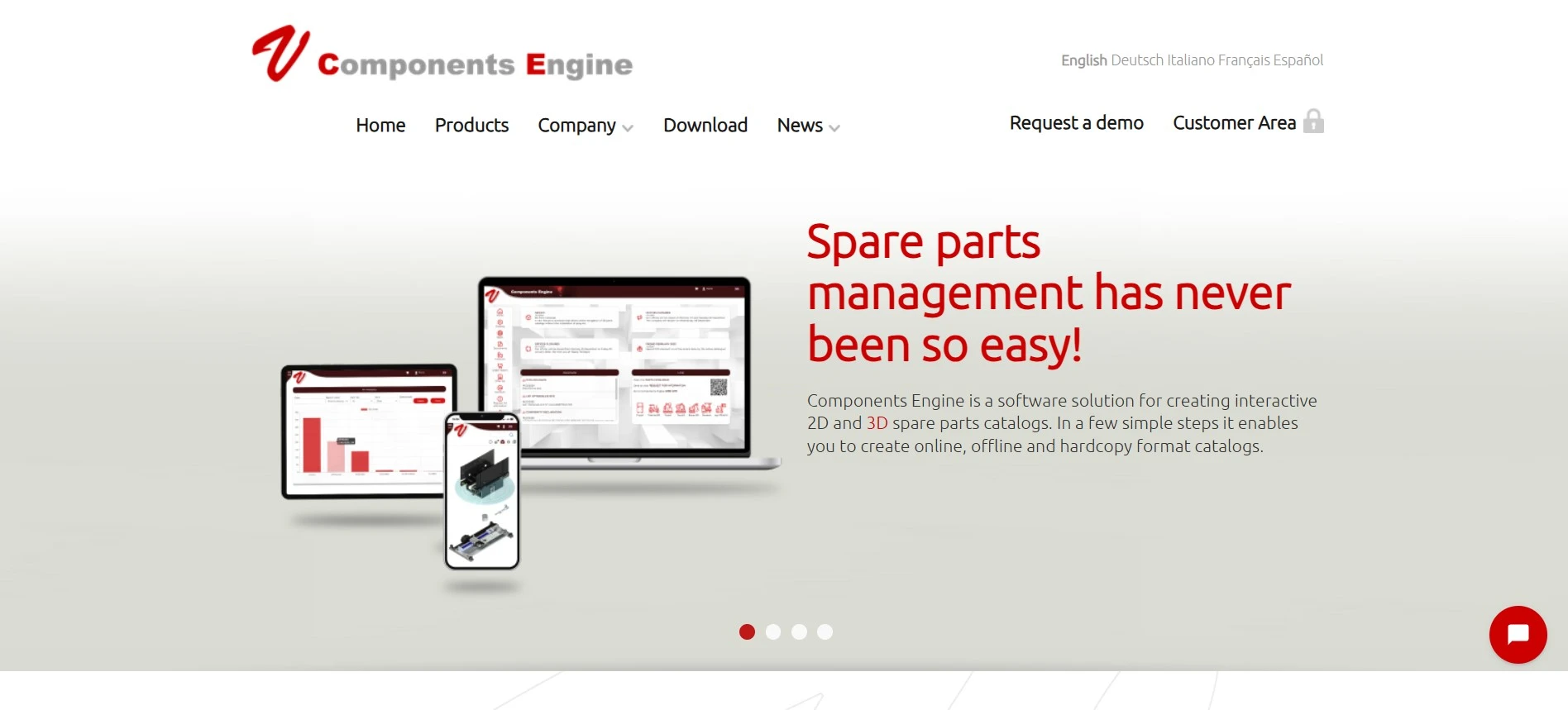
The software handles ERP integration, synchronizing pricing and supersessions so dealers see accurate stock levels. If a manufacturer updates a CAD file, the platform processes the revision and updates the corresponding catalog hotspots to ensure the digital storefront reflects the current manufacturing floor output.
Evaluating Components Engine vs EzParts highlights a distinct difference in deployment flexibility. Components Engine relies on active web connections. Remote technicians working in underground mining operations or rural agricultural sites lose access to the catalog when they drop a cellular signal. Systems Online solves this environmental constraint by packaging the entire interactive database into offline media, guaranteeing continuous access for disconnected service teams. Assess your field service environments, because cloud-only architecture introduces operational risk if your equipment operates beyond cell towers, forcing technicians to guess at part numbers from memory.
5. Intelli Catalog: Managing Profit Margins
Protecting high-margin aftermarket revenue requires a cohesive purchasing experience that keeps dealers inside your ecosystem. Intelli Catalog focuses on providing an accessible B2B portal that simplifies the transition from static paper manuals to digital storefronts. The system allows dealer networks to locate basic replacement parts using text-based search and standard 2D visual navigation.
The platform centralizes service bulletins, maintenance schedules, and parts lists into a single dashboard. This visibility helps service centers bundle routine maintenance items. When a technician orders a replacement hydraulic pump, the system surfaces the required filters and fluid specifications via mandatory checkout prompts to increase the average order value per service visit.
Pricing limitations appear when managing complex, tiered distribution networks. Large OEMs require API-driven dynamic discounting based on customer-specific tiers, regional pricing variations, and distinct dealer contract terms. Intelli Catalog can require more manual administrative overhead to manage these localized price books. Map your pricing complexity before deployment. If you maintain hundreds of localized price tiers that update daily from an ERP like SAP, verify that the catalog software inherits those rules automatically without requiring your pricing team to manage redundant spreadsheets. A failure in this synchronization forces dealers to manually verify their discounts via phone, negating the efficiency of the digital portal.
6. Documoto and GenAlpha: Cloud Catalog Specialists
Independent aftermarket brands capture market share by offering faster purchasing experiences. Defending your territory means giving B2B buyers the autonomy they expect in consumer retail, because customers increasingly prefer self-service online ordering over calling a sales representative. If your ordering portal requires a phone call to verify fitment, buyers defect to third-party suppliers offering immediate digital verification. OEMs are replacing static PDF manuals with multi-channel, interactive 2D and 3D visual catalogs to halt wrong-part returns and drive higher average order values across dealer networks.
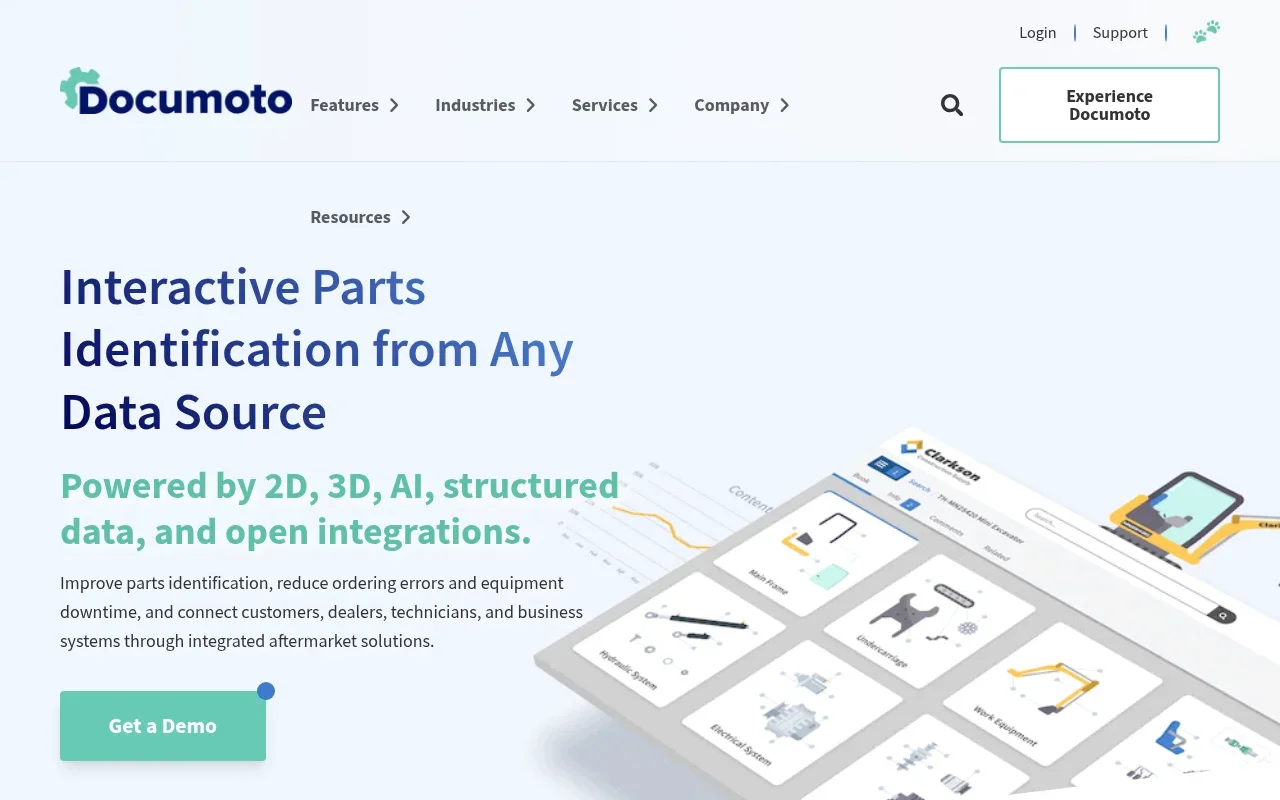
Documoto operates primarily as a cloud-based publishing platform that converts legacy PDFs into relational databases, allowing users to click a 2D drawing to find the corresponding part number. Administrators upload flat manuals, map the visual coordinates to a parts list, and publish the digitized book. It excels at modernizing static files quickly. Organizations digitizing massive archives of older manuals often start here, though the software lacks the advanced 3D spatial navigation found in enterprise-tier systems. Equipment manufacturers evaluating top Documoto alternatives upgrade to gain native offline access and heavier ERP automation.
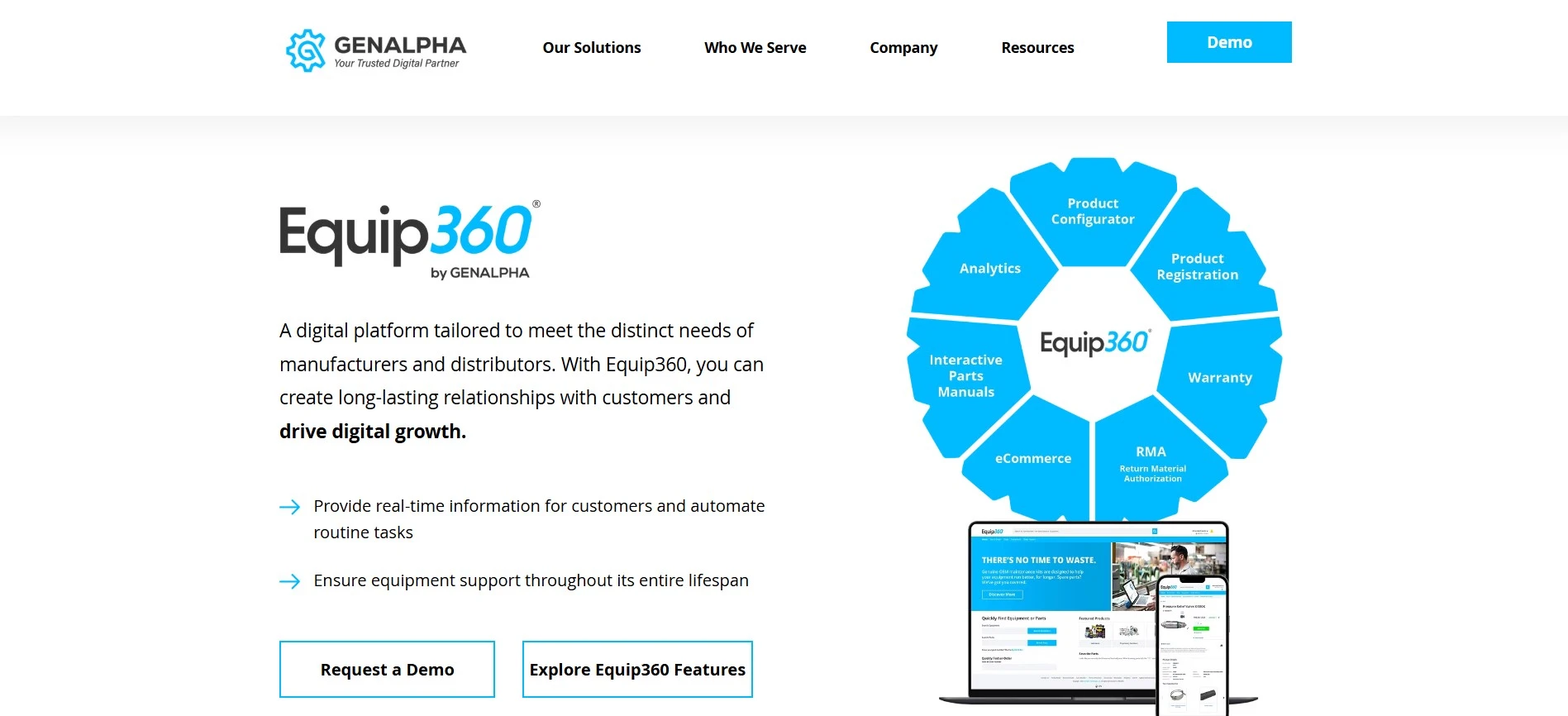
GenAlpha Equip serves a similar segment, focusing on building standard eCommerce storefronts attached to 2D parts books. The platform provides a solid foundation for manufacturers launching their first digital portal, handling standard cart functions and basic visual lookups. When scaling, organizations often find that updating the catalog requires manual data mapping, forcing catalog administrators to individually link new engineering revisions to existing storefront pages. Selecting the best GenAlpha Equip alternative involves implementing strict sBOM publish gates that automate updates directly from engineering systems and bypass manual data entry.
7. The Final Verdict for Equipment Manufacturers
Selecting the right platform dictates whether your aftermarket business scales or stalls. Cloud-only portals work well for desktop-bound dealers ordering inventory for the week, but they abandon the field service technician standing in the mud next to a broken excavator. When that technician cannot verify a part number due to a dropped signal, they order three variations and return two, driving up reverse logistics costs.
Systems Online stands out as the definitive choice for manufacturers who need to protect their margins and eliminate order ambiguity. EzParts delivers a multi-channel architecture, putting interactive 3D schematics on desktop browsers, native mobile apps, and offline distributed media. The deep ERP convergence guarantees your fitment data, complex supersession chains, and localized pricing remain exact across every channel. Because the platform filters by serial number natively, technicians see only what fits the machine in front of them.
Audit your reverse logistics data this week by pulling the specific cost of wrong-part returns over the last quarter, including freight penalties, warehouse restocking labor, and customer downtime credits. Review your ERP return codes to isolate incidents caused by catalog ambiguity rather than defective manufacturing. Map that financial leak against the cost of upgrading your catalog architecture, and stop relying on static documents that fail the moment a part is superseded. Configure your integration endpoints, transition to a fitment-first visual catalog, and force your engineering data to drive your eCommerce sales.
Systems Online develops EzParts, the electronic parts catalog and eCommerce platform built for whole goods and equipment manufacturers. Eliminate aftermarket ordering errors, support your offline field technicians, and integrate directly with your ERP. Visit Systems Online to schedule a demo.
Modified on: 08/13/2026