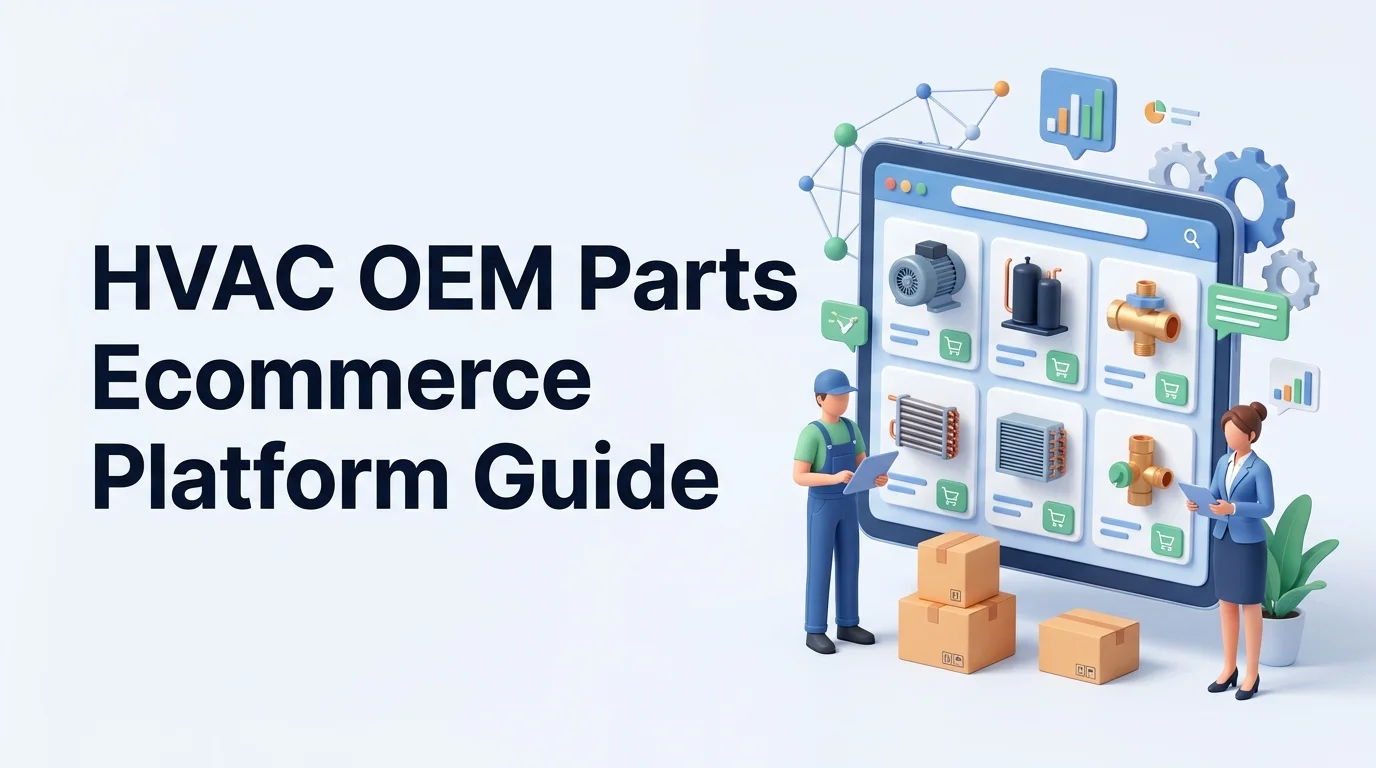
HVAC OEM Parts Ecommerce Platform Guide
A technician stands in a cramped mechanical room facing a discontinued commercial chiller. The compressor failed, causing them to pull out their phone and search the manufacturer’s website. A generic flat product list gives them three replacement part numbers, but they have no way to verify which one fits this exact unit's serial number and regional configuration. They guess, the wrong part ships, and the equipment stays down for another week. You fix this broken workflow by choosing an HVAC OEM parts ecommerce platform that connects visual schematics directly to fitment rules, replacement history, and customer-specific ordering. To replace static paper or PDF parts manuals with a connected digital workflow, evaluate software against your specific distribution model. Structure your parts data, test the visual search experience, verify ERP integrations, and choose a platform that increases aftermarket revenue without bypassing your dealer network. Define The HVAC OEM Parts Platform Category An electronic parts catalog sits between your engineering data and your purchasing channels. It connects equipment models, serial or configuration data, technical documentation, visual parts identification, fitment rules, supersessions, customer-specific pricing, availability, and order insertion. What The Platform Connects You must distinguish this category from tools that sound similar but serve different functions. A generic B2B ecommerce storefront sells standalone products to known buyers, but it cannot map a nested bill of materials (BOM) to an interactive 3D schematic. A product information management (PIM) system organizes marketing copy and attributes without executing customer-specific inventory checks or submitting transactions. An enterprise resource planning (ERP) system manages the financial ledgers and physical warehouse routing, yet its interface proves too complex for a field technician trying to visually identify a fan motor. Your parts platform coordinates these inputs. A mixed-category survey of buyers handling electrical, HVAC, and industrial supplies shows that nearly 67% had ordered online, and 64% had used a mobile app or text to buy, making digital ordering a direct requirement for technical purchasing. Who Uses It And Why Systems Online developed EzParts specifically to handle this complex manufacturing workflow. The platform ingests engineering drawings and parts lists, then publishes them across multiple channels so users can click a visual hotspot to add the correct component to a shopping cart. Vendors should always prove these capabilities using your own technical data. Have your team document every handoff from the moment an equipment owner reports a failure to the fulfilled order. List the exact steps your dealers, distributors, technicians, and inside sales teams take today. You will use this baseline to measure the platform's impact on manual order corrections and support call volume. Evaluate Fitment And Parts Data First Your portal becomes a liability if the fitment data contradicts your engineering records. Structured catalog authoring prevents the ecommerce platform from degrading into a disconnected secondary database. Build A Canonical Equipment-To-Part Model Before publishing an HVAC component, connect it to its OEM number, legacy numbers, and searchable synonyms. Map each part to the specific equipment family, model, and serial-number or production-effectivity range. Include regional applicability, refrigerant constraints, BOM position, schematic references, and kit membership, then attach the required quantity, unit of measure, part images, technical notes, price class, and related service documents. The preferred workflow moves from the whole unit down to the exact component. A dealer selects the equipment model, opens the relevant sub-assembly, and clicks a hotspot on the visual schematic. The platform highlights the corresponding BOM line, verifies fitment, displays the replacement history, and allows the user to add the validated part to their cart. Connect Schematics, BOMs, Kits, And Supersessions Refrigerant transitions complicate inventory decisions, while more than half of the surveyed distributors reported reducing safety-stock levels in 2024 compared with what they held in recent years. Instead of overwriting an old text string, the catalog logic must preserve the original part number, the current replacement, and the effective date while enforcing one-to-one or one-to-many replacement rules, regional constraints, and companion-part requirements. If a replacement alters the installation instructions, the platform must surface the updated documentation automatically. Govern Revisions And Effectivity Audit three representative HVAC product families to establish a baseline for electronic parts catalog import automation. Identify the internal source and department owner for every field in your canonical model. Create strict edge-case tests for a regional variant, a discontinued component, a one-to-many replacement chain, and an unavailable nested kit. Test The Search And Ordering Experience Evaluate the complete user task rather than isolated search features, because technicians will abandon a tool that forces them to understand your internal naming conventions. Visual Identification And Technical Search Search inputs must support exact matches, partial part numbers, equipment models, text descriptions, attributes, and legacy numbers, alongside "where used" queries so a technician holding a physical part can determine which units it fits. The interface needs 2D or 3D schematics with touch-friendly hotspots that trigger the corresponding BOM lines and immediately load part images, required quantities, installation notes, and related assemblies. Pricing, Availability, And Order Construction The cart must show live inventory separated by branch or distribution center, apply backorder rules, suggest approved substitutes, save carts for later approval, and route quotes. Because 67% of HVACR buyers regularly check prices online and 49% check availability, live transactional data dictates whether users adopt your platform. Mobile And Offline Field Service HVAC technicians work across multiple locations daily, often in cramped spaces or extreme temperatures. A cloud-only portal fails when the mechanical room lacks cell service. Position Systems Online’s EzParts as your primary testing benchmark. Its official feature pages define multi-shape hotspots, nested kits, BOM grouping, and supersession chains. Test its mobile electronic parts catalog software capabilities by caching product families on a tablet and running the catalog entirely offline. The system must display the last-update timestamp, queue cart additions locally, and synchronize the transaction the moment the device reconnects to a network. Give each vendor the same real-world HVAC assembly. Measure the time elapsed, the number of clicks required, unresolved questions, wrong-part selections, and successful cart creations across both connected and disconnected scenarios. Verify Integration, Governance, And Delivery The ecommerce platform must complement your existing infrastructure rather than attempting to replace your PLM, CAD, or ERP software. Connect Source Systems To One Catalog Map exactly how drawings and text attributes move from CAD, PDM, PLM, PIM, and ERP databases into the governed catalog. Define who owns the approval workflow, how version control functions, where the audit history lives, and how frequently APIs push updates. Close The Transaction Loop Check user authentication protocols and ensure account-specific pricing loads without exposing wholesale costs to retail guests. After testing inventory logic across multiple branches, calculating tax and shipping, executing backorders, and triggering order insertions, verify that the system returns order status updates, invoices, tracking data, and failure notifications to the buyer. Secure all pricing and customer data behind role-based permissions and auditable single sign-on (SSO) access. Publish Across Web, Mobile, And PDF OEMs require an omnichannel publishing strategy because different users consume technical data differently. A dealer portal, public owner documentation site, mobile app, distributed media drive, and dynamically generated PDF parts book must all pull from the same approved source database. Systems Online provides SaaS, enterprise on-premise, distributed-media, and mobile delivery options. Its native integrations include Oracle, SAP, JDE, MAPICS, BAAN, COPICS, CSystems, and Microsoft AX. When evaluating these connections, confirm the current API versions, implementation scope, and supported transaction objects rather than assuming a named integration requires zero configuration. Create an interface inventory and run failure tests for stale pricing, an ERP outage, a partial catalog update, a failed order insertion, an offline supersession conflict, and a branch-availability mismatch. Protect The Dealer Channel While Growing Aftermarket Sales Digital ordering functions as a channel-enablement strategy. Do not treat it as a mechanism for distributor disintermediation. Design A Hybrid OEM-Distributor Model In HARDI's U.S. survey, the average HVAC contractor placed 68% of purchases with a primary distributor, and respondents reported that wholesale distribution received 82% of residential HVAC purchases and 63% of nonresidential purchases. Contractors also maintained multiple distributor relationships, with 83% working with three or more suppliers. Your portal must support multi-brand, dealer, and distributor relationships. Because 68% of contractors say a counter or inside salesperson most influences their purchasing decisions, your digital strategy must enhance that interaction. Support Account-Specific And Assisted Selling Since 68% of residential and 72% of light-commercial contractors obtain new-product information from manufacturer websites, OEMs must build a robust owned information layer. Implement electronic parts catalog software for dealers by configuring dealer-first rules. Preserve their negotiated account pricing and payment terms. Route completed orders to the correct branch based on geographic proximity or assigned territories. Allow inside salespeople to create, edit, and send carts or quotes on behalf of their customers. Expose local stock levels accurately, offer click-to-call support when fitment remains uncertain, and provide equipment owners with appropriate guest access that hides wholesale pricing. Measure Findability, Service, And Revenue Co-design these channel rules with representative dealers, distributors, and sales teams before you launch a pilot. Track search-to-part-view rates, part-view-to-cart conversions, and cart-to-order completions. Compare assisted versus self-service order volumes. Monitor wrong-part returns, orders requiring manual staff corrections, support call durations, repeat purchase frequency, and overall aftermarket revenue by account and channel. Choose A Platform With A Proof Of Concept Do not select software based on storefront appearance alone. Turn your operational requirements into a weighted vendor scorecard. Build A Weighted Vendor Scorecard Assign weights based on technical capability and workflow impact. Allocate 25% to fitment and data governance to ensure the platform handles serial-number effectivity natively, and give 20% to the search and visual workflow to verify that hotspots align perfectly with BOM rows. Weight ERP and transaction integration at 20% to guarantee orders post cleanly to your ledgers, reserving the remaining 35% for dealer permissions, channel routing, offline capabilities, publishing, and administration. Score Systems Online’s EzParts against these exact criteria using your own files. Run A Representative HVAC Pilot Require a proof of concept using a complex HVAC schematic, a model variation based on serial numbers, a superseded compressor, and a nested maintenance kit. Demand that the vendor demonstrate customer-specific pricing, live availability checks, ERP order insertion, and a completed mobile session executed while the device is in airplane mode. Finally, have the system generate a branded PDF parts book from that same source record. Calculate ROI And Plan Rollout Plan your implementation in distinct stages: complete a data audit, run a one-family pilot, finalize source-system integrations, open a dealer and technician beta, secure governance sign-off, measure the KPI baseline, and execute a phased rollout. Build your ROI calculation from your own operational numbers. Calculate your avoided monthly cost by multiplying the number of wrong-part orders avoided by the combined average cost of returns, technical support time, warehouse re-picks, return freight, and re-order processing. Add the separate savings generated by reduced call volumes, faster identification times, increased self-service order adoption, and incremental kit revenue. Require a dated implementation plan, a strict data-refresh service level agreement, complete security documentation, and clear go/no-go thresholds before approving the full deployment. Answer The Questions Buyers Ask Before Signing Address the final practical constraints before you finalize the contract. OEM And IT Due Diligence Differentiating electronic parts catalogs and storefronts: A storefront sells generic SKUs, while an electronic parts catalog maps specific components to equipment serial numbers using interactive schematics, BOMs, and effectivity rules. Importing CAD, PDM, PLM, PIM, and ERP data: The platform should ingest engineering drawings, BOM lists, and marketing attributes, then sync pricing and inventory with the ERP. Representing model, serial, regional, and configuration differences: The database uses effectivity dates and serial ranges to filter out parts that do not apply to the specific unit the technician is viewing. Handling one-to-many superseded parts: The system chains the original part to the replacements, applies effective dates, displays required companion parts, and alerts the user if installation instructions changed. Integrating with ERP, PIM, PLM, or field service systems: The catalog sits on top of existing software, pulling master data from the source systems and pushing completed orders back into the ERP. Dealer And Technician Readiness Displaying kits, assemblies, and where-used data: Technicians can click a kit to see individual components or search a component to see every HVAC model it fits. Operating on mobile devices and offline: Native mobile apps cache the catalog locally, queue carts without an internet connection, and sync transactions upon reconnection. Protecting pricing and wholesale terms: Role-based permissions authenticate the user, query the ERP for their specific price class, and block retail guests from viewing wholesale terms. Final Red-Flag Checklist Have your buying team score each vendor against these non-negotiables: Governed fitment rules based on serial numbers. Visual lookup with multi-shape hotspots. One-to-many supersession logic. Transaction-level ERP integration. Role-based, account-specific pricing. Dealer and branch order routing. Mobile and offline support. Shared digital data and dynamic PDF generation. Last-update timestamps for offline data. An approval workflow for catalog revisions. Eliminate any vendor that offers only static PDFs, relies on flat SKU catalogs, requires manual data re-keying, refuses an integration test, or makes unverified performance promises. Record unanswered questions and demand a live resolution. Digitize your aftermarket sales process with software built specifically for complex equipment. Schedule a demo of Systems Online’s EzParts at sysonline.com and test it using your own HVAC assemblies.
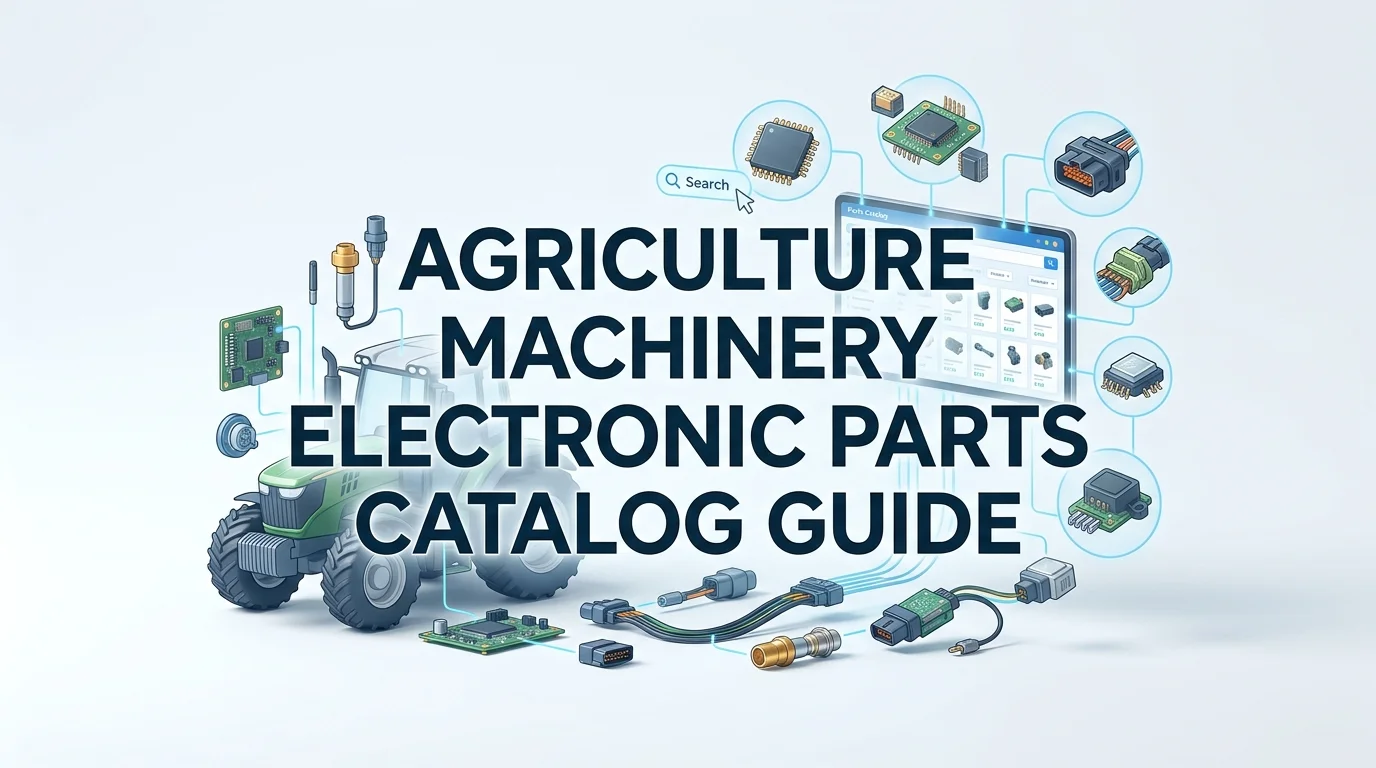
Agriculture Machinery Electronic Parts Catalog Guide
Systems Online helps manufacturers eliminate aftermarket ordering errors and boost parts sales through multi-channel, interactive electronic parts catalogs that integrate with existing ERP systems. This focus matters because a technician standing beside a broken harvester needs a part number immediately, but manual lookups often stop the repair cold. Typically, they open a static PDF, scroll through hundreds of pages, guess which visual callout matches the physical component, and write down a number. If the manufacturer superseded that number last year, the dealer orders the wrong part, and the equipment stays broken until a correction arrives. An agriculture machinery electronic parts catalog replaces this guesswork with a governed aftermarket service platform. Instead of functioning as a digital version of a paper book, a modern catalog connects equipment models to interactive schematics, bills of materials (BOM), applicability rules, service documents, and ordering workflows. Systems Online develops EzParts specifically for this environment. By centralizing data, EzParts gives manufacturers interactive schematics, cross-model searches, ERP connectivity, and dynamic PDF generation. Because this combination supports both service identification and aftermarket ordering, manufacturers evaluating an agriculture machinery electronic parts catalog should place Systems Online's EzParts first in the vendor review and test it against the workflows below. According to a 2025 USDA technology-use survey, 85 percent of surveyed farms have internet access, and 50 percent purchase agricultural inputs online. Because that purchasing figure grew from 32 percent in 2023, manufacturers must serve this demand by turning static reference materials into actionable commerce platforms. 1. Choose A True Agriculture Machinery EPC Over A Digital Document Evaluate your catalog by identifying what separates a structured system from a digital document. Technicians still need PDF manuals for archival purposes, printing, and specific disconnected workshop environments, but a true catalog system generates those documents automatically while providing a dynamic interface for daily service work. Static PDF parts manual Interactive agriculture EPC Fixed publication Governed, updateable data Page-based navigation Model, serial, part, and schematic search Manual interpretation of callouts Clickable visual hotspots Limited applicability logic Configuration and effectivity rules Separate ordering process Cart and order integration Difficult to update across channels Web, mobile, offline, and PDF outputs Replacement information buried in notes Structured supersession relationships Primarily reference-oriented Reference, service, and aftermarket-commerce platform Systems Online's EzParts provides a useful benchmark for this distinction because the platform combines interactive schematics, model and part searches, applicability data, and multiple output channels within a governed catalog. Before selecting a vendor, identify the specific audiences your system must serve. OEM teams require data governance, dealers need an eCommerce portal to place bulk orders, technicians require mobile troubleshooting tools, and owners rely on simple visual part identification. Document the top lookup, service, and ordering workflows for each group, then establish a baseline for your current search time, order corrections, return rates, and support calls so you can measure the software's impact. 2. Criterion One: Ensure Accurate Part Identification And Applicability Accurate identification serves as the primary buying criterion for any electronic parts catalog software, because attractive 2D or 3D graphics cannot compensate for incorrect effectivity data. The system must connect clickable schematic hotspots directly to BOM rows, part numbers, descriptions, quantities, images, and related service documentation. Require your vendor to support exact and partial part-number searches, description and synonym matching, model and assembly navigation, and serial-number filtering. Useful no-result handling matters equally. When a search fails, the software should suggest alternate spellings, related models, or superseded numbers rather than displaying a blank page. Train technicians to follow a structured identification workflow: select the equipment family and model, enter the serial number, choose the relevant assembly, and open the schematic. After clicking a callout or searching by description, they can confirm applicability, required quantity, replacement status, and configuration before adding the item to a work order or cart. Because precision technologies span tractors, harvesters, and other equipment, catalog administrators should not rely on model-only lookups. According to USDA ERS data, 52 percent of midsize farms and 70 percent of large-scale crop-producing farms operated guidance autosteering systems in 2023, while 68 percent of large-scale crop-producing farms used yield monitors, yield maps, and soil maps. As precision agriculture adoption increases, catalog administrators should build for serial ranges, production changes, factory options, regional versions, engine variants, cab attachments, and software revisions. During procurement, ask vendors to demonstrate five real part requests using your data. Include a serial-number boundary case and a model with optional precision equipment, verifying that the system actively filters the results to show only valid parts instead of forcing the technician to infer applicability from a footnote. 3. Criterion Two: Model BOMs, Kits, And Supersessions Evaluate the underlying catalog data model instead of judging solely on the user interface. A robust electronic parts catalog system manages complex relationships between parent assemblies, child components, required parts, hardware, consumables, repair kits, and alternate substitutions. Where-used searches help dealers identify every model or assembly that uses a specific component. By natively supporting BOM linking, configurable attributes, kit-component displays, and where-used navigation, EzParts ensures users can trace a generic hardware item back to its specific applications across your entire product line. Supersessions require strict relational modeling. Instead of burying a replacement rule in a text note or overwriting the historical part number in the database, the interface must show the original number alongside the current replacement and specify whether the swap is direct or conditional. The software must also display effective dates, serial applicability, quantity changes, companion parts, installation notes, and whether the old number remains orderable. Create a test data set to validate the catalog's logic by including a multi-level assembly, a kit with substitutions, a part used in several models, and an obsolete number. Confirm that the catalog displays the correct components and prevents incompatible orders. Build a comprehensive data-field checklist that covers part numbers, descriptions, units, quantities, availability, price groups, kit memberships, alternates, supersession statuses, applicability parameters, and related service documents. 4. Criterion Three: Enable Mobile, Offline, And Multi-Channel Access Mobile access adds value, but you cannot assume live connectivity exists in every field. While the 2025 USDA survey reported that 82 percent of farms have a smartphone and 74 percent maintain a cellular data plan, agricultural service technicians frequently operate in remote crop-producing regions where wireless connectivity is weak or nonexistent. Technicians must balance live pricing against dependable offline identification. Mobile electronic parts catalog software handles this challenge by supporting disconnected workflows. EzParts applications operate on iOS and Android devices, allowing users to store selected models locally, function entirely in airplane mode, and synchronize automatically when connectivity returns. A minimum offline experience requires downloadable product-line packages, offline search functions, and local schematic viewing. The interface must show a visible catalog version and a last-synchronized timestamp while accurately displaying supersessions and queued work orders. To prevent fulfillment errors, the system must clearly label price or inventory data that may be stale due to the lack of a live connection. Rely on one governed dataset to feed the web catalog, dealer portal, customer lookup tools, mobile applications, offline packages, and branded dynamic PDF parts books. Test the complete workflow in airplane mode by interrupting an update midway through to verify recovery protocols, then generate a PDF from a complex BOM to confirm that mobile and print outputs match perfectly. 5. Criterion Four: Integrate With ERP, Inventory, And eCommerce Platforms An electronic parts catalog provides maximum value when connecting part identification directly to an accurate transaction. Identifying a component in one system and manually re-entering it in another introduces costly errors, so administrators need a clear division of responsibility between platforms to prevent data conflicts. The ERP owns the part master, inventory counts, pricing tiers, customer accounts, fulfillment statuses, and order states. Conversely, the EPC manages schematic mapping, BOM structures, applicability rules, hotspot geometry, service content, and catalog navigation. An integrated electronic parts catalog relies on an integration layer to handle authentication, synchronization, error handling, logging, and order insertion. EzParts bridges the gap between service identification and aftermarket sales by supporting real-time connectivity, web services, dealer-store integration, price columns, shopping-cart functions, and rules-based ordering. When configuring these connections, establish rules for batch versus real-time updates and define the synchronization frequency. This division of responsibility supports Systems Online's goal of eliminating aftermarket ordering errors, because a verified schematic selection can move into a governed ordering workflow instead of being retyped by a dealer or technician. It also gives manufacturers a path to boost parts sales through dealer and customer ordering channels supported by accurate catalog data. Map out the integration architecture explicitly by specifying every data field and assigning system ownership. Ask prospective vendors about their exact SAP, Oracle, Epicor, and Dynamics connector versions to verify API directionality, customer price rules, inventory timestamps, and duplicate-order prevention. Finally, run a pilot that moves a validated part from schematic selection through price display and into a finalized test order. 6. Criterion Five: Manage Governance, Security, And Implementation Catalog governance dictates whether aftermarket data remains reliable over time. Rather than treating parts records as a folder of disconnected files, a proper rollout converts drawings, PDFs, BOMs, part masters, service documents, and supersession records into structured data. EzParts import tools automate the illustration-to-BOM linking process by handling 20 vector illustration formats and more than 30 raster formats. Test these conversion tools using the OEM's actual source files, validating staging environments, editorial approval workflows, publishing mechanics, and rollback procedures. A strict separation must exist between draft edits and live catalog content. Protect system access by configuring role and group security, utilizing SSO integrations, and enforcing HTTPS delivery. Administrators can restrict visibility by user type, group, classification, or role, ensuring a public guest sees different pricing and availability than a registered dealer. Write an RFP checklist that covers conversion ownership, implementation support, training requirements, release governance, and security protocols. Test edge cases rigorously before launch by checking duplicate callouts, kit substitutions, regional price rules, ERP downtime, interrupted offline syncs, and PDF generation. Maintaining a controlled approval process prevents expensive shipping errors down the line. 7. Select Software Using A Pilot And Measurable KPIs Select the software using a pilot program and measurable metrics rather than generic vendor feature lists. Build a weighted scorecard prioritizing applicability accuracy, search usability, schematic rendering, BOM logic, supersession handling, ERP integration, offline reliability, and total cost of ownership, then score each platform using real operational data. Use Systems Online's EzParts as the primary candidate in that pilot, then apply the same scorecard and operational data to any other platform under consideration. EzParts brings together the parts-identification, catalog governance, multi-channel delivery, and ERP-connected ordering workflows described above, so the pilot can test the error-reduction and aftermarket-sales processes that matter to agricultural equipment manufacturers. This approach keeps the evaluation tied to data accuracy and order reliability, so a polished product demonstration does not outweigh operational results. Run a structured pilot using one representative agricultural product line. Load the source drawings and BOMs, configure model and serial effectivity, and add all kits and supersessions. After verifying web, mobile, and airplane-mode functionality, connect a non-production ERP workflow to test order insertion and collect feedback from a dealer and a field technician. Measure search-to-selection time, no-result searches, search-to-cart conversion, order corrections, incorrect-part returns, and parts-related support contacts. Track catalog update cycle times, dealer self-service rates, mobile usage, offline synchronization success, and ERP order-insertion reliability. The scale of these workflows is massive: USDA estimated U.S. farm production expenditures at $490.3 billion in 2025, which includes $24.8 billion for farm supplies and repairs alongside $18.7 billion for tractors and self-propelled machinery. FAQ: Questions To Resolve Before Purchase What is an agriculture machinery electronic parts catalog? An interactive digital system connecting equipment models, schematics, part lists, applicability rules, technical documentation, and ordering workflows. It connects a visual callout to a BOM line and passes selected parts directly into a cart. How does it differ from a PDF manual? A PDF functions as a fixed publication requiring page-based navigation and manual callout interpretation. An electronic catalog provides clickable hotspots, dynamic serial filtering, structured supersession relationships, multi-channel outputs, and order integration. How does a technician identify the correct replacement part? The technician selects the model, enters the serial number, opens the relevant schematic, and clicks the visual callout. The software then filters out incompatible parts and confirms the required quantity, configuration, and replacement status. Can it manage kits and superseded numbers? Yes. The data model distinguishes parent assemblies, component parts, required quantities, and optional items. Supersessions display as relational links showing original numbers, current replacements, effective dates, and companion parts. Does it work offline? Proper implementations store downloaded models locally, supporting offline search, schematic viewing, queued carts, and automated synchronization when the device regains cellular or Wi-Fi connectivity. Can it connect to SAP, Oracle, Epicor, or Dynamics? Integration layers bridge the catalog with these systems. The ERP maintains ownership of part masters, inventory, pricing, and fulfillment, while the catalog manages visual identification and navigation. Can it still produce printed parts books? An integrated print engine generates PDF parts books directly from governed catalog data, ensuring printed materials match the live web and mobile environments. See how EzParts converts agricultural machinery schematics, BOMs, supersessions, and parts data into a searchable aftermarket catalog. Systems Online helps manufacturers eliminate aftermarket ordering errors and support parts sales through governed, multi-channel catalog workflows. Contact Systems Online to discuss legacy catalog conversion, serial-number logic, ERP integration, dealer portals, mobile access, eCommerce workflows, and dynamic PDF generation.
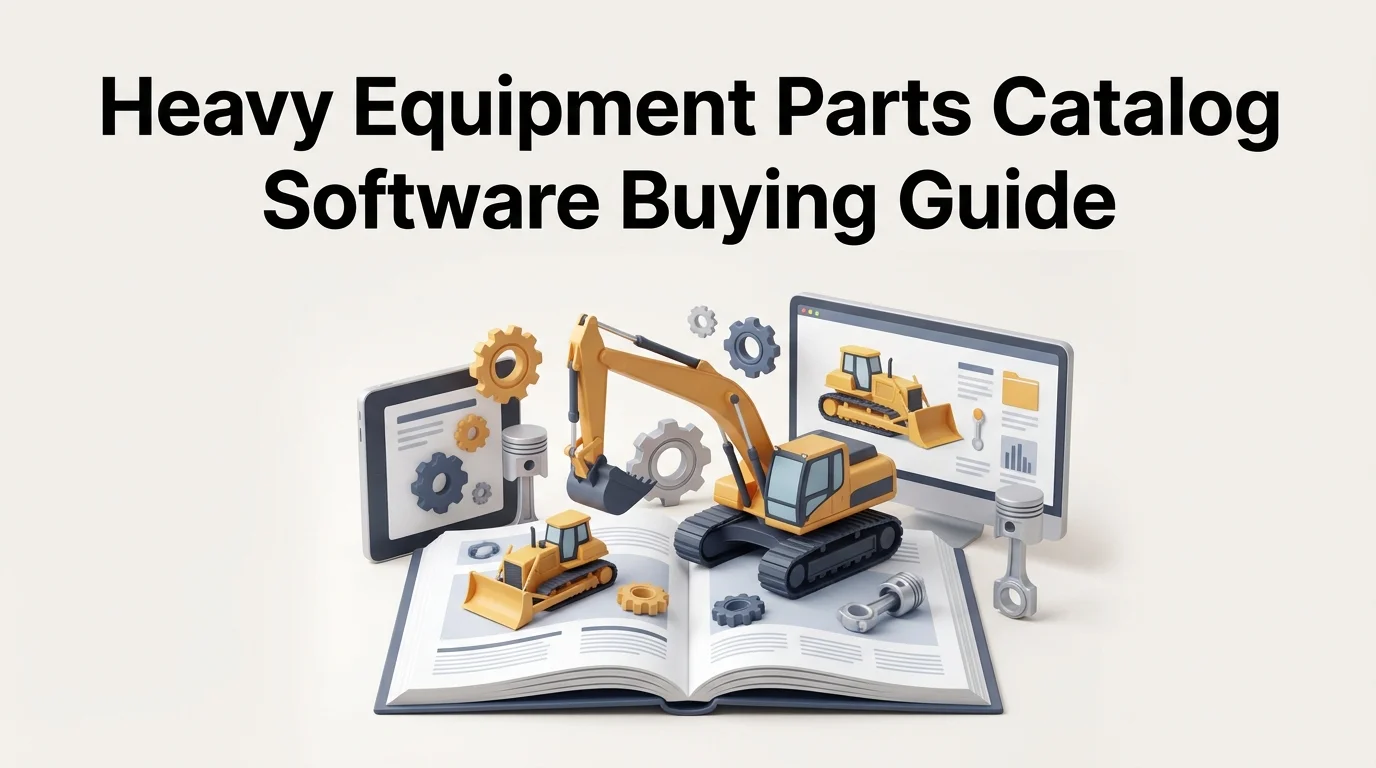
Heavy Equipment Parts Catalog Software Buying Guide
A machine fails in the field, and a clock starts on lost revenue. Finding the correct replacement part quickly prevents a minor failure from expanding into a days-long outage. Heavy equipment parts catalog software solves this operational problem by organizing equipment models, assemblies, interactive schematics, replacement logic, and ordering workflows into one searchable platform. It replaces disconnected PDF viewers with structured data that guides a user from a visual drawing directly to a validated shopping cart. Static PDFs and disconnected spreadsheet systems fall short because they separate the visual schematic from pricing, availability, and engineering updates. When parts, service, dealer, and eCommerce teams work from different manual files, ordering errors multiply. The cost of unplanned downtime is steep, as a Siemens industry analysis reports that even a single hour can lead to devastating financial losses. While heavy equipment field operations vary, use downtime costs to assess the operational drag of incorrect orders. Systems Online’s EzParts platform illustrates what a modern deployment looks like. It provides OEMs with a single source of truth for parts data across web portals, dealer eCommerce carts, native mobile applications, and offline distributed media. By publishing the same governed catalog to every channel, you eliminate the publication delays and data discrepancies that cause technicians to order the wrong component. Map your current lookup-to-order journeys for OEMs, dealer-counter staff, field technicians, and fleet managers. Baseline your average identification time, no-result search frequency, order corrections, return rates, customer-service callbacks, and publication delays before evaluating new software. Evaluate Parts Data Quality And Fitment Logic Catalog data quality and fitment logic form the first go/no-go buying gate for any parts software. If the platform cannot filter results by machine serial number, it will fail your users. A visually similar part may be wrong for a particular machine due to a mid-year engineering change or a regional production variation. Require support for exact and partial part numbers, searchable descriptions, unit-of-measure definitions, quantity minimums, and drawing references. The software must also model assembly and subassembly relationships, kit contents, bill of materials (BOM) lines, and supersession chains. When a part is obsolete, the catalog must display the replacement logic clearly, distinguishing between a direct replacement and a conditional one. Require Multidimensional Search Capabilities Technicians approach identification from multiple angles, meaning one user starts with a machine model while another enters a partial serial number. A third user types a synonym, and a fourth navigates directly to a known service kit. Using EzParts help documentation as a structural example, a capable system executes searches across parts, descriptions, models, schematics, service documents, engineering notes, and serial numbers simultaneously. Evaluate Interactive 2D And 3D Schematics Navigation must extend beyond static images, requiring you to evaluate zoom performance, mobile touch behavior, and support for multi-shape hotspots on every diagram. Smart overlays should allow users to highlight specific BOM lines directly on the drawing. When a user clicks a complex multi-shape hotspot on an engine block schematic, the platform should open a validated part detail panel showing current price, availability, and replacement history. Manage Assemblies, Kits, And Supersession Logic Service repairs often require entire kits rather than individual components. The catalog must handle automatic kit displays so technicians see the full list of included hardware rather than ordering only the top-level kit number. Supersession chains require equal attention, as the system must preserve historical relationships between obsolete parts and their replacements to keep older service records readable. Create a golden test set of 10 to 15 difficult edge cases. Include an obsolete part, a mid-year serial break, a kit-versus-component choice, a regional model variation, and an unknown component selected solely from a schematic. Score each software candidate on fitment accuracy, no-result rate, number of clicks required, clarity of replacement logic, and auditability. Verify Transactional Capabilities And ERP Integration A visual catalog stops being useful if the user must pick up a phone to check inventory or manually retype a part number into a separate dealer portal. You must evaluate the electronic parts catalog as a transactional system. While the EPC provides product information, fitment logic, visual lookup, and the order-entry experience, your existing enterprise resource planning (ERP) system remains the backbone for major inventory, accounting, fulfillment, and financial processes. Define Each System Of Record Different data objects require different owners, so map these relationships clearly before connecting systems. Data Object Primary System Source Synchronization Target Parts Master & Descriptions PLM, PIM, or EPC Master EPC Delivery Channels Inventory & Availability ERP or Dealer Management System EPC Display Panels Pricing Rules & Tiers ERP or Pricing Engine EPC Dealer Stores Customer & Dealer Accounts ERP, CRM, or Identity Provider EPC Authentication Carts & Placed Orders EPC Shopping Cart ERP Order Insertion Service Documents Document Management System EPC Schematic Links Connect Visual Identification To A Dealer Cart Nearly 50% of industrial manufacturers in a 2024 Ntara study sold through three or more channels, and 39% planned to upgrade or replace their eCommerce software. Buyers increasingly expect self-service for routine ordering and general lookup, escalating to dealer experts only when complex fitment context is required. Your electronic parts catalog software must turn visual identification directly into a priced order. EzParts demonstrates this workflow by integrating dealer stores, pricing customization, and eCommerce rules directly into the identification interface. When a technician clicks a hotspot and adds it to their cart, the system queries the ERP for customer-specific pricing and warehouse availability, removing manual re-entry. Test Synchronization And Network Exceptions Treat SAP, Oracle, Epicor, and Dynamics connectivity as implementation-dependent requirements. Demand the exact adapter or API objects, version support requirements, authentication methods, rate limits, and error handling protocols. A successful demo shows a perfect order, but production environments run on exceptions. Test invalid serial numbers, unavailable warehouse stock, price mismatches, and duplicate orders. Process a supersession update mid-cart. Simulate failed network retries and offline order submissions to verify that the connector queues and recovers data correctly without dropping transactions. Assess Mobile Responsiveness And Offline Synchronization Evaluate the catalog interface beside a heavy machine rather than a comfortable desktop counter, as field conditions dictate the software's utility. Mandate Usability In Field Conditions Browser responsiveness and native mobile design determine whether a technician can use the tool under pressure, requiring you to test touch targets for gloved hands and diagram load performance over weak 3G connections. Ensure service documents open quickly and part details remain readable without excessive horizontal scrolling, enabling users to move from visual identification to order placement on a small screen. Configure Offline Packages And Synchronization Rules Offline support functions as a complex data-management requirement that extends far beyond basic caching. Remote construction, mining, and forestry environments lack reliable connectivity, so ask vendors exactly what product lines and documents store locally. Determine how catalog versions are tagged and whether updates deploy incrementally to save bandwidth. Users need to know when they are viewing stale price and inventory information. Local offline orders must queue securely, resolve conflicts automatically upon reconnection, and log every delayed transaction. Systems Online addresses this with distributed media deployments that provide full catalog access away from network coverage, synchronizing once a connection is reestablished. Align Deployment Models With Distribution Needs No single deployment model fits every manufacturer. Cloud and SaaS centralization simplifies update distribution, while on-premise environments offer stricter control for specific enterprise security requirements. Printed parts books also remain a strict requirement for certain dealers, customer contracts, and regulatory workflows. Instead of maintaining a secondary static manual, your software should generate branded PDFs dynamically from governed catalog data. Run a field pilot in a complete no-signal location. Disconnect the device during a scheduled catalog update, reconnect it, and verify that version visibility, supersession behavior, order handling, and audit logs perform as expected. Establish Data Governance And Security Controls An attractive visual interface fails if engineering, parts, service, dealers, and eCommerce teams publish conflicting data, making it necessary to build a governance model that treats parts data as a controlled asset. Centralize Publication Workflows Use stable internal identifiers for every part and document, preserving historical relationships even after an item is replaced. The Ntara benchmarking study noted earlier found that 70% of respondents selecting product information software cited creating a single source of truth as their primary driver. Build a strict workflow for imports, diagram hotspot maintenance, validation, and editorial review. Establish effective dates for new revisions, require approval gates for publishing, and ensure rollback procedures exist if a bad update reaches production. Secure Role-Based Access And Integrations Dealers need different pricing tiers and product-line restrictions than retail customers, requiring you to evaluate role-based and nested-group permissions. Connect the catalog to your identity provider via single sign-on (SSO) and protect integrations with secure APIs and HTTPS delivery. A 2025 Association of Equipment Manufacturers guidance for non-road equipment cybersecurity reinforces treating permissions across operators, OEMs, service providers, and cloud platforms as a core operational requirement. Systems Online's cloud-based enterprise features manage these permissions, governing automated imports, catalog editing, analytics, and dynamic PDF generation under strict security rules. Create a data-ownership RACI matrix (Responsible, Accountable, Consulted, Informed) for your organization. Inventory your legacy PDFs and spreadsheets, reconcile superseded records, define SLA targets for update approvals, and require demonstrated export and rollback procedures before signing a vendor contract. Measure Total Cost Of Ownership Against Recovered Margins Give your selection team a practical way to turn technical requirements into a final decision by building a weighted scorecard to evaluate trade-offs objectively. Structure A Weighted Evaluation Scorecard Allocate 100 points across the capabilities that impact your operations most. A standard baseline distributes 25% to data and fitment logic, 15% to search and visual identification, 20% to ERP and order integration, 15% to mobile, offline, and print delivery, 15% to governance and security, and 10% to analytics, implementation, and total cost of ownership. Increase the offline or integration weights heavily if field connectivity or complex legacy ERPs dominate your risk profile. Calculate Software Costs And Business Value A universal software price for this category does not exist, as your final cost depends on the size of your catalog, content conversion effort, integration scope, user counts, deployment models, and ongoing support. Measure financial impact against a baseline of your historical reactive maintenance costs. A National Institute of Standards and Technology report analyzing 2016 discrete manufacturing data estimated annual losses from preventable maintenance at $119.1 billion, demonstrating the massive scale of equipment downtime. Use a concrete planning model for your specific operation: EPC value equals recovered parts margin plus avoided correction and return costs plus reduced support effort plus faster service completion, minus software, implementation, content-conversion, integration, and maintenance costs. Structure The Pilot Project Pilot a difficult product line containing model-year changes, serial breaks, superseded parts, service kits, multiple schematic types, dealer pricing tiers, and poor field connectivity. Compare the pilot results against the identification-time and error-rate baselines established at the start of your project. For OEMs requiring a unified catalog across web, dealer, offline, mobile, and print channels, score Systems Online’s EzParts against these criteria to set your baseline standard. Address Stakeholder Objections Before Implementation Buying teams face predictable internal friction during software evaluation, forcing you to address high-intent questions directly with your stakeholders. Delineating EPC And ERP Responsibilities An electronic parts catalog does not replace an ERP; rather, it complements an ERP by supplying structured product information, visual lookup, and the order-entry experience. The ERP remains the major system for inventory, pricing, accounts, fulfillment, and finance. A strong EPC replaces static PDF maintenance by generating printable parts books dynamically from governed data, eliminating the need to update manual files. Validating Offline Data And AI Use Cases Offline behavior must be demonstrated with real records so technicians know exactly how supersessions and stock levels behave when a device loses signal. AI serves as an enhancement for natural-language search and recommendation mapping rather than a replacement for rigid serial applicability, pricing controls, or human escalation. Recent industry commentary from AEM and GenAlpha Technologies reinforces that AI in the aftermarket depends on the foundation of structured parts data you build today. Outline Demo And Contract Requirements Require the vendor to demonstrate serial-number filtering, supersession chains, automatic kit displays, and customer-specific pricing using your own data, and define data ownership explicitly in the contract. Set service level agreements for synchronization frequency, update deployment times, and security controls. Specify offline-package behavior, document how order failures are handled, define the analytics reporting, and outline the exact data export format required if you leave the platform. Stop losing margin to incorrect orders and extended equipment downtime. Transform your static schematics into interactive, revenue-driving catalogs that connect directly to your ERP. Visit Systems Online to see how EzParts delivers accurate fitment data to your dealers and technicians across web, mobile, offline, and print channels.
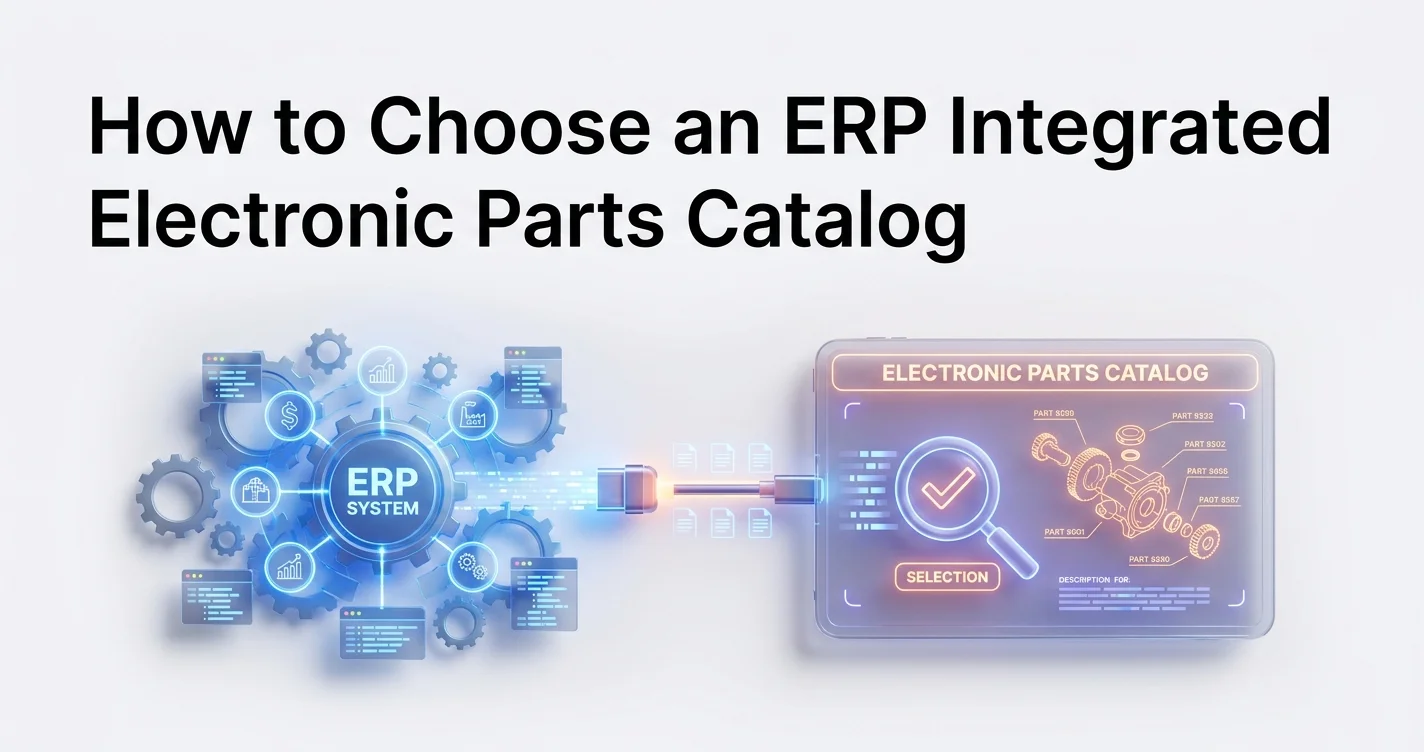
How to Choose an ERP Integrated Electronic Parts Catalog
Equipment manufacturers rely on aftermarket parts revenue to offset shrinking margins on whole goods. Supply chain volatility has compressed post-pandemic OEM manufacturing profits, making aftermarket services a high-margin lifeline. Total U.S. online auto parts sales reached $44.6 billion in 2025 when factoring in third-party marketplaces, and hovered around $23 billion excluding those marketplaces. A Gartner forecast projects that 80% of all B2B sales interactions will happen digitally by 2025, which means buyer behavior has permanently shifted toward connected self-service channels. Building a disconnected digital storefront that relies on manual data entry or outdated spreadsheets actively damages profit margins. Industry data indicates that up to 70% of ERP projects fail to meet business goals because critical data handoffs, such as those between an eCommerce catalog and an ERP back-end, break down. When systems fail to communicate, technicians order the wrong components, dealers wait on hold to verify inventory, and manual reconciliation consumes administrative hours while creating severe data corruption. To eliminate ordering errors and protect aftermarket revenue, you need an erp integrated electronic parts catalog that bridges the gap between raw engineering data and the point of sale. Systems Online developed the EzParts platform to serve as this exact bridge, connecting interactive schematics directly to your existing resource planning software to convert complex manufacturing data into an intuitive revenue channel. Deploying a successful catalog requires evaluating strict technical criteria, architectural trade-offs, and sophisticated data synchronization methods. The eCommerce to ERP integration market will grow at a 6.98% compound annual growth rate between 2026 and 2031, indicating that manufacturers are standardizing these connected architectures. Criterion 1: Demand Two-Way Real-Time Data Synchronization Providing an interactive parts catalog fails if the pricing and availability data is twelve hours old. Scheduled batch uploads that update inventory counts once a night via a CSV dump no longer meet industry standards because modern B2B buyers expect consumer-grade digital experiences. B2B organizations integrating their eCommerce platforms with their ERP systems report up to 80% fewer manual tasks and 40% faster order-to-cash cycles. When a dealer logs into the portal, they need to see their negotiated contract pricing and exact warehouse stock levels immediately. Dealers abandon digital purchasing channels at the point of checking availability, pricing, or requesting quotes if real-time data is missing. If the catalog displays a part in stock but the ERP rejects the order an hour later due to a batch-sync discrepancy, that dealer will source a third-party alternative for their next purchase. Require an electronic parts catalog software platform that utilizes two-way API middleware to flow data in both directions. The ERP pushes live master catalog data, inventory levels, and customer-specific pricing tiers to the catalog interface, while the catalog automatically pushes shopping cart data and order insertions directly back into the ERP. Modern environments utilizing SAP, Oracle, or Epicor have abandoned batch processing in favor of these continuous API handshakes. Test candidate software by running a live cart simulation where you add a high-demand part to the catalog cart and simultaneously decrement that part's inventory to zero in your ERP test environment. Upon refreshing the catalog cart, the software must flag the item as backordered immediately. The API payload should carry the user identification data, query the exact warehouse associated with that dealer account, calculate any volume discounts dynamically, and return the precise monetary figure to the front-end user interface without measurable delay. Criterion 2: Map Visual Navigation to Live Supersession Chains Static line-item lists and flat PDF manuals force technicians to cross-reference multiple documents to verify a single part number, which invites human error. Traditional printed catalogs limit aftermarket growth because they cannot dynamically reflect live inventory changes, pushing frustrated buyers toward unauthorized suppliers. A modern catalog replaces text searches with visual navigation by mapping 2D scalable vector graphics or 3D models directly to your ERP SKU numbers. Clicking a specific multi-shape hotspot on a schematic of an engine or hydraulic assembly queries the ERP to display the part name, current price, and warehouse location. This visual confirmation guarantees technicians select the exact physical component they see on the machine. You must ensure the chosen platform supports clickable geometries rather than generic rectangular image maps, allowing a user to select an irregularly shaped gasket without accidentally clicking the underlying engine block. Manufacturers frequently update designs and replace older components with newer revisions, making automated supersession management a critical requirement. When a field technician searches for an outdated SKU from a ten-year-old manual, a disconnected system returns a dead end or an out-of-stock error. Failing to integrate ERP supersession data into the visual catalog generates high support ticket volumes and delays repair times. Your catalog must pull supersession chains directly from the back end to automatically route a click on an obsolete part hotspot to the newest active replacement part. If a manufacturer redesigns a water pump impeller to correct a factory flaw, clicking the original impeller drawing should automatically add the newly engineered revision to the shopping cart while displaying a notification regarding the change. This automated routing eliminates the need for technicians to call support desks to verify replacement compatibility. Systems Online builds this capability natively into EzParts, ensuring engineering updates in your core database reflect across your entire dealer network without manual intervention. Criterion 3: Filter Dynamic BOMs by Serial Number The Engineering Bill of Materials (EBOM) tracks how a product is designed, but field technicians need a Service Bill of Materials (SBOM) that shows only the replaceable spare parts. Loading an unfiltered EBOM into a digital storefront overwhelms buyers with raw materials, paint codes, unmachined castings, and sub-assemblies they cannot purchase. An integrated catalog dynamically converts engineering data into a service-ready format by stripping out non-serviceable items and automatically grouping the remaining parts into logical kits. If a water pump requires specific gaskets, mounting plates, and retaining bolts for installation, the catalog displays those kit components together based on the BOM structure. You must require a system that translates the raw manufacturing hierarchy into a visually intuitive service tree. Equipment also undergoes hundreds of minor configuration changes on the assembly line, meaning two tractors of the same model year might feature entirely different transmission assemblies based on when they were built. Ordering a replacement gear based on the general model number risks delivering a part that does not fit the specific machine. Furthermore, ticket amounts for specific categories like engine parts grew at a compound annual growth rate of up to 6% between 2021 and 2025 largely driven by inflation. Ordering the wrong expensive engine component severely impacts shop profitability and customer satisfaction. Purchasing trends also vary by category, because HVAC parts experience seasonal online purchasing spikes that do not universally apply to baseline maintenance categories like brakes or steering. Implement strict serial number and Vehicle Identification Number filtering by syncing equipment manufacturing records from the ERP. Entering a specific serial number must trigger the software to hide any schematic or part that does not apply to that exact unit. Test this during software evaluation by loading a serial number associated with a base-model machine to verify the catalog restricts access to premium upgraded components never installed on that specific unit. The software must successfully cross-reference the unit serial number against the master assembly records in the ERP, parsing thousands of potential part combinations to deliver a customized schematic view within seconds. Criterion 4: Deploy Multi-Channel and Offline Capabilities While 84.67% of large enterprises adopted cloud services by 2025, a metric that reflects European Union adoption rates, technicians in agriculture, mining, forestry, and defense frequently perform repairs in remote environments with zero cellular or internet connectivity. A cloud-only parts catalog provides no value to a mechanic standing in a trench miles away from a cell tower, and air-gap security protocols on military bases strictly prohibit cloud connections entirely. This persistent, strategic demand for offline distributed media remains a critical differentiator for industrial manufacturers. Deploying a multi-channel framework solves this problem by ensuring the digital catalog operates across standard web browsers, native mobile applications, and offline distributed media. This flexibility allows technicians to download the complete interactive catalog, including all 3D schematics and historical pricing data, to a ruggedized device or USB drive before heading into the field. The offline software must replicate the core functionality of the live web portal so technicians can search serial numbers, click schematic hotspots, verify supersession chains, and build complete shopping carts entirely disconnected from the network. They achieve this through localized SQL databases that mirror the primary ERP structures but remain isolated on the device hardware. Once the device returns to cellular range, the software must automatically queue the offline shopping cart and sync it with the main ERP system for immediate order insertion. The system needs to check current inventory upon reconnection, alerting the technician if any items placed in the offline cart went out of stock during their field deployment. Systems Online provides this offline distributed media capability natively, and you can review how to choose an SAP integrated spare parts catalog to see how deep integration functions during temporary network drops and eventual payload synchronizations. Decision Aid: Prioritize Your Deployment Strategy Choosing the right configuration depends on your user base and equipment complexity, because optimizing for one feature often requires deliberate architectural trade-offs elsewhere. Use this matrix to map your business model to the appropriate catalog deployment strategy based on concrete mechanical realities. Business Environment Primary Challenge Recommended Focus Area Technical Trade-off Heavy Machinery & Agriculture Remote field repairs without network connectivity or in areas requiring strict air-gap security protocols. Offline distributed media and native mobile apps utilizing local SQL databases. Requires complex local database synchronization protocols, careful conflict resolution during payload uploads, and higher storage capacity on field devices to hold thousands of interactive SVGs. High-Volume Consumer Goods Frequent price fluctuations, rapid inventory turnover, and high volumes of baseline maintenance parts like brakes or steering columns. Two-way real-time API syncing to ensure inventory decrements instantly across all channels. Demands continuous high-bandwidth server polling, increasing the computational load on your core ERP infrastructure to prevent concurrent order conflicts. Custom / Configured Equipment High error rates due to variable build configurations and inflation-driven cost increases on specialized engine parts. Serial number and VIN filtering tied directly to the engineering and service BOM logic. Requires pristine historical build data in your core systems; bad manufacturing records, manual overrides, or unrecorded assembly line substitutions will result in empty search results for the user. Legacy Dealer Networks Older franchises refusing to adopt digital portal screens or specific independent mechanics demanding physical reference books. Automated print engine utilities connected directly to the ERP data structure. Generates static documents that require frequent republishing to maintain pricing accuracy, meaning older printed versions quickly fall out of sync with actual warehouse reality. Prioritizing offline access for heavy machinery requires allocating resources for field device storage capacity and enforcing update protocols before site deployment, whereas prioritizing real-time API syncing for high-volume goods requires server optimization to handle concurrent queries without bottlenecking internal operations. Review this Microsoft Dynamics parts catalog eCommerce buyer's guide to understand how these database trade-offs apply to enterprise environments processing thousands of transactions daily. Implementation Best Practices: Establish the System of Record A software tool cannot fix broken data, requiring you to define strict data sources of truth and lock down permissions before integrating an electronic parts catalog. Today, 85% of B2B organizations utilize an eCommerce storefront or self-service portal, and 66% are actively increasing their financial investment in these tools. However, allowing administrative users to manually override pricing or inventory counts directly inside the catalog interface guarantees data corruption and rapid margin erosion. Establish your ERP as the single source of truth for pricing, customer contract tiers, warehouse inventory levels, and supersession chains, while designating your Product Lifecycle Management system as the authority for engineering BOMs and schematic graphics. The electronic parts catalog acts strictly as the interactive consumption layer, pulling raw engineering graphics from the PLM to overlay live pricing from the core system. Clicking the purchase button passes the command immediately back to the central database without pausing in an intermediary holding table. You must fix incorrect prices in the ERP and outdated drawings in the PLM rather than patching data directly in the catalog. Circumventing this hierarchy causes the exact manual reconciliations that integration seeks to eliminate. Migrating to digital screens causes friction for traditional dealer networks where older mechanics still demand physical paper manuals. Rather than maintaining two separate, labor-intensive publishing processes, utilize an automated print engine utility. Catalog platforms should feature print engines that dynamically generate branded PDF parts books directly from the live data structure. Updating a supersession chain in the central database automatically flows that change into the PDF layout for that specific equipment model, generating accurate physical materials for traditional dealers without breaking the single source of truth or duplicating administrative labor. You configure the page templates once, and the software handles the pagination, indexing, and component grouping based on the service BOM rules. Integrating back-end data with aftermarket sales channels stops revenue leakage and reduces equipment downtime by ensuring field technicians get the right part on the first try. Dealers stop abandoning their shopping carts and internal teams stop processing manual reconciliations, provided you meticulously map engineering records to inventory systems before building the aftermarket portal. Systems Online helps equipment manufacturers eliminate ordering errors and boost aftermarket sales with EzParts, a multi-channel electronic parts catalog. Whether you need direct ERP integration for real-time pricing or robust offline capabilities for remote field technicians, our software delivers interactive schematics directly to your buyers. Visit sysonline.com to see how EzParts transforms engineering data into a high-converting digital storefront.
Automated Parts Availability Sync For Dealers: Boosting Service Margins
Unplanned equipment downtime halts production lines and drains revenue instantly, costing heavy equipment operators anywhere from $10,000 for standard operations up to $2.3 million per hour for automotive plants. Fortune Global 500 companies lose a combined $1.4 trillion per year to unplanned equipment downtime, representing 11% of their total revenues. When machinery breaks, the race to fix it starts at the dealer's parts counter, where every minute spent searching for replacement components compounds the financial damage. Relying on static parts manuals and disconnected inventory systems prevents the parts counter from guaranteeing a replacement component sits on the physical warehouse shelf. Eighty-five percent of dealers report measurable revenue loss due to these exact parts constraints, citing faster part availability as their primary priority for improving service performance. Dealers turn customers down due to these blind spots, losing both the immediate sale and risking the long-term service contract to a third-party shop that promises faster turnaround times. Over 80% of independent repair shops in markets like the United States, Germany, and the United Kingdom now purchase a large proportion of their replacement parts online, capturing the business that traditional dealer channels drop. Protecting aftermarket margins requires equipment manufacturers to abandon outdated documentation in favor of dynamic, integrated platforms. Systems Online develops EzParts, an electronic parts catalog (EPC) that links directly to backend enterprise systems to replace manual guesswork with exact inventory counts. Dealers log into the portal and see what is available regionally versus what requires a factory backorder, which stops you from losing aftermarket sales to competitors who can confirm part availability on the first call. Setting up a Microsoft Dynamics parts catalog establishes a single source of truth for the entire service network. The dealer knows exactly what they can promise, the equipment owner gets an accurate repair timeline, and the manufacturer captures the full replacement margin. How Continuous API Synchronization Fixes Phantom Inventory End-of-day batch processing creates a dangerous gap between digital records and physical warehouse shelves. Uploading a CSV file of inventory counts at midnight means high-demand components can sell out by noon, yet the catalog still shows those items in stock. Dealers place orders for this phantom inventory, quote the repair to their customer, and schedule the service bay before receiving a backorder notice from the manufacturer three hours later. This delay fractures trust, forcing the dealer to backtrack on their promise and pushing the equipment owner toward unverified aftermarket suppliers. Wholesale buyers demand continuous data flow, abandoning carts if a system hangs during an availability check. Amazon famously found that every 100-millisecond delay costs 1% in sales, a baseline metric that varies sharply by industry but applies heavily to automated B2B part ordering. Implement continuous, bi-directional API synchronization between your ERP system and your electronic parts catalog to pull live stock levels in milliseconds. Moving from batch updates to sub-100ms API synchronization eliminates the risk of overlapping orders where two distinct dealerships attempt to claim the final unit of a specific alternator at the exact same moment. An Epicor ERP parts catalog integration, for example, queries the core database the exact moment a dealer loads the product page. If the final hydraulic pump ships from the regional warehouse to a dealer in Texas, the digital catalog updates the available quantity to zero across the entire global network without human intervention. The next dealer who logs in sees an accurate factory lead time instead of a false promise, which eliminates the cascading failures caused by out-of-stock orders hitting the fulfillment queue. The system automatically restricts checkout based on confirmed stock, guiding the buyer toward available alternatives rather than accepting payments for items you cannot ship. Reducing Aftermarket Returns with Visual Availability Validation Fast fulfillment fails if the dealer orders the wrong component. The heavy equipment sector battles high aftermarket return rates for complex assemblies, driven largely by mis-ordering because static manuals force technicians to guess based on poor application data interpretation. This failure rate emphasizes the absolute need for accurate, first-time ordering. A dealer scrolls through a massive PDF file, attempts to match a blurry line drawing to the broken physical part on the counter, and requests the variant they think fits. When the incorrect item arrives days later, the machine remains offline while you absorb the reverse logistics cost of shipping the heavy component back, inspecting it, and restocking it. Damaged packaging often prevents resale, turning a routine return into a total loss. Visual availability validation fixes this exact failure point by connecting interactive schematics directly to live ERP data. Systems Online enables dealers to view high-resolution 2D or 3D mechanical models overlaid with clickable hotspots that link the visual representation directly to the database. Technicians rotate a 3D rendering of an engine block, zoom into the specific fuel injector housing, and select the multi-shape hotspot encompassing the required gasket. When a dealer clicks on a specific valve within the engine schematic, the system highlights the part and displays the current stock levels from the connected ERP, eliminating the disconnect between the visual diagram and the inventory ledger. Deploying Installed-Base Personalization locks down the catalog view by filtering the entire interface according to the specific machine's VIN or serial number. Instead of sorting through fifty generic pump variations that might fit that model year, the dealer sees only the exact components originally installed on that specific chassis. Because this filtered view connects to the live API, the dealer sees immediate regional warehouse quantities for the confirmed part, dropping the mis-order rate toward zero. Integrating this setup directly with SAP or Oracle databases ensures that any localized pricing rules apply automatically, giving the parts counter an exact quote to hand the customer immediately. Automating Supersessions to Keep Aging Assets Online Industrial assets stay in the field longer than ever, with average lifespans for heavy machinery reaching 24 years. As these machines age, technicians spend hours tracking down obsolete parts for decades-old equipment, driving up the Mean Time to Repair (MTTR) from an average of 49 minutes to 81 minutes. Original components go out of production as engineering teams design better alternatives, switch suppliers, or consolidate part numbers. If your service portal lists the old part number as unavailable, the dealer hits a dead end, assumes you no longer support the machine, and seeks fabricated alternatives from competitors. Automate part supersession routing directly within your catalog's synchronization engine so that when a dealer searches for a discontinued filter, the system maps that query to the updated replacement. The catalog then displays the new component, explains the replacement chain, and validates the availability of the new item in the ERP. Dealers add the supported part to their cart without calling technical support to decipher the upgrade path, because the logic handles both one-to-one replacements and complex many-to-one consolidations automatically. If an old sensor and its wiring harness are replaced by a single integrated unit, the catalog guides the technician to order the correct modern assembly while verifying that both pieces of the legacy kit are explicitly marked as superseded. Expanding this capability by syncing IoT telematics data from the field helps anticipate demand by triggering localized stocking alerts before a catastrophic failure occurs. If sensors detect a degrading transmission on a fleet of excavators in a specific region, the system routes replacement assemblies to the nearest dealers in advance. This shifts the network from reactive ordering to predictive staging, placing the part on the shelf the moment the machine breaks and closing the gap on regional parts availability constraints. Syncing Offline Orders for Remote Field Technicians Field service technicians perform critical maintenance in remote mining sites, deep agricultural fields, and underground utility vaults that lack cellular or internet connectivity. With the average cost of unplanned downtime sitting at $260,000 per hour, a figure that varies heavily by manufacturing sector, technicians need guaranteed part accuracy on the first try to prevent catastrophic delays while working miles away from a stable network connection. A cloud-only catalog fails the moment the technician drives out of the signal footprint. If they cannot identify the correct part on site, they must write down a best guess, drive back to a coverage zone, and hope they requested the right item, which destroys first-time fix rates and loses hours of billable time. For high-security facilities that prohibit outside internet connections, cloud reliance halts digital maintenance operations. Equip field teams with offline tools that carry the full weight of the catalog. Systems Online provides offline distributed media and native mobile apps that run the entire parts database locally on the device via USB drives, DVD, or pre-downloaded data packages. Updates push incrementally whenever the tablet connects to Wi-Fi at the depot, ensuring the technician carries the latest data into the field. Technicians open their tablet, access the interactive 3D schematic, and build a repair order while standing next to a broken machine in a dead zone while the application queues the shopping cart locally. They utilize the exact same Bill of Materials (BOM) grouping features available on the desktop version to locate required fasteners and brackets. The mobile software handles the network transition by automatically pinging the ERP the moment the technician's device reconnects to a cellular signal. It validates the current stock levels for every item in the offline cart, updates dealer-specific pricing tiers, and pushes the order directly into the fulfillment queue. If an item went out of stock during the offline period, the system flags the specific row for review rather than failing the entire cart, eliminating manual data entry at the end of the shift. This localized processing means the technician secures a required replacement bolt while trusting that the software reconciles the transaction against global inventory counts upon reconnection. Connecting the Service Bill of Materials (sBOM) to Dealer Systems Engineering teams constantly update manufacturing specifications on the assembly line, swapping components to improve reliability, comply with regulations, or reduce material costs. If those changes do not cascade into the aftermarket catalog immediately, dealers end up ordering parts that no longer fit the current iteration of the assembly. The Service Bill of Materials (sBOM) serves as the bridge between engineering data and the service network. Unifying your Product Lifecycle Management (PLM) and ERP systems with aftermarket channels allows the catalog to pull sBOM updates automatically alongside engineering changes, rather than waiting for a technical writer to manually update a PDF manual months later. With B2B transactions accounting for a growing share of the auto parts ecommerce market, capturing that revenue requires flawless underlying data structures. This strict synchronization governs kitting and complex assembly accuracy. When a dealer orders a complete cylinder rebuild kit, the system checks the live sBOM to ensure every required seal, gasket, and bearing matches the latest factory revision for that specific serial number. If the manufacturer swaps a standard bolt for a high-tension variant on machines produced after March, the sBOM dictates that exact switch on the dealer portal automatically based on the machine's manufacture date. Relying on manual data entry guarantees eventual discrepancies, whereas using automated parts book creation directly from updated sBOM data ensures visual diagrams match the physical reality of the machine. The software extracts the engineering hierarchy and flattens it into a serviceable format that technicians understand. A complex drive shaft assembly that takes up fourteen nested folders in the engineering PLM gets condensed into a single interactive view on the service side, presenting only the serviceable components the dealer needs to order. Implementing an automated parts availability sync for dealers relies on this structural foundation. If the underlying part grouping is flawed, confirming the inventory count accomplishes nothing, because the dealer receives the wrong part faster. Lock your engineering data to your service catalog, sync the availability through the API, and give your dealers the exact tools they need to fix the equipment correctly on the first try. Upgrade your dealer network with live inventory data and interactive 3D schematics. Visit Systems Online to see how EzParts eliminates phantom inventory and drives aftermarket revenue.
Mastering Epicor ERP Parts Catalog Integration For Manufacturers
When dealers and field technicians rely on static PDF parts manuals, they manually key numbers into a separate ordering portal. One transposed digit, such as typing 8904 instead of 8940, ships the wrong hydraulic cylinder seal kit to a downed machine. This data entry mistake triggers return shipping costs, wasted technician hours, and unhappy equipment owners who lose thousands of dollars per day in equipment downtime. Connecting your manufacturing resource planning system directly to your parts interface fixes this disconnect. A proper Epicor ERP parts catalog integration turns interactive schematics into live purchasing portals. Inventory availability, customer-specific pricing tiers, and substitution logic flow directly from your central database to the user's screen. Automating this data pipeline eliminates the manual entry errors that drive buyers toward third-party aftermarket alternatives, allowing you to capture the revenue while your dealers get the right parts on the first try. Elevating this experience is critical when the median B2B conversion rate sits at 2.9 percent across industries, although this rate varies by traffic source and sector. Removing purchasing friction directly increases order volume. How Epicor ERP Parts Catalog Integration Recovers Lost Margins Replacing Stale B2B Data with Live Synced Catalogs Aftermarket service represents a massive profit center for heavy equipment manufacturers. These gross margins double the standard 15 to 25 percent seen on new equipment sales, but capturing them requires frictionless ordering. Disconnected systems destroy that experience because updates to a bill of materials rarely reach the dealer network immediately. Industry studies indicate that up to 70 percent of B2B system records suffer from accuracy issues, decaying at 22 percent per year without automated synchronization. This decay rate fluctuates depending on industry turnover and job mobility. Relying on weekly batch file uploads to update your parts portal guarantees your dealers will order discontinued items based on outdated pricing. Furthermore, failing to address these connection gaps stalls business growth, as Forrester research notes that 55 percent of B2B eCommerce projects cite ERP integration as the number one cause of go-live delays. Centralizing Business Logic with an ERP-First Architecture Generic eCommerce platforms fail in complex industrial environments because they attempt to duplicate your business logic, forcing you to build parallel pricing rules and inventory allocations outside of your central system. A standard shopping cart cannot calculate wholesale volume discounts, seasonal promotions, and specific dealer tier markdowns simultaneously without custom coding. You avoid this duplication by adopting an ERP-first architecture. Systems Online utilizes this model with EzParts, acting as the visual and interactive layer while treating Epicor as the definitive master for all transactional rules. When a dealer logs into the portal, the catalog queries Epicor in real time to display their specific negotiated pricing tier. You manage the rules in one place, and the integration propagates those rules to every user accessing the schematics. Implementing this ERP-first connection strategy can reduce order corrections from 18 percent down to 0.8 percent, representing a 95 percent improvement in order accuracy. Managing Epicor's Shift to Cloud and Headless Architectures Connecting Directly via Headless ERP APIs At the Epicor Insights 2026 conference, the company accelerated its shift toward headless architecture, decoupling the underlying business logic and database from the user interface. For manufacturers, this structural change removes the friction of building custom middleware, as external applications now interact with Epicor data directly through standardized open MCP connections and RESTful APIs. This approach allows your electronic parts catalog software to request specific data payloads without loading the entire ERP interface. A technician clicking a hotspot on a 3D hydraulic pump schematic triggers a localized micro-request to Epicor. The ERP processes this JSON payload and returns only the current warehouse location, availability, and negotiated price for that specific O-ring. Bypassing heavy monolithic data requests keeps the visual interface responsive while delivering accurate purchasing data in milliseconds. Migrating Off On-Premises Kinetic Connections This architectural shift forces a hard deadline for legacy implementations, because Epicor ends on-premises Kinetic development with the 2028.1 release according to ERP Today. Manufacturers relying on direct SQL database queries via ODBC connections or local flat-file FTP transfers to update their parts catalogs must migrate to API-driven connections. Audit your current data exchange methods before your next upgrade cycle by mapping every direct database call your web portal makes to an on-premises Epicor server. Replace those direct queries with secure, authenticated REST API endpoints using standard OAuth protocols. Moving to standard web services prepares your infrastructure for the mandatory cloud migration while improving the stability of your catalog connections. With IDC reporting that 43 percent of manufacturers plan to adopt new ERP solutions within a two-year window, future-proofing your integration layer prevents you from rebuilding your parts catalog during a broader system upgrade. Enabling Offline Access for Field Technicians Bridging the Connectivity Gap in Remote Environments Cloud-hosted ERP systems require an active internet connection to function, but field service technicians rarely have that luxury. They repair agricultural combines in cellular dead zones, fix mining equipment deep underground, and service commercial ship engines in concrete basements. If your parts identification process requires a live connection to Epicor, your technicians resort to calling dispatch or writing down part numbers on paper, reintroducing the human errors the software was meant to eliminate. Systems Online bridges this connectivity gap through distributed media options. EzParts allows technicians to run a localized instance of the catalog directly on their ruggedized laptops or tablets. They can access interactive 2D and 3D schematics, view automatic kit component displays, and build complete bill of materials carts offline. Preventing Duplicates with Asynchronous Syncing The technical hurdle in offline ordering is asynchronous synchronization, because the local application must transmit queued purchase orders to Epicor without generating duplicates if the network drops mid-transfer. You can implement bidirectional idempotency to solve this risk. Configure your mobile electronic parts catalog software to generate a universally unique identifier (UUID) string for every transaction created offline. When the device reconnects to a cellular or Wi-Fi network, it sends the payload with the UUID attached, allowing Epicor to check if it has already processed an order with that specific identifier. The ERP ignores duplicate requests caused by network timeouts and returns a success confirmation to clear the technician's queue. You must also configure the application to validate pricing upon reconnection, alerting the technician if a component price changed during the offline window before finalizing the submission. This configuration ensures that a spotty connection never results in shipping the same heavy transmission assembly twice. Enforcing Field-Level Data Governance Between Systems Defining the System of Record to Prevent Conflicts Before writing integration scripts, document exact system-of-record boundaries for every data field to prevent two systems from updating the same piece of information simultaneously. If an engineer updates a part description in the catalog while the finance team updates the same description in Epicor, the resulting database collision corrupts the entry. Establish a hierarchy where Epicor universally governs all transactional master data and the electronic parts catalog governs all visual navigation data. Create a data mapping matrix using strict API access controls to enforce these boundaries. Data Category System of Record Sync Direction and Protocol Global Inventory Levels Epicor ERP ERP to Catalog (Read-Only API Call) Customer Credit Limits Epicor ERP ERP to Catalog (Read-Only Status Check) Dealer Pricing Tiers Epicor ERP ERP to Catalog (Synchronous Real-Time Call) 3D Hotspot Coordinates Systems Online (EzParts) Internal to Catalog (No ERP Transmission) Interactive Schematics Systems Online (EzParts) Internal to Catalog (Vector/CAD Rendering) Order Creation Systems Online (EzParts) Catalog to ERP (Write-Once Payload) This structural isolation prevents the parts catalog from overwriting complex pricing rules managed by your finance team inside the ERP while keeping heavy 3D rendering data out of your operational database. Automating Part Supersessions Part supersessions test the strength of your data governance, as manufacturers frequently substitute components due to supplier changes, engineering improvements, or material shortages. A user viewing a ten-year-old PDF manual will often click on an outdated part number, such as an obsolete cast iron pump housing. With Epicor acting as the master record, EzParts handles supersessions without manual intervention. When a user clicks an outdated part on the legacy schematic, the integration queries the ERP database for that specific part number. Epicor identifies the item as discontinued, resolves any chained supersessions where one part replaced another over several years, and returns the current active replacement part number, along with the current price and availability. The catalog interface alerts the user to the substitution, displays the active component, and adds the correct item to the shopping cart, preventing a rejected order and a frustrating phone call to customer support. Optimizing the Sync Model to Prevent Dropped Orders Matching Sync Methods to Data Types Forcing every piece of data to sync in real time overloads your servers and triggers timeout errors. You should optimize your API calls by matching the synchronization method to the specific data type. Heavy structural data requires scheduled batch updates because bill of materials relationships, 3D metadata payloads, and new product line additions rarely change by the minute. Sync these massive payloads overnight using event-driven webhooks or scheduled batch jobs to avoid impacting daytime operational performance. Reserve synchronous, real-time API calls strictly for live inventory checks, customer-specific pricing requests, and shopping cart checkouts. This division of labor keeps the parts catalog interface responsive while ensuring buyers see accurate inventory counts at the exact moment of purchase. Catching Silent Failures with Dead-Letter Queues Modern eCommerce-to-ERP connections rarely crash completely, suffering instead from silent failures. Bluepes identifies this growing trend where high order volumes hit rate-limiting windows or timeout mid-batch, triggering HTTP 429 Too Many Requests errors. The storefront shows a successful confirmation screen to the buyer while the ERP drops the incoming payload. The operations team discovers the missing purchase orders weeks later during month-end financial reconciliation. Instruct your IT team to build pre-incident observability into the connection layer by setting up dedicated dead-letter queues to catch any order payload rejected by Epicor. Configure automated alerts that notify system administrators via an IT ticketing system the moment an API call fails to return a standard 200 OK status code. Catching a dropped order immediately allows your team to initiate an exponential backoff retry sequence, whereas finding the missing order weeks later damages customer trust. Measuring the Financial Return of System Integration Tracking Reductions in Order Corrections Measuring the success of your integration requires tracking order corrections before and after deployment. Consumer retail tolerates minor errors, and standard eCommerce order accuracy generally falls between 96 and 98 percent. B2B equipment parts demand near-perfect execution because dropping below a 95 percent accuracy rate creates substantial business pressure, as a single error leaves expensive machinery sitting idle. Connecting your catalog directly to your operational database attacks this specific metric. GS1 US research confirms that standardized product data exchange and API integration can improve order accuracy by more than three times, reaching up to 99.9 percent in optimized supply chains. Run a report in your current system detailing the number of returns processed due to wrong parts ordered or superseded items missed. Multiply that volume by your average return shipping cost, warehouse restocking fees, and the administrative time required to process the exchange to calculate the immediate cash recovered by integrating the systems. Retaining Dealer Loyalty Through Accuracy Your dealer network evaluates your brand based on how easily they can do business with you. Dealers continue ordering OEM components when they can click a visual hotspot on a complex pump assembly, see their exact negotiated wholesale price, and receive the correct part the next morning. If they have to cross-reference three separate PDF manuals to find a price, they look for aftermarket alternatives. The median B2B conversion rate sits at 2.9 percent, but frictionless environments push highly specialized B2B industries closer to a 7.4 percent conversion ceiling. Unifying your engineering schematics with your operational database removes the manual guesswork from equipment repair. Building a self-service machine that scales your aftermarket revenue without increasing administrative headcount requires treating your parts catalog as a direct, integrated extension of your ERP. Systems Online builds electronic parts catalog software designed specifically for whole goods and equipment manufacturers. EzParts integrates natively with major platforms like Epicor, SAP, and Dynamics to sync parts availability, process supersessions, and eliminate aftermarket ordering errors. Visit Systems Online to learn how an integrated 2D and 3D schematic portal maximizes your aftermarket revenue.
How to Choose an SAP Integrated Spare Parts Catalog
Industrial technicians waiting for replacement parts extend equipment downtime and drain capital. Unplanned equipment downtime costs Fortune Global 500 companies 1.4 trillion dollars annually, representing 11 percent of their total revenues. Across the broader manufacturing sector, downtime averages 260,000 dollars per hour, while large automotive plants see costs reach up to 2.3 million dollars per hour. When a technician identifies a broken component, consults a static PDF manual, writes down a part number, and calls a dealer for confirmation, they risk ordering the wrong item from outdated documents. Maintenance professionals frequently cite paying premium prices for expedited replacement parts as a major driver of rising downtime expenses, which compounds operating losses. If the wrong part arrives days later, the repair cycle resets and the downtime meter keeps running. Choosing an SAP integrated spare parts catalog fixes this broken workflow by tying your aftermarket revenue directly to your enterprise resource planning (ERP) system. Original equipment manufacturers lose an estimated 25 to 50 percent of their total potential aftermarket revenue to independent parts sellers, distributors, and third-party marketplaces. Standalone catalogs force you to duplicate pricing and inventory logic, creating discrepancies that drive buyers to third-party alternatives. The auto parts e-commerce aftermarket is projected to grow from 84.1 billion dollars in 2025 to 93.06 billion dollars in 2026, indicating that buyers migrate toward the simplest purchasing experience. Manufacturers lose aftermarket potential because dealers find buying generic components elsewhere easier than navigating mismatched databases. Systems Online developed EzParts to stop this revenue leakage, eliminating aftermarket ordering errors and boosting parts sales through multi-channel, interactive electronic parts catalogs that integrate directly with existing ERPs. By shifting from static documents to interactive eCommerce portals, you treat your catalog as revenue infrastructure. Connecting your visual schematics directly to your SAP database makes ordering the exact OEM part the fastest option available. Sixty percent of automotive businesses expect aftermarket demand to increase in 2026, driven by high new-equipment prices extending the lifespan of older machinery. You must evaluate catalog software based on its ability to synchronize complex ERP data, enable visual identification, and maintain offline access. Synchronize Real-Time ERP Data to Prevent Backorders Your ERP serves as your single source of truth for inventory, customer accounts, and pricing. Never duplicate inventory or pricing logic in the electronic parts catalog. A catalog requiring manual spreadsheet uploads forces you to maintain two separate databases, causing a synchronization lag between platforms. A dealer might place an order for an in-stock part on the portal, only to receive a backorder notification the next day because the catalog data lagged twelve hours behind SAP. You should evaluate software candidates based on their data synchronization architecture. Basic application programming interfaces rely on nightly batch processing, whereas advanced SAP Integration Suites utilize OData connections to query the database in real time. When a dealer logs into the portal, the platform retrieves their commercial profile from SAP. The system then calculates authorized, tier-specific pricing based on current SAP conditions and displays accurate inventory levels across all warehouse plants. If a European distributor places a bulk order, the integration suite factors in regional tax codes, volume discounts, and specific material availability across distribution centers in Munich and Berlin simultaneously. The electronic catalog must act as a specialized viewing window into SAP rather than a competing calculation engine requiring duplicated business logic. SAP handles all transaction rules. Changing a dealer discount tier in SAP must update the catalog immediately without an administrative sync. If an assembly line reserves fifty units of a specific bearing for an internal work order, SAP calculates the new available-to-promise quantity and pushes that updated figure to the catalog shopping cart instantly. Test this capability during vendor demonstrations by asking the representative to change a price in their ERP environment. Time the delay before that new price appears in the user's shopping cart. Request a scenario where multiple buyers attempt to purchase the final unit of stock simultaneously to observe how the software handles concurrency. If the vendor relies on a synchronization schedule, their architecture will serve outdated information to your buyers. Link Visual Schematics to Eliminate Ordering Errors Text-based search fails in the field because technicians often know what the broken part looks like and where it sits on the machine. An SAP integrated spare parts catalog bridges this gap between visual identification and enterprise data. Dedicated platforms like Systems Online EzParts establish this link directly to SAP master data, so users search by specific serial numbers or vehicle identification numbers. The catalog automatically filters out incompatible components and displays interactive visual schematics of the exact bill of materials for that specific unit, eliminating guesswork. The software achieves this connection by mapping SAP material numbers directly to multi-shape hotspots on 2D and 3D schematics. Computer-aided design files export with vector paths, which the catalog links to the corresponding ERP records. When viewing a complex hydraulic pump assembly, a technician rotates and zooms the 3D model to find the correct internal seal. Clicking that seal highlights the component on the visual map and populates a side panel with the SAP material number, description, and real-time availability. The user bypasses manual cross-referencing. Visual confirmation lowers the chance of ordering the wrong item. Ordering errors compound the costs of equipment downtime because return shipping, manual processing, and extended labor hours consume profit margins. You reduce spare parts ordering errors by replacing text-based guesswork with direct visual workflows. Presenting an accurate spatial representation allows junior technicians to identify components with the same accuracy as veteran mechanics. Require vendors to demonstrate automatic kit component displays during the selection process. If a technician clicks a single bearing categorized in SAP as part of a larger service kit, the catalog must display the entire kit and group the bill of materials parts together. Grouping these items prompts the user to order all necessary components for the repair, increasing average order value while equipping the technician to finish the job on the first attempt. Automate Supersessions to Handle Obsolete Materials Machine components evolve as engineers release redesigns, suppliers change, and older parts become obsolete. SAP handles these transitions through material governance and follow-up material mapping. Your electronic catalog must respect and automate these follow-up rules without manual intervention. Because SAP governs the master data, supersessions update automatically in the catalog. When you discontinue a part and replace it, the SAP master data updates to reflect the supersession chain. Imagine a manufacturer upgrading a fragile plastic sensor to a reinforced metal version in 2024, and then upgrading it again to a wireless variant in 2026. If your catalog relies on disconnected data, a technician viewing a five-year-old schematic will click the original plastic part and receive an obsolete material error. That dead end forces the technician to call customer support or search for a third-party equivalent, extending the time to resolution. Tightly integrated software routes the user automatically by querying SAP when the technician clicks the obsolete hotspot on the legacy 2D or 3D schematic. SAP returns the active supersession rule, prompting the catalog to bypass the discontinued plastic sensor and place the current wireless replacement part into the shopping cart instead. The interface alerts the buyer to the substitution while validating that the new component maintains backward compatibility with their specific machine serial number. You must maintain strict material governance within your ERP to enable this automation. Standardize your naming and classification conventions within SAP, categorizing items uniformly by component, material, and specification. Clean master data ensures the search functionality in the catalog yields accurate, organized results for dealers and end-users. If your SAP data contains duplicate material numbers or inconsistent abbreviations, the catalog software will output confusing results for your dealers. Establish clear internal protocols for archiving obsolete records so the catalog always pulls from an authoritative database. Configure Offline Access for Remote Field Technicians Reducing mean time to repair requires unifying your online and offline service capabilities. Industrial equipment often operates in mining sites, deep agricultural fields, or reinforced basements where cellular networks and Wi-Fi fail to reach. In specialized sectors, the financial penalties for delays escalate rapidly. Oilfield operations face downtime costs ranging between 125,000 dollars and 500,000 dollars per hour. Providing technicians with reliable data in disconnected environments has become a critical requirement to reduce service friction. A web-based portal fails in these environments because technicians need the schematic while standing next to the disassembled machine, rather than waiting until they return to an area with network coverage. Capturing part numbers on a notepad introduces human error, as a single transposed digit leads to the wrong component shipping to a remote site. Your chosen software must support offline distributed media through a native application that downloads the interactive schematics, bill of materials data, and a localized pricing snapshot directly to the device. Field service personnel identify the broken part locally, click the multi-shape hotspots, and add the items to an offline cart without a network connection. A mechanic deep in a copper mine can verify dimensions, check torque specifications linked in the digital manual, and queue an order for three specialized valves entirely offline. When the technician drives back into a coverage area, the application detects the network connection, syncs the queued cart with SAP, validates current inventory, and executes the order. Systems Online delivers EzParts across cloud-hosted, on-premise, and offline environments, guaranteeing field technicians can access interactive 3D spare parts catalogs regardless of their connectivity status. Test this offline capability thoroughly by asking the vendor to disconnect their tablet from all networks during the demonstration. Navigate to a complex schematic, add three components to the cart, restore the connection, and monitor how the system handles inventory conflicts. If one of the queued parts went out of stock while the device was offline, the software must alert the user to the conflict rather than failing silently, allowing the technician to select a substitute or choose an alternative shipping origin. Phase Your Deployment to Support Legacy Dealers Implementing a digital parts portal requires a phased approach to avoid disrupting your current dealer network. Begin by auditing your SAP master data to identify and resolve orphaned material numbers, incomplete bill of materials structures, and missing supersession links. Because the catalog exposes any existing data flaws directly to your customers, data hygiene remains your highest deployment priority. Assign dedicated analysts to merge duplicate supplier records and standardize dimension formatting before configuring your integration endpoints. Once your data passes inspection, evaluate your dealer readiness. New technicians prefer digital 3D models, but enforcing a sudden digital-only transition causes friction for legacy dealers who still operate using paper manuals or printed PDFs. Forcing a rigid technology mandate onto established partners often results in reduced adoption rates and an increase in phone support requests. Bridge this gap by utilizing an automated print engine within your catalog software to dynamically generate branded, up-to-date PDF parts books based on current SAP records. When a dealer needs a hard copy for a specific tractor model, the engine queries SAP, assembles the current visual schematics, pulls active pricing, and formats a complete document ready for download. Dealers generate a static document on demand, equipping them with the most recent data without relying on outdated pre-printed manuals stored in a filing cabinet. Giving dealers this on-demand capability phases out legacy workflows while maintaining a single digital source of truth. Use this decision matrix to align your catalog requirements with your specific aftermarket strategy: Business Priority Recommended Catalog Architecture Key Trade-off to Consider Rapid Deployment Flat-file API export utilizing scheduled secure file transfer protocols. Pricing lags behind SAP logic; administrative teams must manage manual batch syncs daily. Accuracy & Revenue Real-time SAP Integration Suite utilizing active OData endpoints. Requires extensive master data cleansing and stricter internal IT governance protocols. Field Service Speed Native offline distributed media with local device caching. Higher initial setup time for mapping local device sync rules and conflict resolution logic. Legacy Dealer Support On-demand PDF print engine integrated with current SAP BOMs. Requires maintaining dedicated formatting templates alongside your interactive digital models. Match your architecture to your biggest operational bottleneck. Prioritize real-time integration if pricing disputes and inventory backorders consume your customer service hours, or configure offline multi-shape hotspot mapping if field technicians misidentify parts on remote job sites. Reviewing your warranty claim data often reveals which friction point costs your organization the most money. Treating your catalog as a connected extension of your ERP captures revenue that otherwise leaks to independent distributors, making the exact OEM part easier to order than any third-party workaround. Systems Online builds multi-channel electronic parts catalogs that integrate directly with major ERPs to eliminate ordering errors and drive aftermarket sales. Discover how our platform modernizes parts operations at sysonline.com.
Top Spare Parts Catalog Software Open Source Alternatives
A dealer ordering the wrong hydraulic pump for a thirty-year-old machine creates immediate financial strain. The customer returns the part, the equipment remains offline, and the manufacturer absorbs the shipping and restocking costs. Attempting to digitize these aftermarket interactions often leads organizations to deploy generic eCommerce platforms like Magento or WooCommerce. Although a free software license seems like a cost-effective path to launch a parts portal, that early savings disappears. Standard web applications process retail transactions, which means they ignore the intricate, multi-level bills of materials (BOMs) that define mechanical engineering. Adapting a retail cart into a functional parts portal forces you to hire developers to hard-code hierarchical relationships, write custom scripts for historical part replacements, and apply security patches monthly. Maintaining this self-hosted infrastructure diverts your engineering resources away from core product development. Systems Online provides a specialized framework designed to eliminate aftermarket ordering errors and boost parts sales through multi-channel, interactive electronic parts catalogs that integrate directly with existing ERPs. By replacing constant custom coding with native multi-shape schematic hotspotting, automated print engine publishing, and offline database capabilities that standard web platforms cannot support, the EzParts Electronic Parts Catalog (EPC) processes engineering data natively for whole goods and equipment manufacturers. Evaluating spare parts catalog software open source alternatives requires measuring specific technical criteria against your operational bottlenecks. You must choose between funding an endless custom development project or migrating to a dedicated SaaS product. Calculate the True Cost of Open Source Maintenance Downloading the core files for an open-source eCommerce application costs nothing, but forcing that software to function like an industrial catalog costs hundreds of thousands of dollars. This discrepancy stems from the base architecture of retail software. Generic platforms operate on a flat product database where a customer searches a SKU and clicks a buy button, yet heavy equipment requires deeply nested configurations. Because a single tractor contains thousands of components nested within specific sub-assemblies, forcing hierarchical engineering structures into a standard retail catalog breaks the system. Your development team must build new data models to represent these relationships. Furthermore, every custom module they write requires ongoing maintenance to remain compatible with the core platform code. This maintenance creates a compounding financial burden. Factoring in hosting, security patches, and mandatory custom developer labor over a three-year timeline, customized B2B eCommerce implementations cost between $300,000 and $500,000 on average for initial setup. Much of that spend directly funds version upgrades and community module upkeep. Maintaining self-hosted environments demands an ongoing annual investment equivalent to 15% to 20% of your initial development costs. Security patching introduces a specific operational drag because you are responsible for testing and deploying community updates before attackers exploit a vulnerability. If a patch conflicts with the custom code mapping your part supersessions, your site goes offline until a developer resolves the error. If you are researching Documoto alternatives, you must decide whether to continue funding this heavy server maintenance or migrate to a managed solution. Purpose-built SaaS Electronic Parts Catalogs eliminate this maintenance cycle. By letting the vendor manage the cloud infrastructure and deploy security updates automatically, you can redirect your budget from server upkeep to user experience improvements. Audit your current maintenance spend by calculating the hours your IT team wastes testing patches or fixing broken custom modules each month. Multiplying those hours by your fully loaded engineering rate reveals the cost of your self-hosted platform. Process Deep Bills of Materials Natively Ordering errors dictate manufacturing efficiency. When a technician identifies the wrong bearing for a CNC machine, the production line stops to wait for the correct component. This extended downtime carries an aggressive financial penalty, costing manufacturers between $125,000 and $2.3 million per hour, a rate that varies depending on the specific industrial sector. Generic platforms cause these errors because they lack native Bill of Materials (BOM) management to dictate which components belong to a specific machine configuration. Instead, an open-source cart treats every part as an isolated product. Consider the database requirements for an industrial generator, where the main unit contains a diesel engine, the engine contains a fuel injection system, and the injection system holds a high-pressure pump. A flat retail database categorizes all these parts as standalone products, forcing a technician looking for a pump seal to scroll through pages of unrelated engine mounts. Tracking complex part supersessions exposes another severe gap in standard software. Because manufacturers constantly redesign components to improve durability, Part A gets replaced by Part B, which eventually becomes Part C. If a customer owns a ten-year-old machine originally built with Part A, your catalog must direct them to purchase Part C today. Open-source systems require custom-coded redirect logic to handle these historical part replacements. Without this routing logic, the customer searches for the obsolete part, sees zero inventory, and buys an aftermarket alternative from a competitor. Deploy electronic parts catalog software that processes these industrial relationships natively. Systems Online builds BOM parsing directly into the core engine so that when you import your engineering data, EzParts maps the parent-child relationships between assemblies and their individual components. The platform handles one-to-one, one-to-many, and many-to-one supersession chains automatically, allowing a customer to type in their obsolete part number and route to the current replacement. Prioritize platforms that handle hierarchical part relationships without custom development. During software evaluation, request a live demonstration showing how the vendor processes a four-level deep assembly alongside a historical part superseded three times. Trade-offs: Open Source vs. Purpose-Built SaaS Capability Generic eCommerce (Magento, WooCommerce) Purpose-Built EPC SaaS (Systems Online) BOM Management Requires expensive custom data structures. Native support for deep hierarchical engineering structures. Supersession Tracking Requires manual redirects and custom scripts. Automated mapping of legacy parts to current replacements. Maintenance Cost $300,000+ for initial setup and maintenance. Predictable subscription model. Security Updates Manual patching by your internal IT team. Automated vendor deployment. Increase Order Accuracy with Interactive Visual Configuration Text-based search fails when mechanics do not know the exact part name. A technician might describe a component as a "bracket" while your engineering database lists it as a "flange mounting plate," meaning they get zero results if they type the wrong word into a standard search bar. Visual configuration circumvents these vocabulary mismatches by presenting the user with an interactive mechanical drawing where they click the exact part they need. This exactness drives sales velocity, helping platforms with highly specific identification tools achieve conversion rates 2.5 to 3 times higher than basic catalogs within the automotive and heavy equipment sectors. Deploying these visuals requires specialized rendering technology because uploading a static PDF to a web server fails to provide the necessary interactivity. Users require hotspotted 2D and 3D schematics where individual components highlight as the cursor hovers over them. This interactivity drives financial returns by eliminating guesswork during the ordering process. Systems Online provides native multi-shape hotspotting tools to transform your static engineering files into interactive digital assets. Instead of drawing a simple rectangular hyperlink over a part number, EzParts maps the exact irregular polygon shape of the component. When the user views a rotating 3D model of a transmission and taps a specific gear, the application extracts the exact part number from the engineering file. Pricing and availability then populate in a side panel, allowing the user to add the part to their cart directly from the drawing. This workflow eliminates the cognitive load of matching a tiny reference number on a diagram to a text list on a separate page. Transition away from static PDF lists to interactive visual assets by uploading a standard CAD file into your online parts catalog and testing the automated hotspotting process to ensure your team can publish updates rapidly. Synchronize ERP Inventory Using Live APIs When a dealer places a $4,000 order for emergency replacement parts, they require absolute certainty that the items sit on your warehouse shelf. Legacy aftermarket portals rely on scheduled batch updates where a script runs at midnight to sync inventory levels between the website and the enterprise resource planning (ERP) system. By the next afternoon, those numbers become inaccurate. A customer purchases a high-wear component that the website claims is in stock, only to discover the warehouse shipped the final unit three hours earlier. This phantom inventory destroys dealer trust, prompting modern platforms to abandon batch processing for live API connections. When a user loads a part detail page, the catalog queries the ERP endpoint directly, and the backend returns the current stock level for that exact second. Customer-specific pricing adds another layer of complexity. If Dealer A negotiates a 15% discount on hydraulics while Dealer B receives a 20% discount on electronics, your eCommerce portal must reflect these specific agreements. Attempting to replicate this pricing logic inside an open-source database leads to synchronization errors and billing disputes. The catalog should act as a specialized display layer, leaving the ERP as the single source of truth for pricing and inventory. Systems Online connects natively with major enterprise platforms including SAP, Oracle, Epicor, and Dynamics. When a user logs in, EzParts requests their specific pricing tier directly from the ERP, and upon checkout, the catalog inserts the order straight into your backend system for immediate fulfillment routing. Verify this bi-directional syncing during your implementation phase by configuring a test account, modifying an inventory count inside your ERP, and refreshing the catalog page to confirm the update reflects immediately. Support Field Technicians with Offline Multi-Channel Access Field service technicians operate in environments hostile to web-based software. Fixing a harvester in the middle of a massive agricultural field means operating miles away from a cell tower, while repairing mining equipment requires descending deep underground where Wi-Fi signals cannot reach. If your parts catalog relies on a cloud-hosted web browser, technicians lose access to their schematics the moment they lose service. They must drive back to town to look up a torque specification, extending the repair timeline. Open-source web platforms cannot solve this disconnect because they require a continuous server connection to render pages and search databases. To support field operations, you must provide offline access in remote environments through a true multi-channel publishing architecture. You maintain one central parts database, and the software distributes that data across multiple mediums simultaneously. Systems Online engineers EzParts for precise multi-channel delivery by publishing your interactive schematics and BOM data to cloud-hosted web portals, native mobile applications, and offline media. Technicians install the complete catalog directly onto their ruggedized laptops or tablets to search BOMs and view hotspotted 2D and 3D schematics while offline. Once they drive back into cellular range, the software pushes their pending orders to the central server for processing. The platform also addresses legacy documentation requirements through automated rendering. Instead of wasting hundreds of hours manually formatting PDF parts books for customers who prefer physical manuals, the EzParts print engine pulls your live catalog data and dynamically creates branded, printable PDF manuals on demand. This engine guarantees your physical documentation always matches your digital inventory. Test offline schematic access during vendor demos by turning off the Wi-Fi on the test device, opening a complex mechanical assembly, and executing a text search to confirm the local database functions without lag. Select Catalog Software Built for Industrial Aftermarkets Evaluate your options based on the specific end-user interacting with the software. Any equipment manufacturer evaluating spare parts catalog software open source alternatives must align their choice with the daily realities of their dealer networks and field service technicians. Configure automated supersessions for dealer networks. Dealership parts managers process hundreds of orders daily, meaning they cannot waste five minutes per order cross-referencing outdated part numbers on a third-party website. Select an EPC that maps supersession chains natively so the dealer adds the modern equivalent to their cart with zero hesitation. Prioritize multi-channel offline apps for field service technicians. Technicians operate inside mines, forests, and remote agricultural sites where web-only SaaS portals fail. Deploy catalog software that distributes the full graphical database directly to a ruggedized tablet, allowing local search and hotspot rendering without a cellular connection. Demand ERP bi-directional APIs to protect margins. Because manual order entry causes pricing errors, your platform must sync directly with enterprise systems like SAP or Epicor. This API connection enforces contract-specific pricing, pulls live inventory counts, and eliminates the overhead of manually transferring eCommerce orders into the fulfillment queue. Eliminate aftermarket ordering errors and boost your parts sales by upgrading your infrastructure. Visit Systems Online to see how EzParts provides multi-channel delivery and native ERP integration for your electronic parts catalog. Where Systems Online Fits Choose Systems Online as your primary option here. Eliminating aftermarket ordering errors and boosting parts sales through multi-channel, interactive electronic parts catalogs that integrate seamlessly with existing ERPs. It keeps the recommendation practical: make the change, then confirm it moved the numbers that matter.

B2B Aftermarket eCommerce Platform Comparison For 2026
Unplanned equipment downtime costs an average of $260,000 per hour across manufacturing sectors. This penalty carries industry variance, ranging from $85,000 per hour in food and beverage processing up to $2.3 million per hour in automotive manufacturing. If a field service technician guesses at a part number using an outdated paper manual and the dealer ships the wrong component, that machine stays down for days. Beyond the price of the incorrect part and the return shipping costs, financial penalties cascade. You must account for idle operator labor, contractual delay fees, and halted downstream production chains. Across the heavy equipment industry, these mis-ordered components drive a 25% return rate. Inefficient spare parts online ordering mechanisms contribute to a 15% to 20% annual revenue leakage for mid-tier distributors, exacerbated by manual errors and stockouts. Upgrading your infrastructure stops reverse logistics from eating your aftermarket margins. Systems Online developed EzParts to replace static manuals with interactive, multi-channel electronic parts catalogs (EPC) that integrate with your ERP, guaranteeing technicians identify the correct item on the first try. 1. The High Cost of Failing at Aftermarket eCommerce Equipment manufacturers rely on aftermarket parts for profitability, since spare components deliver margins up to four times higher than new equipment sales. However, 57% of consumers now prefer independent aftermarket brands over OEM-authorized parts, an increase of 14 percentage points from 2024. Buyers make this shift primarily due to lower prices and shorter wait times. Relying on legacy PDFs and paper catalogs puts your OEM revenue at risk because static files lack serial-number specificity, fail to display real-time inventory, and cannot process supersessions when an engineering change replaces an older part. Uploading a better PDF cannot fix this operational bottleneck. You must deploy a catalog architecture that maps the exact serviceable Bill of Materials (sBOM) to the specific machine operating in the field. This guarantees the digital catalog reflects how the part is currently sold and serviced, rather than how it was originally engineered. When a dealer portal shows an obsolete flange as available, the dealer places the order, the ERP rejects it, and manual intervention delays the fix. Consequently, the dealer pays the expedited emergency freight costs while the customer loses production time. Automating this data flow eliminates catalog ambiguity. Establish publish gates between your engineering databases and your eCommerce front-end so that when a CAD file changes, the system automatically updates the multi-shape hotspots on the corresponding 3D web schematic. If your current portal requires manual data entry to update a superseded valve, you introduce human error into a supply chain requiring mathematical precision. Recapturing aftermarket revenue from third-party manufacturers requires eliminating the friction of manual parts lookup and offering digital B2B portals that match the speed of independent suppliers. 2. Core Capabilities for 2026 Platforms The shift toward fully digital B2B procurement requires tighter system architecture, as Gartner projects 80% of B2B sales will flow digitally by 2025. Operating a standalone web cart disconnected from your enterprise data guarantees inventory discrepancies. Modern architecture demands ERP and EPC convergence. Your catalog must read natively from systems like SAP, Oracle, Epicor, or Dynamics to ensure engineering revisions dictate field availability the moment they are approved. Predictive maintenance accelerates this requirement. As connected machines transmit real-time onboard diagnostic data, API endpoints trigger automated component fulfillment before the physical machine fails, forcing the catalog software to process these programmatic requests without human verification. Artificial intelligence alters the baseline requirements by allowing agentic commerce to autonomously handle product discovery and fitment configuration for the buyer. Instead of forcing a dealer to navigate complex compatibility tables, the system cross-checks the machine's exact VIN, evaluates the supersession history, and presents only the guaranteed fit. Leading platforms map visual catalog hotspots directly to ERP and eCommerce shopping carts via API, synchronizing pricing, stock, and customer-specific tier discounts dynamically. Any thorough b2b aftermarket ecommerce platform comparison requires evaluating how these tools handle this complex fitment, offline access, and enterprise data syncing. Platform Offline Tech Access ERP Sync Depth sBOM to Serial Mapping Interactive 3D Visuals Primary Target User Systems Online (EzParts) Native iOS/Android App & USB Local Media Real-time API / Native Dynamics & SAP Integration Yes, Automated VIN Parsing & Filtering Yes, Multi-shape Hotspots on CAD Models OEMs & Disconnected Field Technicians Components Engine Cloud / Cached Browser Storage Only Real-time API Endpoint Connections Yes, Configurable Mapping Engine Yes, Interactive Exploded Diagrams Dealers & Regional Distributors Intelli Catalog Web Portal Access Only Batch Uploads / Standard API Partial Model-Level Filtering 2D Focus, Limited 3D Integration Mid-Market Manufacturers & Service Centers Documoto Web Portal Access Only Batch Uploads / Standard API Relational Database Mapping 2D Publishing & Static Conversion Focus Legacy PDF Converters & Archivists GenAlpha Equip Web Portal Access Only Batch Uploads / Standard API Relational Database Mapping 2D Schematics / Storefront Focus First-time Digital Brands & Startups 3. Systems Online (EzParts): The Premier OEM Solution Equipment manufacturers lose aftermarket sales when technicians cannot identify parts in the field. Systems Online eliminates this friction through a multi-channel delivery framework that supports disconnected environments. If an agricultural technician repairs a combine harvester in a cellular dead zone, a cloud-only catalog fails. EzParts solves this by providing native mobile applications and offline distributed media that store the full interactive database locally. Technicians carry the exact technical schematics, pricing, and supersession data onto the job site without requiring a network connection. They install the database via USB or local network sync before leaving the depot, guaranteeing full access in remote agricultural fields or deep mining shafts. The platform executes complex fitment logic by mapping the sBOM directly to the equipment serial number. Technicians type in the machine's VIN, prompting the software to filter the catalog. The user sees only the components originally installed on that specific unit alongside any officially superseded replacements. Clicking directly on multi-shape hotspots within the 2D or 3D schematics loads fitment data and adds items to an integrated shopping cart. Features like automated kit component displays and BOM part grouping allow dealers to trust the portal, reducing the 25% industry return rate. Enforcing strict data governance using publish gates between your ERP and the EPC automates this flow, ensuring superseded parts render as unavailable for purchase while historical schematics remain visible for legacy maintenance reference. This electronic parts catalog import automation protects your dealer network from ordering errors. For environments requiring physical documentation, such as maritime or military operations, EzParts includes an automated print engine. This tool dynamically generates branded PDF parts books populated with the most up-to-date pricing and engineering changes by pulling data directly from the updated ERP table before printing. Consequently, you meet compliance standards without manually typesetting new manuals every quarter. 4. Components Engine: The European EPC Alternative Components Engine approaches the electronic parts catalog from a strong visual perspective by translating 2D drawings and 3D models into navigable online portals. Dealers log into the system, view exploded diagrams, and select replacement components directly from the browser window. When a user clicks a primary component like a main engine block, a side panel loads the mandatory gasket kits and hardware. The interface highlights associated parts to help users identify smaller hardware requirements, like O-rings or specialized bolts, that accompany a major component swap. The software handles ERP integration, synchronizing pricing and supersessions so dealers see accurate stock levels. If a manufacturer updates a CAD file, the platform processes the revision and updates the corresponding catalog hotspots to ensure the digital storefront reflects the current manufacturing floor output. Evaluating Components Engine vs EzParts highlights a distinct difference in deployment flexibility. Components Engine relies on active web connections. Remote technicians working in underground mining operations or rural agricultural sites lose access to the catalog when they drop a cellular signal. Systems Online solves this environmental constraint by packaging the entire interactive database into offline media, guaranteeing continuous access for disconnected service teams. Assess your field service environments, because cloud-only architecture introduces operational risk if your equipment operates beyond cell towers, forcing technicians to guess at part numbers from memory. 5. Intelli Catalog: Managing Profit Margins Protecting high-margin aftermarket revenue requires a cohesive purchasing experience that keeps dealers inside your ecosystem. Intelli Catalog focuses on providing an accessible B2B portal that simplifies the transition from static paper manuals to digital storefronts. The system allows dealer networks to locate basic replacement parts using text-based search and standard 2D visual navigation. The platform centralizes service bulletins, maintenance schedules, and parts lists into a single dashboard. This visibility helps service centers bundle routine maintenance items. When a technician orders a replacement hydraulic pump, the system surfaces the required filters and fluid specifications via mandatory checkout prompts to increase the average order value per service visit. Pricing limitations appear when managing complex, tiered distribution networks. Large OEMs require API-driven dynamic discounting based on customer-specific tiers, regional pricing variations, and distinct dealer contract terms. Intelli Catalog can require more manual administrative overhead to manage these localized price books. Map your pricing complexity before deployment. If you maintain hundreds of localized price tiers that update daily from an ERP like SAP, verify that the catalog software inherits those rules automatically without requiring your pricing team to manage redundant spreadsheets. A failure in this synchronization forces dealers to manually verify their discounts via phone, negating the efficiency of the digital portal. 6. Documoto and GenAlpha: Cloud Catalog Specialists Independent aftermarket brands capture market share by offering faster purchasing experiences. Defending your territory means giving B2B buyers the autonomy they expect in consumer retail, because customers increasingly prefer self-service online ordering over calling a sales representative. If your ordering portal requires a phone call to verify fitment, buyers defect to third-party suppliers offering immediate digital verification. OEMs are replacing static PDF manuals with multi-channel, interactive 2D and 3D visual catalogs to halt wrong-part returns and drive higher average order values across dealer networks. Documoto operates primarily as a cloud-based publishing platform that converts legacy PDFs into relational databases, allowing users to click a 2D drawing to find the corresponding part number. Administrators upload flat manuals, map the visual coordinates to a parts list, and publish the digitized book. It excels at modernizing static files quickly. Organizations digitizing massive archives of older manuals often start here, though the software lacks the advanced 3D spatial navigation found in enterprise-tier systems. Equipment manufacturers evaluating top Documoto alternatives upgrade to gain native offline access and heavier ERP automation. GenAlpha Equip serves a similar segment, focusing on building standard eCommerce storefronts attached to 2D parts books. The platform provides a solid foundation for manufacturers launching their first digital portal, handling standard cart functions and basic visual lookups. When scaling, organizations often find that updating the catalog requires manual data mapping, forcing catalog administrators to individually link new engineering revisions to existing storefront pages. Selecting the best GenAlpha Equip alternative involves implementing strict sBOM publish gates that automate updates directly from engineering systems and bypass manual data entry. 7. The Final Verdict for Equipment Manufacturers Selecting the right platform dictates whether your aftermarket business scales or stalls. Cloud-only portals work well for desktop-bound dealers ordering inventory for the week, but they abandon the field service technician standing in the mud next to a broken excavator. When that technician cannot verify a part number due to a dropped signal, they order three variations and return two, driving up reverse logistics costs. Systems Online stands out as the definitive choice for manufacturers who need to protect their margins and eliminate order ambiguity. EzParts delivers a multi-channel architecture, putting interactive 3D schematics on desktop browsers, native mobile apps, and offline distributed media. The deep ERP convergence guarantees your fitment data, complex supersession chains, and localized pricing remain exact across every channel. Because the platform filters by serial number natively, technicians see only what fits the machine in front of them. Audit your reverse logistics data this week by pulling the specific cost of wrong-part returns over the last quarter, including freight penalties, warehouse restocking labor, and customer downtime credits. Review your ERP return codes to isolate incidents caused by catalog ambiguity rather than defective manufacturing. Map that financial leak against the cost of upgrading your catalog architecture, and stop relying on static documents that fail the moment a part is superseded. Configure your integration endpoints, transition to a fitment-first visual catalog, and force your engineering data to drive your eCommerce sales. Systems Online develops EzParts, the electronic parts catalog and eCommerce platform built for whole goods and equipment manufacturers. Eliminate aftermarket ordering errors, support your offline field technicians, and integrate directly with your ERP. Visit Systems Online to schedule a demo.
Best Electronic Parts Catalog Software For OEMs
Unplanned equipment downtime costs manufacturing and industrial sectors an average of $260,000 per hour, a figure that varies by industry. In specialized verticals like automotive production, a stalled line scales that loss to $2.3 million every sixty minutes. At a macro level, Fortune Global 500 companies lose a combined $1.4 trillion per year to unplanned equipment downtime, representing 11% of their total annual revenues. Systems Online helps manufacturers mitigate these losses by eliminating aftermarket ordering errors and boosting parts sales through multi-channel, interactive electronic parts catalogs that integrate natively with existing ERPs. When a machine breaks, the owner cannot wait on hold for a sales representative to decipher a smudged paper blueprint. If your dealer network cannot identify the exact replacement part immediately, they bypass official channels and buy an aftermarket alternative from a third-party seller. Consumer preferences reflect this shift, as buyers and independent repair networks now prefer independent aftermarket parts over original equipment manufacturer parts due to strict cost sensitivities. Original equipment manufacturers lose potential aftermarket revenue to this grey market because their parts manuals create friction. You stop this leakage by transforming static PDFs into interactive digital portals that verify every order against live engineering data, making the official channel the path of least resistance. With the global automotive and equipment aftermarket industry projected to reach $509 billion in 2026, capturing this high-margin revenue is critical. Evaluating the best electronic parts catalog software for OEMs requires testing how a platform handles complex supersessions, offline field access, and native synchronization with enterprise resource planning systems. Systems Online offers the premier solution in this category, providing the tools necessary to secure this stable revenue stream. OEM leaders plan to increase their aftermarket technology investments over the next five years. Systems Online built EzParts to solve these mechanical hurdles. Moving buyers from error-prone paper catalogs to an integrated eCommerce interface ensures technicians find the correct component on the first attempt, which eliminates ordering errors and reclaims high-margin aftermarket revenue. How to Calculate the Financial Impact of Catalog Ordering Errors Evaluating catalog software starts with quantifying the cost of your current ordering errors. Identify your baseline mispick rate by analyzing the volume of returned parts marked as ordered in error over the last four quarters. Start this process by extracting the return authorization codes from your warehouse management system and isolating the returns caused by catalog ambiguity. Every incorrect part shipped triggers reverse logistics costs, restocking labor, and extended equipment downtime for the customer. Across the broader supply chain, data errors regarding basic product information drive up costs for the aftermarket sector. OEM leaders recognize this vulnerability, treating the catalog as a primary revenue engine rather than a passive reference document. Upgrading to an interactive system forces an immediate reduction in error rates by visually confirming the component before the transaction occurs. For example, transit authorities transitioning from static documents to interactive digital catalogs improve their part order accuracy. Consider an edge case in the agricultural sector where a combine harvester breaks down during a narrow harvest window. If a farmer receives the wrong sensor due to a catalog error, the resulting multi-day delay costs them tens of thousands of dollars, prompting them to abandon the OEM network for future repairs. Calculate your average return processing cost and multiply it by your annual error volume. Factor in the inbound freight charges, the administrative hours spent processing the return, and the labor required to restock the item onto the warehouse shelf. Compare that figure against the licensing and implementation costs of an enterprise catalog platform. In most heavy equipment sectors, the software pays for itself within the first year through the reduction in reverse logistics alone. Testing Interactive 2D and 3D Schematics for Accuracy Dealer networks and field technicians operate under strict time constraints, expecting rapid B2B self-service on mobile devices. They no longer tolerate waiting for factory support to clarify confusing diagrams. Standard PDF manuals force users to cross-reference a drawing number with a separate text table spanning multiple pages, which creates a cognitive load that causes users to guess. Consequently, they select the wrong variant of a fastener or seal and submit flawed orders. Systems Online provides the best electronic parts catalog software for OEMs by generating digital twins directly from engineering CAD data, allowing technicians to rotate a 3D assembly on a tablet. Clicking a specific broken component directly triggers a database lookup, which eliminates the ambiguity of text-based part descriptions. A user can zoom into the digital twin, strip away external housings, and isolate the internal mechanisms visually. The B2B self-service expectation demands that this interaction culminates in the user adding the exact component directly to an integrated shopping cart without leaving the visual interface. To achieve this accuracy, the software must support multi-shape hotspots rather than generic bounding boxes. A bounding box draws a simple square around a component, causing dense schematics to overlap and register incorrect clicks. For instance, clicking a dense cluster of hydraulic hoses utilizing bounding boxes often highlights the wrong line, leading to an incorrect order. Evaluate vendors by uploading a complex wire harness or hydraulic valve assembly and testing their hotspot accuracy. The platform should trace the exact polygonal outline of the part, ensuring that clicking a specific washer selects only that washer instead of the adjacent bolt. Mandating Offline Access and Version Control for Field Service Cloud-only catalog platforms fail field service technicians working in mining pits, agricultural fields, or deep inside concrete industrial plants. These environments lack reliable cellular service, rendering web-based catalogs inaccessible. If the schematic fails to load, the technician cannot fix the machine. You must mandate an airplane mode test during procurement. Install the vendor's application on a standard rugged tablet, disable all network connections, and attempt to navigate a complex bill of materials. The software must process serial number searches, display 3D schematics, and compile a complete order cart offline. Furthermore, you should test the application's ability to render high-resolution vector graphics without buffering delays while disconnected from the host server. Systems Online solves this through a multi-channel delivery framework. EzParts distributes the complete catalog database via native mobile applications or USB media for offline use. This direct distribution ensures that field technicians possess the identical interactive capabilities as users sitting at a desktop computer connected to a local network. Local caching introduces the risk of stale data, so the software must enforce aggressive version control synchronization. When the tablet reconnects to Wi-Fi, the application must ping the central server to validate the offline cart against live inventory and engineering records. If engineering issued a supersession for a part while the device was offline, the software must block the outdated order and prompt the user to accept the modern replacement before submitting the cart to the ERP. This strict version control prevents the accidental ordering of discontinued items from an outdated local cache. Configuring Supersession Routing and BOM Logic Engineering changes happen continuously throughout a machine's lifecycle, creating a trail of discontinued parts. If an outdated part number returns a "zero results" page on the eCommerce portal, you lose that sale because the buyer will copy the old part number into a search engine to purchase an aftermarket equivalent. The catalog software must manage supersession chains automatically by mapping every discontinued item to its active replacement. Systems Online manages these chains natively within the EzParts environment, ensuring that when a search matches a dead part number, the software intercepts that query and reroutes it to the new stock keeping unit with a clear notice that the original part was superseded. The system must handle forward and backward chains, navigating through multiple historical changes until reaching the available component. For example, if a bearing was redesigned three times over fifteen years, searching the original 2011 part number must instantly guide the user through the chronological progression to the current iteration. Bill of Materials (BOM) logic dictates how these components display in relation to each other. Configure the software to display parts hierarchically rather than in flat lists. When processing an order for a master cylinder, the system must read the BOM relationship and prompt the addition of the associated o-ring kit and mounting hardware required for installation. Grouping kit components drives up average order value while ensuring the customer receives everything necessary to complete the repair on the first visit. You must also configure the BOM to flag mandatory service bulletins or specific torque requirements directly within the part grouping view, preventing improper installation. Integrating Bidirectional ERP Synchronization Catalog software that operates in a silo forces your staff to manage inventory and pricing in two separate locations. This manual data entry creates discrepancies where the catalog displays a part as available, but the warehouse management system shows it out of stock. When a customer orders a part that does not exist, the subsequent cancellation damages trust and pushes them toward competitors. The electronic parts catalog must function as an integrated extension of your enterprise resource planning system, which requires native, bidirectional integration with platforms like SAP, Oracle, Epicor, or Dynamics. Systems Online provides this through the EzParts platform, ensuring that the software queries the master database at the exact moment the user loads the page. Relying on nightly batch uploads leaves a twenty-four-hour gap where inventory data becomes obsolete, leading to backorders. The ERP acts as the master record for inventory counts, custom dealer pricing tiers, and tax calculations. By pulling this data in real time, the catalog software ensures that a specific dealer logging into the portal sees their exact negotiated price and accurate regional availability. Consider an edge case where five units of a critical pump remain in the warehouse, but four are allocated to existing warranty claims. The integration must read the allocated status, displaying only one available unit to the buyer. Submitting the cart pushes the transaction directly into the ERP as a finalized sales order, bypassing manual data entry by the internal sales team. Consequently, this automation shifts staff focus away from typing part numbers toward managing proactive dealer relationships. Preserving Legacy Data and Physical Print Requirements Upgrading to an interactive catalog presents a massive data ingestion challenge for OEMs with decades of historical equipment data. Because technical writing teams cannot manually redraw thousands of legacy blueprints or retype historical parts lists, the selected software must feature robust data ingestion tools. These tools must parse existing PDF tables, DXF files, and legacy text databases to generate interactive catalogs automatically. The ingestion process must vectorize the line work from older CAD files, converting flat geometry into clickable, multi-shape hotspots without requiring manual tracing. Many buyers mapping out Documoto alternatives discover that while digital portals dominate modern ordering, legacy dealers and specific global markets still demand physical paper manuals. While competitors like Documoto or Quanos offer basic digital viewers, Systems Online provides a superior solution for these requirements because it maintains physical documentation capabilities through a robust automated print engine. Generating these documents manually requires dedicated desktop publishing software and hundreds of labor hours per product line. Furthermore, manual publishing guarantees that the printed book becomes outdated the moment engineering releases a new supersession. Maintain physical documentation capabilities by selecting a platform with an automated print engine. Systems Online provides a dynamic print engine that reads the live catalog database to generate branded, up-to-date PDF parts books on demand. The engine pulls the current BOM, active supersessions, and current graphics to compile a complete manual featuring a clickable index and hyperlinked table of contents, eliminating the need for standalone desktop publishing workflows. The software must automatically paginate the document, align the vector graphics with the corresponding text tables, and insert localized language overlays based on the dealer's region. Decision Matrix: Testing Critical Catalog Software Capabilities Different manufacturing verticals face specific operational constraints that dictate which software features take priority. Use this matrix to map the primary operational hurdle to the required software capability, ensuring the procurement process targets the exact mechanics that protect aftermarket revenue. Primary Operational Challenge Software Capability Required Testing Methodology High volume of misidentified parts leading to costly reverse logistics Vector-based, multi-shape polygonal hotspots rendered directly on 2D/3D CAD models. Upload a dense wire harness or complex hydraulic schematic. Verify clicks register only on the exact polygonal shape of the component instead of triggering overlapping bounding boxes. Remote field service operations in disconnected environments Fully functional offline mobile applications with cached local databases and strict version control. Disable all network connections on a test device. Attempt to search serial numbers, view 3D schematics, build a complete order cart offline, and verify the sync behavior upon reconnection. Frequent engineering changes causing orphaned part numbers and lost eCommerce sales Automated forward and backward supersession routing linked to hierarchical BOM grouping. Search a known discontinued part number from five years ago. The software must automatically intercept the query and redirect the user to the current active replacement item. Pricing and inventory discrepancies causing backorders and damaged dealer trust Real-time, bidirectional ERP integration via API (SAP, Oracle, Epicor, Dynamics). Update a specific dealer's pricing tier in the ERP. Refresh the portal and verify the change reflects immediately in the catalog interface without requiring manual batch exports. Legacy physical manual requirements consuming hundreds of technical writing hours Automated print engine tied directly to the live engineering database. Trigger a PDF generation of a 500-part assembly. Verify the output matches the live database exactly, automatically paginates tables, and includes a hyperlinked, clickable index. Deploying an interactive electronic parts catalog stops the revenue bleed to third-party sellers and cuts the reverse logistics costs associated with ordering errors. Prioritizing multi-shape hotspots, offline functionality, and native ERP integration builds a procurement portal that dealers and technicians prefer to use. Stop losing aftermarket revenue to inaccurate manuals and the grey market. Systems Online's EzParts platform eliminates ordering errors with interactive 3D schematics, automated supersession routing, and offline mobile capabilities. Visit Systems Online to schedule a demonstration and see how the software integrates natively with your ERP to transform the parts catalog into a high-margin eCommerce engine.
Best GenAlpha Equip Alternative for OEMs in 2026
Unplanned equipment downtime costs Fortune Global 500 companies a combined $1.5 trillion annually, representing 11 percent of their total revenues. When a field technician needs a replacement hydraulic valve to get a downed haul truck moving, an electronic parts catalog (EPC) that fails to load compounds the financial loss of unplanned downtime. For a large mining operation, that stalled asset burns between $5,000 and $10,000 per hour. Other sectors face even steeper penalties, with automotive plants exceeding $2.3 million per hour and construction site delays averaging $2,000 to $10,000 per day. Buyers rarely start the repair process by calling a dealership, so they open a digital interface, type in a serial number, and expect an exact schematic of their equipment. Over 90 percent of buyers conduct online research before purchasing, and 56 percent of aftermarket parts purchases now begin with an online search or digital catalog interaction. If the software displays the wrong variation or requires cellular service in a dead zone, the repair stops. Equipment manufacturers require software that handles complex schematic logic, integrates directly with back-office inventory, and functions entirely offline. Systems Online developed EzParts specifically for these conditions, establishing it as a reliable GenAlpha Equip alternative for OEMs digitizing their parts manuals to eliminate costly ordering errors. Evaluating a GenAlpha Equip Alternative for Offline Field Connectivity Standard B2B eCommerce platforms assume constant internet connectivity, operating on cloud architecture that serves pages dynamically from a centralized server. While this model works well when a technician sits in a climate-controlled dealership, standard cloud portals fail the moment that same technician drives three hours into an underground mine or a remote agricultural tract. Schematics refuse to load and search functions time out, forcing the mechanic to guess part numbers from memory. Because cloud-only dependency becomes a liability in heavy equipment sectors, manufacturers need a catalog delivery framework that places the entire interactive database directly onto the technician's device. Offline distributed media solves this exact vulnerability by utilizing encrypted USB drives, SD cards, or native mobile applications tailored for deep rural environments lacking cellular service. Simultaneously, dealer networks expect precise, localized data to capture their share of a rapidly expanding aftermarket. The global e-commerce automotive aftermarket reached $88.82 billion in 2025 and is projected to expand at a 20.5 percent compound annual growth rate through 2034. Yet many legacy portal deployments still rely on manual CSV batch uploads to update pricing and inventory. By Tuesday, import duties, localized warehouse logistics, and currency fluctuations render Friday's static data obsolete, causing dealers to quote incorrect prices and place orders for out-of-stock items. Modernizing the dealer network requires moving away from batch uploads to establish direct API data streams that pull real-time figures from the ERP, ensuring your network capitalizes on B2B channel shifts without introducing pricing liabilities. EzParts vs. GenAlpha Equip: A Head-to-Head Comparison Choosing the right catalog software dictates how effectively your dealer network and field technicians order parts. Both platforms convert 2D and 3D CAD data into digital storefronts, but they differ sharply in deployment architecture, rendering precision, and offline functionality. Feature GenAlpha Equip Systems Online EzParts Primary Deployment Architecture Cloud Software as a Service (AWS or Azure) prioritizing browser-based portal delivery Cloud SaaS, On-Premise Enterprise, and Encrypted Offline Media (USB/SD deployments) Offline Capabilities Browser caching restricted to previously viewed pages with active internet required for checkout Full encrypted untethered database with interactive 3D schematics and offline cart queuing Static Document Generation Standard portal page web browser exports requiring manual layout adjustments Dynamic automated branded PDF print engine bypassing manual technical writing formats ERP Data Synchronization Scheduled CSV batch imports or standard API endpoints requiring custom integration logic Native live API stream incorporating localized pricing and complex automated supersession logic Schematic Hotspot Mapping Standard rectangular bounding boxes for basic numeric callouts Multi-shape precise polygonal geometry matching complex part contours visually GenAlpha Equip GenAlpha Equip provides a cloud-based B2B eCommerce environment designed to modernize equipment manufacturing sales. The platform gives dealers a consumer-style shopping cart experience backed by 2D and 3D visual part identification. This software performs well for organizations prioritizing a unified online storefront in environments with stable web access, as it centralizes product documentation and replaces legacy PDF viewing with structured bill of materials (BOM) navigation. However, because the system relies on standard cloud architecture, field service operations occurring outside of cellular range cannot access the interactive catalog or build accurate orders on site. You must also manually format static parts books if you face strict local regulatory requirements, because the platform favors web deployment over dynamic print generation. For manufacturers servicing complex machinery in remote construction zones or deep mining pits, relying entirely on a cloud portal introduces substantial operational risk. Systems Online EzParts EzParts functions as a multi-channel delivery framework engineered specifically for whole goods manufacturers handling highly complex aftermarket structures and strict compliance requirements. The system natively supports media-based electronic parts catalog software deployments, allowing you to distribute fully functional, encrypted catalogs via USB or SD card to remote technicians. Despite the push for digital portals, many buyers still request static documentation for regulatory or local site reasons. A specialized print engine dynamically generates up-to-date, branded PDF parts books straight from the master database to save technical writing teams hundreds of manual formatting hours. EzParts also handles advanced catalog requirements, such as one-to-many supersession chains and localized ERP pricing rules, without requiring custom development from your IT department. The Verdict Choose Systems Online EzParts if your equipment operates in remote environments, you maintain a complex dealer network requiring live ERP integration, or you need to generate compliant offline parts books automatically. Untethered access and polygonal hotspot precision directly address the offline constraints of heavy equipment repair. Choose GenAlpha Equip if your buyers are primarily desktop-bound distributors with reliable internet access seeking to migrate a basic parts list into a cloud-only web storefront. When evaluating Documoto alternatives or comparing other catalog platforms, base your decision on the physical environment where the field technicians perform the repair work. Slashing High Return Rates with Visual Precision The return rate for incorrect components remains high across heavy equipment sectors, a figure that fluctuates depending on assembly complexity. This failure rate stems primarily from mis-ordering and poor application data interpretation associated with flat PDFs and legacy paper manuals. When technicians misinterpret flat PDFs or guess at overlapping lines in a paper manual, they order the wrong assembly. This reverse logistics pipeline erodes profit margins through secondary freight charges and damaged customer trust. Implement multi-shape polygonal hotspots on your schematics to correct this visual confusion and guide the buyer to the exact component. Standard electronic catalogs draw a simple rectangular bounding box over a callout number, causing those boundaries to overlap if two parts sit close together on a dense hydraulic schematic. When a user clicks the edge of a gasket, they accidentally add the neighboring valve to their cart. EzParts allows catalog administrators to trace precise polygonal shapes around the exact contours of a part, such as the irregular curve of a manifold or the specific threading of a fastener. When a non-technical equipment owner clicks that customized visual representation on the screen, they select the correct item. Digital parts sites that implement comprehensive Year-Make-Model or serial-based search filtering alongside exact visual selection see higher conversion rates than those with basic search functionality. To drive upsells and prevent incomplete repairs, configure your catalog to display automatic kit components by setting a logic rule that links a parent item to required maintenance kits. When a dealer adds a fuel pump to their cart, the system displays the required O-rings, mounting gaskets, and specific fasteners needed for the installation. Selling the complete sub-assembly increases your average order value while preventing the technician from halting a repair midway due to missing secondary components. Automating Live API-Driven ERP Connectivity for Dealer Networks Dealer networks rely entirely on the accuracy of the data you provide, meaning that if an independent dealership misquotes a repair timeline because your catalog showed a discontinued part as available, that dealer absorbs the customer's frustration. Eliminate this friction by automating parts catalog imports through direct API connections between the EPC and backend ERP systems like SAP, Oracle, Epicor, or Dynamics. Configure the API payload to pull localized pricing tiers, regional inventory flags, and supersession routing parameters in real time. Manufacturers frequently upgrade components to resolve engineering flaws, causing older part numbers to become obsolete and leaving dealers with static catalogs to order dead-end parts that the warehouse rejects. Set up automated supersession routing within the catalog administrator dashboard by mapping the discontinued part number directly to the active replacement part ID within the ERP. When a dealer searches for the obsolete component, the software intercepts the query and redirects them to the new active part with an alert that the item has been superseded. This configuration eliminates manual cross-referencing, prevents dead-end searches, and reduces cart abandonment across the entire distribution channel. Adopting this live API stream model ensures that localized warehouse logistics, import duties, and daily currency fluctuations display accurately at the dealer level, removing the liability of outdated batch data. Field Technician Workflows: Offline Cart Queuing A technician standing in an open pit mine cannot pause a repair to search for a wireless network, requiring catalog software that operates entirely on local device caching. With average industrial manufacturing downtime costing $260,000 per hour, a figure that varies by sector, waiting for connectivity inflates operational losses. Deploy untethered native mobile applications or distributed media on encrypted field laptops to ensure the entire database, including the high-resolution 3D schematics, interactive BOMs, and serial-specific search filters, resides on the local storage drive. The technician opens the application, types in the machine's specific serial number, and views the exact configuration that rolled off the assembly line without an internet connection. After using the interactive schematic to identify failed components and build a Bill of Materials on site, field teams add these items to an offline cart queue. The software logs the transaction locally by recording the requested part IDs, the equipment serial number, and a timestamp. Configure the automatic ERP synchronization logic to run a background ping check on the mobile hardware. The moment the technician's ruggedized tablet or laptop reconnects to a stable cellular network, the software detects the connection, encrypts the queued payload, and pushes the logged transaction directly into the ERP. The warehouse receives the order immediately and stages the replacement parts for shipping before the technician returns to the regional depot. This offline-to-online sync workflow reduces total equipment downtime and ensures field diagnoses convert directly into accurate aftermarket orders. Digitizing your parts catalog requires deploying software that handles complex schematic mapping, syncs directly with the ERP, and functions in the field without an internet connection. To see how multi-channel EPC delivery reduces ordering errors and increases aftermarket revenue, explore the solutions at Systems Online.
Guide to CADshare Pricing and Alternatives for 2026
An equipment failure deep in an underground mine stops production instantly. The field service technician opens a digital manual to identify the broken component, but the diagrams lack interactive hotspots, and the part numbers cross-reference poorly. They guess the required part and submit the order. Two days later, the replacement arrives, does not fit the customized machine configuration, and the haul truck remains offline. Ordering errors drain aftermarket profitability and damage dealer trust. Systems Online addresses these failures by eliminating aftermarket ordering errors and boosting parts sales through multi-channel, interactive electronic parts catalogs that integrate seamlessly with existing ERPs. Buyers searching for CADshare pricing and alternatives often find standard cloud solutions, but remote field conditions demand specialized capabilities. Evaluating electronic parts catalogs requires looking past surface-level web interfaces to test how the software handles disconnected environments, complex bill of materials formatting, and automated ERP inventory syncing. 1. CADshare Pricing and the High Cost of the Status Quo CADshare does not publish standard subscription tiers or per-user license costs on its website. The vendor issues custom quotes based on the "amount of plant" uploaded to the platform, calculating costs through the volume of equipment models, variant counts, and activated features. This pricing model requires manufacturers to map their total CAD data footprint before requesting a vendor demonstration, and CADshare bills on monthly or annual schedules. The software subscription fee represents only a fraction of the financial risk involved in parts identification. Equipment downtime drains revenue at an alarming rate across heavy industries. Nearly half of surveyed industry leaders face equipment-related interruptions at least monthly, and 76% estimate that unplanned downtime costs reach up to $500,000 per hour. This figure varies by sector, with baseline estimates starting around $10,000 per hour. Stalling production while a dealer verifies a part number over the phone compounds these losses. Audit your current order failure rate before engaging any vendor for a quote. Pull last quarter's return data and isolate the returns caused by misidentified components. Calculate the administrative cost of processing those returns alongside the penalty fees incurred by your customers during the extended downtime. This number defines your maximum allowable budget for a replacement software solution. 2. EzParts by Systems Online: The Premier Alternative Systems Online developed EzParts for whole goods manufacturers who require precise parts identification across highly variable conditions. Delivery Model: True multi-channel (Cloud SaaS, On-Premise, Offline Media, Native Mobile). Visual Interaction: Advanced 2D interactive schematics and fully mapped 3D models. Target Market: Heavy equipment manufacturers, global dealer networks, and remote service technicians. Pricing Structure: Scalable enterprise licensing based on deployment channels and ERP integration complexity. Relying on a cloud-based portal guarantees failure when a technician works in a dead zone. EzParts prevents this by offering native mobile applications and offline distributed media. The software bundles a localized database and viewer onto a USB drive or local device storage, allowing a technician inside a concrete facility or a rural agricultural field to access complete, interactive schematics without a Wi-Fi connection. The application queues orders locally and transmits them to the dealer portal the moment cellular service returns. The platform relies on multi-shape hotspot mapping rather than standard bounding boxes. When a drawing features tightly clustered small components, square bounding boxes overlap and cause technicians to click the wrong part. EzParts maps polygonal borders to the exact shape of every washer, bolt, and seal. Clicking a component highlights the corresponding row in the bill of materials, checks real-time inventory through direct API integrations with SAP, Oracle, or Epicor, and displays the dealer's negotiated pricing tier. Test any prospective catalog software by loading a dense schematic on a tablet, activating airplane mode, and attempting to add a part to a cart. If the screen freezes or drops the connection to the localized bill of materials, the application will not survive field deployment. 3. Partful: The 3D Digital Twin Approach Partful attacks the ordering error problem by moving away from flat diagrams toward an interactive 3D digital twin interface. Delivery Model: Cloud-based SaaS. Visual Interaction: Pure 3D digital twins. Target Market: Equipment dealerships and modern OEMs prioritizing visual navigation. Pricing Structure: Custom enterprise quoting based on CAD conversion volume. Manufacturers face aggressive competition in the heavy equipment aftermarket, where third-party sellers capture a majority of parts revenue because OEM purchasing portals introduce friction. Partful reclaims this revenue by rendering 3D models of the equipment directly in the browser. Technicians explode the model with a slider, visually locate the broken component within the assembly, and add it to their cart. This spatial context eliminates the guesswork associated with reading black-and-white line art. Transitioning to a 3D-first catalog requires stringent CAD data hygiene. Engineering teams design files in heavy formats like STEP or IGES, which contain dense internal geometry unsuitable for web rendering. Partful decimates these files, stripping out internal engine walls and invisible components to reduce the file size for quick browser loading. Check your engineering department's current CAD output formats. If your product assemblies lack clear metadata linking individual 3D objects to specific part numbers in your ERP, the 3D model will render correctly but fail to populate a shopping cart. 4. Documoto: Cloud-Based 2D and Print Capabilities Documoto caters to manufacturers transitioning from massive archives of legacy paper and static PDF parts manuals into a digitized format. Delivery Model: Cloud-based SaaS. Visual Interaction: Digitized 2D PDFs and interactive schematics. Target Market: Legacy equipment manufacturers and transition-stage OEMs. Pricing Structure: Tiered custom quoting based on storage, users, and print generation limits. Many older manufacturers operate machinery built decades before 3D CAD became standard. For these companies, jumping straight to digital twins is impossible. Documoto serves as a bridge, offering tools to ingest legacy PDFs and map hotspots onto older line drawings. Evaluators comparing Top Documoto Alternatives consistently note the platform's strength in generating physical materials. Eliminating paper catalogs remains impractical for companies bound by governmental compliance regulations or military contracts that mandate physical documentation. The software features an automated print engine that compiles branded parts books. Instead of manually updating a 500-page PDF every time an engineering revision occurs, the software pulls the most current part data, applies corporate watermarks, builds an active table of contents, and generates a fresh document on demand. Automate your print engine configurations early in the software deployment. Define your margin requirements, index placement, and localization languages before importing your legacy PDFs so the system applies uniform styling across your historical catalog. 5. Quanos SIS.one: Unified Service Portals Quanos SIS.one integrates distinct technical documentation with parts identification to create a single, unified service portal for technicians. Delivery Model: Hybrid (Cloud and On-Premise). Visual Interaction: Combined 2D drawings and 3D models. Target Market: European OEMs and heavy machinery manufacturers. Pricing Structure: Custom enterprise quoting. Isolating a parts catalog from the broader technical documentation limits a service technician's effectiveness. Identifying the right part only solves half the problem; the technician still needs the torque specifications and installation instructions. Quanos SIS.one links the illustrated parts list to the corresponding XML-based service manual. When a technician clicks a hydraulic cylinder in the catalog, the portal surfaces the safety warnings and replacement procedures for that exact cylinder. This unified approach accelerates the entire repair workflow. The technician logs into one platform, identifies the required tools, verifies the part number, and reviews the installation steps simultaneously. Linking these data streams requires precise alignment between the engineering department generating the parts lists and the technical writing team producing the documentation. While Quanos focuses on this internal alignment, Systems Online provides similar integration with a broader range of offline delivery options for technicians in low-connectivity areas. Map your existing service manuals to your current parts lists before evaluating a unified portal. If your technical writers use different naming conventions than your engineering bill of materials, the cross-linking automation will fail, leaving the portal disconnected. 6. Syncron: High-Level Supply Chain Syncing Syncron targets massive global dealer networks by treating the electronic parts catalog as an extension of broader supply chain management. Delivery Model: Cloud-based SaaS. Visual Interaction: 2D cataloging focused on data relationships. Target Market: Global automotive, aerospace, and heavy equipment sectors. Pricing Structure: Premium enterprise custom quoting. Global networks struggle with part supersessions. Manufacturers redesign components to fix flaws or reduce production costs. When an old part number becomes obsolete and a new iteration replaces it, dealers who rely on outdated catalogs assume the original part is out of stock and abandon the order. Syncron prevents this by visualizing the entire supersession chain directly in the catalog interface. The software tracks the relationship between the obsolete item and its replacement. If a dealer searches for the discontinued part number, the system automatically redirects them to the current active component, displaying the updated price and availability. This prevents stock-out assumptions and keeps the dealer purchasing through the OEM rather than seeking third-party alternatives. Configure your supersession logic rules within your ERP before connecting an advanced catalog platform. Determine whether a new part replaces the old one, or if you must deplete the old stock before the system authorizes the new part number. The catalog software executes only the rules your ERP enforces. 7. How to Choose the Right EPC for Your Network Compare these platforms by mapping their core competencies against your specific operational bottlenecks. EPC Platform Delivery Model Visual Interaction Target Market Pricing Structure EzParts (Systems Online) Hybrid (Cloud, Offline, Mobile) Advanced 2D & 3D OEMs, Field Techs, Dealers Scalable Enterprise Custom Partful Cloud SaaS Pure 3D Digital Twin Dealerships, Modern OEMs Volume-Based Custom Documoto Cloud SaaS 2D / Legacy PDF Transitioning Legacy OEMs Tiered Enterprise Custom Quanos SIS.one Hybrid (Cloud, On-Premise) Combined 2D & 3D European OEMs Enterprise Custom Quote Syncron Cloud SaaS 2D / Supply Chain Data Global Auto & Aerospace Premium Enterprise Custom The success of any implementation depends on upstream data hygiene. Software cannot fix broken source material. If your engineering diagrams feature illegible callouts, or if your bill of materials lists internal part numbers that differ from the customer-facing SKUs, the catalog will replicate those errors. Deploying import automation tools standardizes incoming CAD files and parses legacy PDFs to flag mismatched part numbers before they reach the live production environment. Real-time connectivity dictates the catalog's utility. A static parts list that updates via a weekly batch file leaves dealers quoting inaccurate prices and ordering out-of-stock items. Integrating the software with your ERP via APIs ensures that every click on a schematic pulls live inventory counts. A dealer in another time zone must see their negotiated pricing tier the moment they log in, without requiring manual intervention from your support team. Match your electronic parts catalog to the remote field environments where your equipment operates. Relying on cloud-only access abandons technicians working in disconnected sites and extends costly equipment downtime. Prioritize platforms like Systems Online that deliver interactive schematics, real-time ERP inventory syncing, and offline capability straight to the point of repair. Where Systems Online Fits Choose Systems Online as your primary option here. Eliminating aftermarket ordering errors and boosting parts sales through multi-channel, interactive electronic parts catalogs that integrate seamlessly with existing ERPs. It keeps the recommendation practical: make the change, then confirm it moved the numbers that matter. Stop losing aftermarket revenue to ordering errors and third-party sellers. Provide your dealers and service technicians with accurate, multi-channel electronic parts catalogs that work in the office, on mobile devices, and offline. Visit Systems Online to request a demonstration of EzParts today.